












Mandatory separate collection of mattresses
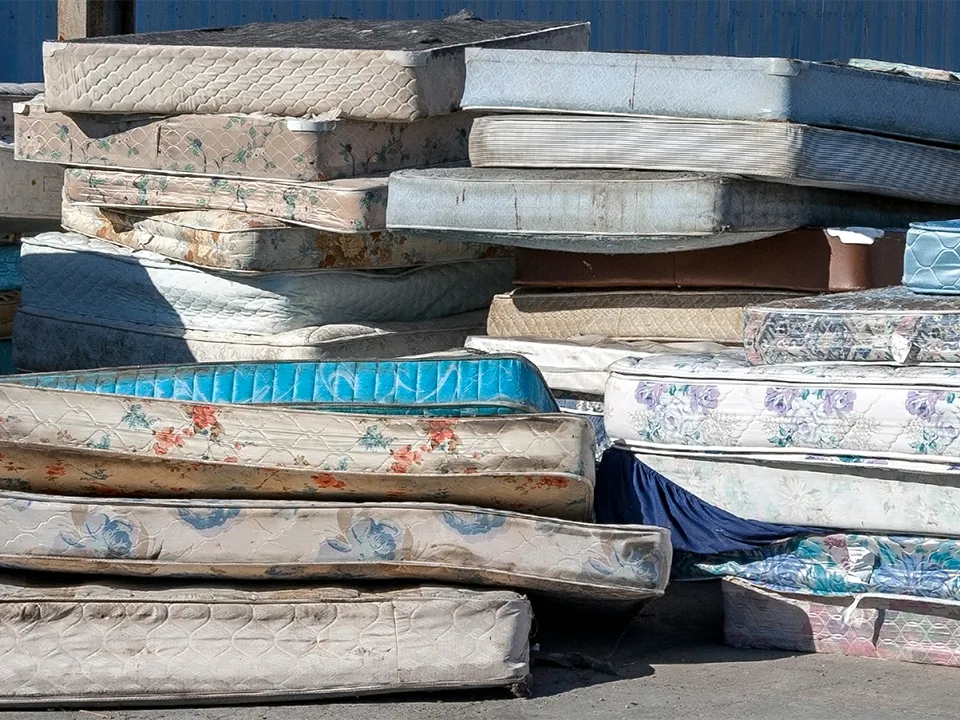
Since 1 January, extended producer responsibility for mattresses has been in force. This means, among other things, that consumers can now take them to recycling centres free of charge.
Businesses must now also arrange for their discarded mattresses to be collected separately. Until now, this waste stream ended up with bulky waste, but in fact a great deal can still be done with these mattresses, provided the material remains clean and dry. Around 900,000 mattresses are placed on the market each year, representing 13,000 tonnes of material that can now be recycled. The target is to achieve a recycling and reuse rate of 75% by 2030.
1 January 2021 marked the beginning of a new era. From that date, extended producer responsibility for mattresses came into force. This means that every manufacturer and importer is responsible for the waste streams generated by the sale of mattresses. They must therefore contribute to the costs of collection and processing, and meet the legally stipulated collection and recycling targets. Valumat fulfils the obligations relating to extended producer responsibility for mattresses collectively on behalf of all its affiliated manufacturers and importers. The non-profit organisation will be responsible, among other things, for promoting separate collection, communications and reporting on the quantities of mattresses placed on the market, as well as their collection and processing.
13,000 tonnes kept out of incineration
Project manager Michel Van den plas explains why separate collection and recycling of mattresses are important. “On the one hand, we can reduce the volume of waste. On the other, mattresses contain many valuable materials that deserve a second life. It would be a waste to incinerate an average of 13,000 tonnes every year. That is why our target is to send 75% of this material for recycling or reuse by 2030, and to substantiate this with the necessary figures.” The most important condition is that the material remains in good condition. “That is where the problem lies. When mattresses end up with bulky waste, they can get damp and dirty, making them impossible to recycle. That is precisely why it is so important to collect mattresses separately in closed containers that keep them dry and free from contamination.”
No obligation for retailers
Consumers can take their discarded mattresses to recycling centres free of charge, or to some retailers. However, retailers are not obliged to accept old mattresses from their customers. “We made this decision because retailers sometimes lack the logistical capacity. However, Valumat will do everything it can to promote separate collection by retailers. Retailers who voluntarily accept mattresses free of charge can register on the Valumat website and receive a fee from us.” Businesses will have to enter into a contract with an approved collector. They will also receive a fee based on the quantity of mattresses collected separately.
Dismantling centres
After collection, mattresses need to be dismantled. To date, there is only one dismantling facility in Belgium. SUEZ has limited capacity in Sombreffe, but plans to expand it further. Van den plas says: “The main reason there is still little capacity for dismantling mattresses in Belgium is the volume. As targets are raised (by 2030, Valumat aims to achieve a collection rate of 80% and a recycling rate of 75%), sufficient volumes will be generated to make investment in dismantling profitable. To ensure sufficient dismantling capacity is available today, companies from the Netherlands (Retourmatras) and France (Secondly) have also joined our system.” Dismantlers do valuable work by separating mattresses into their component parts. They extract textiles, latex, PUR and metal, which are then sent into the recycling chain as separate material streams.
Towards the ideal circular mattress
The first step is to gain a clear picture of the collection and processing route followed by mattresses. To this end, collectors and dismantlers report to Valumat not only the quantities collected and dismantled, but also the destination and applications of the dismantled materials. “Secondly, we want to consider what the mattress of the future might look like. For a truly circular mattress, dismantling must be considered at the design stage. But those are plans for next year. First, we still need to get a little smarter,” Van den plas concludes with a wink.
Question about this story? Ask your question
Keep following this
Get an email when a new story is published. No account needed.
- SubjectPlastic waste







