Plastic waste exports banned from 2026: what does the European export ban mean for businesses and recycling?
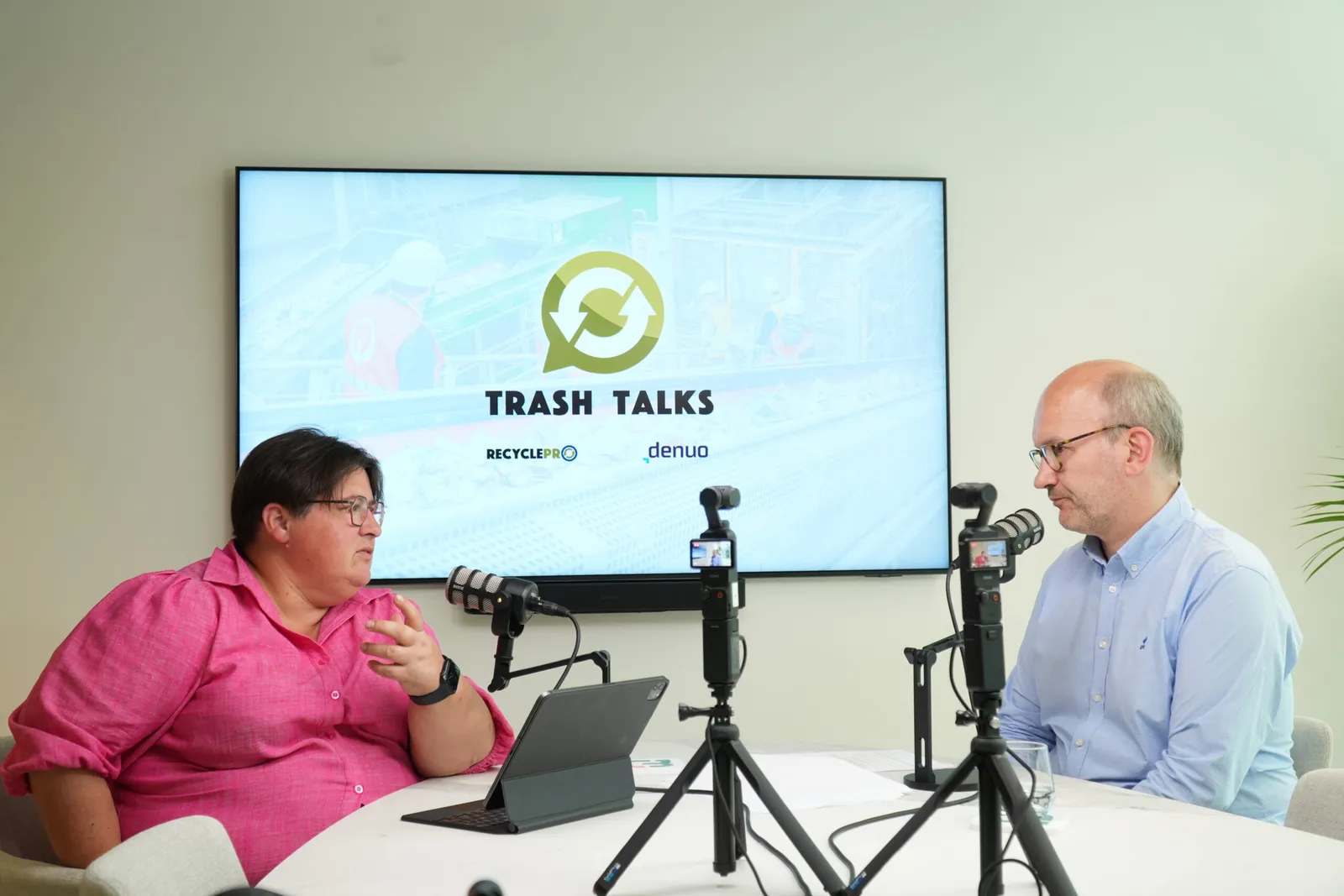
Guest: Xavier Lhoir, Deputy Managing Director at Valipac | Host: Nele Roobrouck
From 21 November 2026, Europe will ban the export of plastic waste to non-OECD countries. The measure is intended to increase recycling within Europe, improve control over waste flows and strengthen the circular economy. But is there enough recycling capacity available today? What impact will the export ban have on businesses, waste operators and recyclers? And what are the implications for the cost and treatment of plastic waste?
In this episode of Trash Talks, Nele Roobrouck speaks to Xavier Lhoir, Deputy Managing Director at Valipac. They discuss the Waste Shipment Regulation, the impact of the export ban on plastic waste, the challenges around recycling capacity, traceability and recycled content, and the role Belgium can play in the European circular economy.
Een zakelijke vraag aan VAL-I-PAC? Get in touch
Full transcript
All chapters (20)
- Introduction to the plastic waste export ban
- Valipac’s role in the chain
- Three key dates in the Waste Shipment Regulation
- Reliance on exports today
- More local recycling and the capacity problem
- Traceability and audits for exports
- A blanket measure with consequences
- Policy based on facts and data
- Impact on businesses and customers
- Costs and operational pressure
- Difficult-to-recycle waste streams
- Opportunities for European and Belgian recyclers
- Policy coherence between the PPWR and the export ban
- More recycling, but fewer outlets
- Risk of illegal exports and less transparent channels
- Risk of recyclable material being incinerated
- Successful implementation of the export ban
- Measures to make the export ban successful
- Key figures behind the export ban
- Closing the conversation
Introduction to the plastic waste export ban
Nele Roobrouck Welcome to Trash Talks, the podcast that takes a close look at the challenges and opportunities in the waste and recycling sector. Today, we’re discussing a measure that will significantly reshape the sector over the coming years: the ban on exporting plastic waste to non-OECD countries, which will come into force on 21 November 2026. Europe wants to send a clear message: more recycling within its own borders, better control over waste flows and a faster transition to a circular economy. But is the sector ready for this today? To discuss that, we’re joined by Valipac’s Deputy Managing Director. Welcome, Xavier.
Xavier Lhoir Thank you, thanks for the invitation.
Nele Roobrouck Perhaps we can start with what Valipac does, as not everyone knows the organisation very well. What exactly do you do, and why is your role so relevant to this debate?
Valipac’s role in the chain
Xavier Lhoir Valipac is the accredited organisation responsible for the take-back obligation for commercial packaging and packaging waste. We meet the individual responsibilities of our 6,000 customers collectively. Every company in Belgium has to prove to the authorities that the packaging it has placed on the market is properly collected and recycled. With the PPWR, companies will have other targets as well. But the core of our mission is to prove that packaging is actually collected and recycled once it has become waste. To do this, we receive a great deal of information from our customers, on the one hand, and from operators, the waste collectors, on the other. They provide Valipac with a lot of information, and Valipac is a data organisation. We collect information to prove that our customers are complying with the legislation. Valipac was set up by industry and provides a service to industry. We take a multi-material, cross-sector approach. It is a kind of collective system, and the basis of our reporting is evidence that recycling targets have been met.
Nele Roobrouck You’re right at the heart of the chain, with insight into both collection and recycling. That makes you the ideal person to be here today. Right, let’s get to the heart of it. What exactly will the export ban change from 21 November, or should we even say from 21 May, just a few days ago?
Read the full transcriptCollapse transcript18 more chapters
Three key dates in the Waste Shipment Regulation
Xavier Lhoir We’re talking about an export ban. It is defined in the Waste Shipment Regulation. We have identified three key dates for us in connection with the Waste Shipment Regulation. The first is 21 May, yesterday. Under the regulation, the authorities are introducing a somewhat more complex administrative process for exporting waste outside Europe. That was the first important step in implementing the Waste Shipment Regulation. The second key date is 21 November, when the ban on exporting plastic waste takes effect. From 21 November 2026, plastic waste will no longer be allowed to be exported to non-OECD countries. These are mainly countries in Asia. Then there is a third date, which we also consider important: from 21 May 2027, exporters will have to provide the authorities with proof that the final recycling destination is certified in accordance with certain European standards.
Reliance on exports today
Nele Roobrouck Those are three very important dates. But looking at the situation today, how reliant is the sector on exports, Xavier?
Xavier Lhoir I could talk for hours about commercial packaging waste. Today, exports are a reality. This is particularly true in Belgium and the Netherlands, where proximity to the port makes exporting easy. In addition, transport from Europe to Asia is relatively cheap. Valipac has a monitoring system, so we know exactly what quantities go to which recycler. Our figures show that 42% of commercial plastic packaging waste is recycled in Europe, 21% in the Middle East and the remaining 37% in Asia. That 37% means that around 26,000 tonnes of plastic leave Belgium each year to be recycled in Asia. Valipac goes beyond monitoring destinations. We also carry out audits at the final destination. Each year, together with operators and traders, we organise audits at the final destination to prove that it complies with the requirements of the Belgian authorities, and soon those of the European authorities. In future, exporters will have to ensure that their buyer, their customer, is certified.
Nele Roobrouck But 37% is a lot. Can European recyclers take on all those volumes today? Is that realistic?
Xavier Lhoir It’s not realistic. It won’t happen. These are significant quantities for Belgium. Just imagine what that figure would be across Europe. We know that, in future, EPR organisations, responsible for extended producer responsibility, will become standard throughout Europe. That means we’ll collect more packaging waste. And we’ll all be looking for outlets and recycling options.
More local recycling and the capacity problem
Nele Roobrouck So if the capacity isn’t there, we risk creating a problem instead of solving one.
Xavier Lhoir That will be the outcome, yes. But what is the aim, really? Do we want more recycling or more local recycling? I think Europe’s political vision is to increase local recycling. And we can support that in principle. It is also what some of our customers and the Belgian authorities expect. Local recycling. Our waste has a certain value, especially in a circular economy, so we need to ensure that it is recycled locally. But the context matters, of course. What does Europe expect in order to achieve this goal? What steps will be taken? Will it be phased in? No, it is an immediate stop to exports. And under the PPWR, the recycled content target only comes into effect in 2030. So the pace of the legislation and the investment climate for certain players are not necessarily favourable today.
Nele Roobrouck No, and the two pieces of legislation aren’t really aligned. Now, Xavier, you’ve just mentioned the different percentages, and Valipac is known for its strong traceability figures. You’ve just said that too. Can you say that exports are currently a problem in terms of traceability and recycling?
Traceability and audits for exports
Xavier Lhoir Not for Valipac. We have managed to turn the limitations of a free-market approach into an opportunity and develop it in a way that encourages collaboration. Other Member States still take a free-market approach, but they don’t have information on the destinations of the quantities collected. Valipac has got things moving in collaboration with waste collectors and traders. We have a traceability system and an audit system too, which adds value. This is specific to Belgium. In the meantime, we have also been able to conclude a number of cooperation agreements with neighbouring countries, including Verpact in the Netherlands and Valorlux in Luxembourg. We also work with EPR organisations in Ireland and the Netherlands, as we usually work with the same traders. So an audit report for Belgian material is also relevant to material from Ireland. Cooperation is possible, but today only a limited number of Member States are actively working together towards this kind of goal.
A blanket measure with consequences
Nele Roobrouck So we’re effectively putting a stop to a system that is currently under control in Belgium and in a number of Member States thanks to traceability. And we’re stopping it with a blanket measure.
Xavier Lhoir Yes, we’ve solved that in Belgium, but that doesn’t mean a solution has been developed everywhere in Europe. The Waste Shipment Regulation also aims to achieve certain objectives across all EU Member States and calls for more cooperation and consultation. They can certainly use Valipac as an example in future.
Policy based on facts and data
Nele Roobrouck So you could say that policy is based on facts on the ground, as some Member States lack traceability. But the consequences are significant, of course. Have those consequences been properly assessed in Europe?
Xavier Lhoir I think the basic problem is a lack of knowledge based on facts and data at European level. Let me give an example. If we look at Eurostat statistics, only two or three countries are shown as actually exporting plastic waste for recycling. That is the reality. And, of course, when the European legislator develops legislation, it uses that data as a basis. So there is a lack of information. They are ignoring the reality. We know the reality. We are in contact with traders and know that they are active throughout Europe. That is a limitation when certain pieces of legislation are approved: there is sometimes a lack of understanding of the reality on the ground. That is certainly a significant constraint. Then, of course, there is lobbying. Lobbying by different stakeholders may produce a consensus on the vision, but the implementation, or final version of the text, is in effect a compromise between the interests of different lobby groups.
Impact on businesses and customers
Nele Roobrouck And to make this really concrete, what does this actually mean for businesses on the ground, including your customers? Will it have a major impact on them?
Xavier Lhoir For our customers? Yes, definitely, because selective collection is going to become more expensive. The effort Valipac will have to make, or the resources Valipac will have to commit to meeting the recycling target, will therefore increase. So our rates for customers will rise. Hopefully only temporarily. We hope that, with the PPWR and the supply and demand for recycled material, the dynamics will change and we will once again be operating in a positive market environment. But in the short term, if we want to continue meeting our recycling target and guarantee selective collection at a lower cost, we will have to commit certain resources. Otherwise, we will see the share of packaging waste in residual waste increase, and we do not want to send additional volumes for incineration. Moreover, incinerators are not looking to burn recyclable material. Quite the opposite.
Costs and operational pressure
Nele Roobrouck So we will see costs rise. But the question is, of course: will there also be additional operational pressure, or will that be less of a concern?
Xavier Lhoir Costs are high today, certainly. That is also a reality. We are seeing values fall. The stability of outlets can no longer be guaranteed either. This is what makes things so complex for operators. Waste collectors are finding it difficult to secure stable outlets. That is also where Valipac comes in. We are arranging a number of temporary operational measures, for example for big bags. We are looking at concluding a single contract with a local recycler, enabling all our operators handling big bags, for instance, to take them to that specific recycler for a recycling solution. But that is not our traditional way of working. We have had to take this step because of the current situation. I think we can count on the support of all operators today, but this is not Valipac’s long-term vision. At some point, free-market dynamics will once again create positive value, and Valipac will then step back from this specific role, allowing it to lower its rates again.
Difficult-to-recycle waste streams
Nele Roobrouck That is indeed the risk with difficult-to-recycle waste streams for which you have found a solution. But looking at the wider picture, are there other waste streams where we are likely to see oversupply on the European market?
Xavier Lhoir We started with big bags because 98% of them are currently recycled in Asia. So big bags faced a problem from 21 November. We are anticipating a problem that we are already experiencing and providing a solution. Another difficult stream is film. Not necessarily transparent film, because that is a very good material for which outlets are available today. But lower-grade coloured film is also likely to become a problematic stream. We are also considering launching a market consultation procedure to identify a preferred partner, a recycler, to whom operators could deliver their material for local recycling.
Opportunities for European and Belgian recyclers
Nele Roobrouck So we can say that there are opportunities for European, and even Belgian, recyclers in this situation?
Xavier Lhoir Yes, definitely. I think European legislation, both the Waste Shipment Regulation and the PPWR, is intended to encourage recycling initiatives in Europe. The problem is that we do face a number of constraints, including under the Waste Shipment Regulation. The export ban applies for a period of 2.5 years, which is not ideal for investment in developing additional recycling capacity. Investors also need certainty about the return on their activity. They need a period of eight, nine or ten years to be sure their investment will be profitable. That is one of the limitations of the legislation. The concept is positive, with its focus on local recycling, promoting the circular economy and sustainability in Europe, but the legislation has a number of constraints. This makes it difficult for investors to secure guarantees for their investments.
Policy coherence between the PPWR and the export ban
Nele Roobrouck And there is also the issue of policy coherence. You mentioned it earlier, both the PPWR and this export ban. It is hard to say this is a coherent system, isn’t it? One has its advantages and so does the other, but the period in between is really not well aligned.
Xavier Lhoir Yes, unfortunately. The European legislator had an opportunity to coordinate the two pieces of legislation, or perhaps to phase them in gradually in a particular direction. That did not happen. So we have an export ban in 2026 and mandatory recycled content in transport packaging in 2030.
More recycling, but fewer outlets
Nele Roobrouck Europe is asking for more recycling, as is the Belgian government, but in effect we are limiting the outlets. Is that compatible?
Xavier Lhoir Are we limiting the market? Yes, in the short term there is a restriction, because exports have always been part of the picture. So I think the aim is to expand the local market. We need to ensure that those initiatives and project developers come forward with proposals for solutions. And our role at Valipac today is to support certain initiatives in the hope of creating momentum over time.
Risk of illegal exports and less transparent channels
Nele Roobrouck New legislation always brings new risks. Can we say that illegal exports or a shift towards less transparent channels are possible risks?
Xavier Lhoir We always need to be alert to the risks involved in introducing new legislation. At Valipac, we have also identified a number of risks under the Waste Shipment Regulation. For example, exports to England, followed by the actual export of waste streams from England to non-OECD countries, since England is not subject to the export ban. The same applies to Turkey. This could certainly happen via Turkey, and these are factors we will monitor in future. In particular, if a waste stream is identified as a product in the transport document, the shipment is not subject to the same rules. Differences between Member States in interpreting the terms of the Waste Shipment Regulation are also a challenge in Belgium, because we interpret the legislation more strictly. We also see differences in interpretation in neighbouring countries, giving operators there a slight advantage or disadvantage. We need to address this too and discuss it with local authorities at European level. The credibility of audits over time is another issue. Today, Valipac carries out audits to certain standards. In future, exporters and local recyclers will choose who conducts the audit. Can they really provide the same guarantees? That is a concern for Valipac, the authorities and the recycling sector, including the local recycling sector. The rules, or the audit requirement outside Europe, are also intended to protect and stimulate local recycling capacity. There are many factors that we at Valipac will need to continue monitoring in future to ensure we are moving in the right direction.
Risk of recyclable material being incinerated
Nele Roobrouck We are talking about the risks. We have already discussed that it must not go for incineration. There is the export ban and the stockpiling of plastics. Is there not a greater risk that, in the period between now and 2030, when the PPWR encourages recycled content, more material will end up being incinerated? How could we prevent that?
Xavier Lhoir That is part of Valipac’s day-to-day work. We carry out sorting analyses at operators’ sites to assess the composition of residual waste sent for incineration. These analyses also allow us to see whether there are any changes in the composition of residual waste going for incineration. I think incinerators carry out their own checks, and the authorities are also paying much closer attention to the composition of residual waste. This will therefore also be part of discussions with operators. But offering solutions for difficult-to-recycle plastic streams is also part of the answer. Why should that material still go for incineration? We have a solution, a temporary one for as long as it is needed.
Successful implementation of the export ban
Nele Roobrouck So we are trying to minimise the risk of anything going for incineration. The export ban is just around the corner. In some ways, we are already past that point. But looking ahead, what would successful implementation of the export ban mean in your view, and in Valipac’s?
Xavier Lhoir I think, first and foremost, the export ban should lead to more local recycling, with recycled material actually being used in local production in Europe. We also need to take a critical look at imports of recycled material from outside Europe. That could create competition, whether fair or unfair, and needs to be considered. Production costs outside Europe are not comparable, however. If we believe in local production, we also need to guarantee that the material is actually recycled and that companies do not favour material recycled outside Europe. That is an important factor in making the Waste Shipment Regulation successful. Another factor is ensuring the legislation is implemented coherently and in a harmonised way, so that all Member States in Europe apply the same rules. We do see differences between countries today, and that should not be the case. For us, of course, the Waste Shipment Regulation has been adopted, and we need to assess whether its first objective becomes a reality. But phasing it in gradually was a missed opportunity in the implementation of the legislation. A gradual transition, moving step by step in a particular direction, would also have given investors a clearer outlook. A 2.5-year export ban is far too short. We expect people to take action and invest in recycling capacity. We need to provide a much longer timeframe, or a much clearer outlook, for those investments to be profitable.
Measures to make the export ban successful
Nele Roobrouck Suppose we went to the minister’s office together and wanted to add one more measure to help ensure the export ban succeeds. Would you focus above all on increasing recycled content sooner, or would you propose another measure?
Xavier Lhoir Moving faster on recycled content will put extra pressure on producers. In order to meet recycled content targets, companies will actually have to adapt their production processes. That seems very difficult to achieve in the short term. But consistent implementation of the legislation in the short term is certainly an important factor for lawmakers. And on their part, particularly in Belgium, supporting initiatives such as Valipac’s initiative to provide more support for hard-to-recycle waste streams is certainly something we need.
Key figures behind the export ban
Nele Roobrouck And if we look at a key figure behind this export ban, which one would you highlight?
Xavier Lhoir One key figure for me is 1%, or actually two figures. One is 58%. So 58% of our recycled plastic commercial packaging waste is actually recycled outside Europe. That is a substantial amount. On the other hand, we are currently at 1% recycled content. Commercial packaging waste containing recycled content accounts for only 1% of the amount placed on the market. That is the reality today. And hopefully, through the Waste Shipment Regulation and the PPWR, for example, that balance will shift in favour of local production and recycled content in general.
Nele Roobrouck That is certainly a striking figure when we consider that 58%. If all of this has to stay in Belgium and, as you have already pointed out, in every Member State, since we are just one of many, then keeping that entire tonnage within Europe’s borders will clearly be a major challenge.
Xavier Lhoir Yes, but the context is going to change. By 2030, all transport packaging must contain at least 35% recycled content. And we are talking about very large volumes at European level. So demand for recyclate will increase. And in 2029, if you invite me back for a podcast, I think we will be describing a different reality.
Closing the conversation
Nele Roobrouck So what is clear today is that the export ban on plastic waste is more than just a technical measure. It is a fundamental choice about how Europe wants to organise its circular economy. But as we have heard, this choice also raises important questions about capacity and difficult waste streams. We have also seen that Valipac is really preparing for this and helping the sector. The challenge will be to ensure that this ambition and, above all, reality go hand in hand, and that well-functioning systems do not come under unintended pressure. Thank you, Xavier, for your insights, and thanks for listening to Trash Talks.
Companies in this story
Keep following this
Get an email when a new story is published. No account needed.
- ThemeMaking plastics and packaging circular
- SubjectPPWR
- CompanyVAL-I-PAC