












Business waste is falling, but further efforts are still needed
The amount of business waste in Flanders continues to fall. In 2025, businesses, excluding the construction and demolition sector, collected around 597 000 tonnes of residual waste. That is 5% less than in 2024. At the same time, in 2024¹, 81 % of all business waste was given a second life after no more than two treatment steps through reuse, recycling, composting or anaerobic digestion. This is according to OVAM’s new report, ‘Business Waste and Secondary Raw Materials in Flanders’.
Business waste is growing more slowly than the economy
In 2025, businesses in Flanders produced a total of around 31.9 million tonnes of business waste. More than half of this was construction and demolition waste. Contaminated soil, sewage sludge, dredging spoil and septic waste also accounted for a large share. These
waste streams are often generated by construction work, soil remediation and water treatment, and fluctuate considerably from year to year.
To assess trends in more regular business waste, OVAM therefore excludes these large waste streams from its analysis. In 2025, this amounted to around 7.7 million tonnes. Between 2012 and 2025, this figure rose slightly, but more slowly than the Flemish economy. This represents relative decoupling: over this period, the economy grew faster than the amount of business waste produced.
Business residual waste continues to fall
Business residual waste is the waste that businesses do not collect separately. According to data from the MATIS Materials Information System, the amount of business residual waste, excluding the construction and demolition sector, fell from around 631 000 tonnes in 2024 to around 597 000 tonnes in 2025.
This decline is linked to various efforts to improve sorting by businesses. Waste collectors are stepping up visual checks of residual waste containers, while the Enforcement Division is also carrying out targeted inspections of waste producers. Since 2024, businesses have also been required to collect kitchen waste and food scraps separately. This waste stream therefore no longer belongs in residual waste.
“These figures are first and foremost a credit to our businesses. They show that better sorting and preventing residual waste are increasingly becoming the norm, including in the workplace. We must maintain and accelerate this momentum. Our ambition is clear: by 2030, we want to produce 30 per cent less business residual waste,” says Jo Brouns, Flemish Minister for the Environment.
The downward trend brings Flanders closer to its target of producing 30% less business residual waste by 2030 than the average for 2018-2020. But the target has not yet been reached. Further efforts are therefore needed.
Introducing billing by the kilogram of business residual waste will be an important next step: businesses that produce less residual waste will pay less. Targeted inspections of waste producers will also remain important in encouraging businesses to sort waste more effectively.
“The figures show that the Flemish economy is growing without business waste generation increasing at the same rate. The fall in business residual waste is also encouraging. At the same time, there is still considerable potential to sort materials more effectively at source and reuse them as raw materials
Werner Annaert, Director-General of OVAM.
to keep them in the loop for longer”
80 % gets a second life
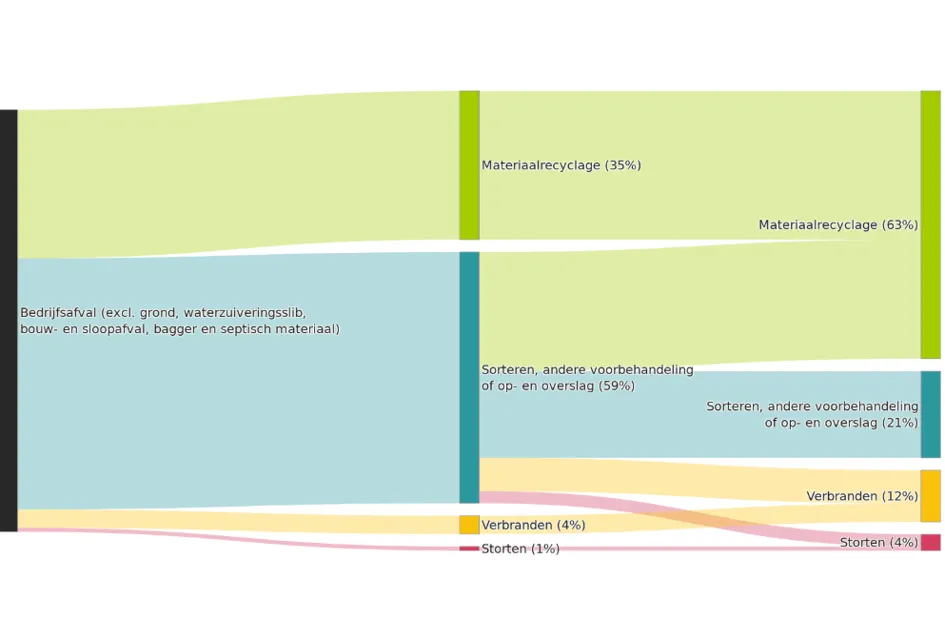
For the first time, OVAM used MATIS to map what happens to primary business waste after one or two treatment steps. In 2024, 81 % went to some form of material recycling. 7 % was incinerated and 6 % landfilled. A further 7 % had not reached its final destination after two steps and still needed to be sorted or pre-treated. The high recycling share is closely linked to the large volume of mineral construction and demolition waste, which can be processed almost entirely into recycled aggregates. Excluding construction and demolition waste, soil, sewage sludge, dredging spoil and septic waste, 63 % of primary business waste went to material recycling after two treatment steps. 12 % was incinerated and 4% landfilled.
Een zakelijke vraag aan OVAM? Get in touch
Companies in this story

Keep following this
Get an email when a new story is published. No account needed.
- ThemeCircular construction and demolition
- SubjectNews
- CompanyOVAM







