The textile crisis explained: collection, recycling, overproduction and EPR
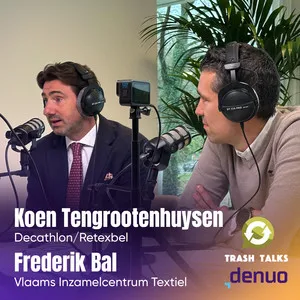
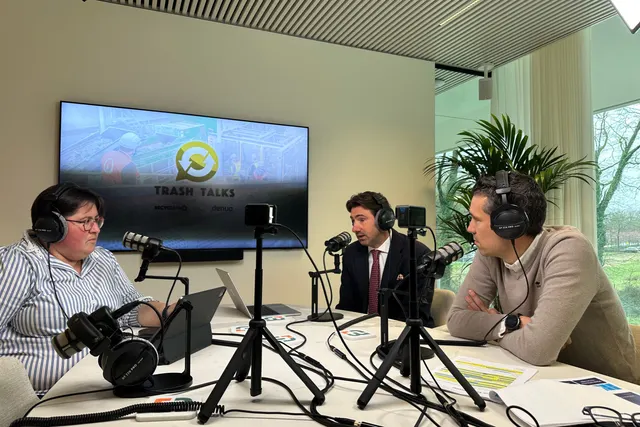
In this third episode of Trash Talks, we take a closer look at the growing textile crisis. Why are volumes of discarded textiles rising year after year? How much of it can still be reused or recycled? And where does the biggest challenge lie today: in waste management, overconsumption, product quality or overproduction? Moderator Nele Roobrouck talks to Frederik Bal of Vlaams Inzamelcentrum Textiel and Koen Tengrootenhuysen of Decathlon and Retexbel about textile collection, reuse, fibre-to-fibre recycling, the social economy and the impact of extended producer responsibility (EPR). A timely and hard-hitting debate on the future of circular textiles in Belgium and Europe.
Full transcript
All chapters (20)
- Introduction to the episode about textiles
- Introducing the guests
- Frederik Bal on his role in the value chain
- How serious is the situation in the textile sector?
- A sector at a turning point
- Overproduction or a waste problem?
- How collection has changed over the years
- How much textile is reusable
- The role of retailers in quality and circularity
- Free collection and consumer behaviour
- The next step after collection
- Perceptions of exports and reuse
- Fibre-to-fibre recycling at scale
- Cooperation with the social economy
- Regional differences and division of roles
- Key message for policymakers
- Practical policy recommendations from the sector
- The most telling figures
- Innovation and opportunities for the future
- Wrapping up the conversation
Introduction to the episode about textiles
Nele Roobrouck Today we have the third episode of Trash Talks, and it is about textiles. The world produces more clothing every year than ever before. But what happens when we throw it away? Only a limited proportion is worn again or recycled, while collectors and processors are receiving increasing quantities of textiles that are difficult to sell. Clothing is getting cheaper, collections are changing rapidly and volumes continue to rise. At the same time, pressure on collectors and recyclers is growing. And extended producer responsibility is on its way. Today, we are bringing together all these links in the chain. Where are the pressure points, and what needs to change? Or what is working well? Is the textile crisis a waste problem? Or does the challenge lie in overproduction and product quality? And can the sector become circular without changing its business model? In this episode of Trash Talks, we will debate these questions with two industry players. At the table: Koen Tengrootenhuysen, Director Public Affairs Europe at Decathlon and chair of Retexbel, and Frederik Bal of Vlaams Inzamelcentrum Textiel, a Flemish textile collector and processor.
Introducing the guests
Nele Roobrouck Welcome, Koen and Frederik. Could you briefly explain where you sit in the textile value chain?
Koen Tengrootenhuysen I work for Decathlon. Last Sunday marked 20 years, and I have been working in Public Affairs for a few years. Textiles are an important part of the group’s strategy. Global warming makes sport extremely important to us. If you want to go skiing, there needs to be snow on the mountains. If you want to swim in the water, it needs to be clean. If it is too hot, you cannot take part in sport. These are the basics, and they are still linked to the DNA of our family business. As for textiles, we are one of the larger sports textile manufacturers, so we certainly have a role to play, and we want to fulfil it as a socially responsible company. What is more, our DNA includes a pioneering spirit, and we certainly want to bring that to the major changes needed throughout the textile process as we know it today. I think that is the starting point for my job today: strategy and Public Affairs for Europe and for the group. On the other hand, I am very pleased, and perhaps this is even more relevant here, that I was able to set up Retexbel with a range of stakeholders, and that I am now its very proud chair.
Read the full transcriptCollapse transcript18 more chapters
Frederik Bal on his role in the value chain
Nele Roobrouck Great. Frederik?
Frederik Bal Thank you for the invitation. I’m Frederik, and I have been working for the Recutex group for 17 years now. Recutex is also a family business, with the third generation at the helm. We have several groups of companies. One is known for its green textile containers on the streets: Vlaams Inzamelcentrum Textiel. We also have our own transport company, Victrans. But our main operation is our sorting company, Recutex NV, which has been in business since 1948, giving us 78 years of expertise in the field. We manage the entire chain for Flemish household textile waste, from collection and transport to processing. We collect it, ensure it is collected correctly, transport it and try to recover as much value from it as possible. That’s it.
How serious is the situation in the textile sector?
Nele Roobrouck You know this already: things are not always straightforward in the textile sector. But how serious is the situation today? How do you see volumes changing, and what about the quality of the textiles collected?
Frederik Bal Shall I start? We see the amount of textiles collected in our containers rising year after year, which is hardly surprising. Consumers buy more every year, and at some point the wardrobe has to be cleared out. When people make room for new textiles, we are ready to collect and recover value from the old ones. In terms of textile quality, we are still often collecting items bought several years ago. So we are not yet really seeing the decline in quality associated with ultra-fast fashion in our processing operations. We do have to say, though, that the additional quantities we collect are generally of lower quality. The share of top-quality goods, the items that are most suitable for reuse, remains more or less the same. But the extra volumes we collect are often of a quality that means they should go for recycling.
A sector at a turning point
Nele Roobrouck And where do you think the sector stands today, Koen?
Koen Tengrootenhuysen I’m very happy to answer that. I think it is at a turning point. I always like to look on the bright side. If you do a SWOT analysis, the opportunities are phenomenal. In recent years, we have been going through a global transformation, driven by digitalisation. Add AI to that and everything is moving very fast. There are three of us around this table, and we each have three shops in our pockets. Within five minutes, you can place an order in China. Within three to five days, a product arrives from China or somewhere else in Asia. That is the reality. And the fact is that our whole sector is not yet fully prepared for it. That applies to every link in the textile chain. So today we are faced with oversupply. Frederik mentioned textile quality, but products made in Asia are also created under economic conditions that we do not have here. The level playing field has completely disappeared. The reality is that we need to adapt our structures. And I think we have no choice but to work together to find a solution. You know, this year, and I occasionally look beyond our borders, Chinese astrology is something that interests me from time to time. This is the Year of the Fire Horse. Fire and horse are two elements that come together and generate energy. And this is a special year. Just look at everything that has been happening geopolitically so far this year. So, once again, let’s seize this opportunity. Frederik and I are doing so today, together with the others around the table at Retexbel. We want to use that energy to bring about real change. So, in my view, this is a turning point. Viewed positively.
Overproduction or a waste problem?
Nele Roobrouck Thank you. So can I say that the textile crisis is not a waste problem, but rather a problem of overproduction?
Frederik Bal The pressure felt by the sector affects everyone, of course. But let’s say it also starts with consumers. We should not look only at producers. Overproduction is often driven by consumer demand too. Koen is right. I pick up my phone here and the day after tomorrow I have a parcel from China. Is that a problem of overproduction? Is it a consumer problem? We will leave that question open for now. What we do have to recognise is that the problem of overproduction and overconsumption affects the whole chain. It starts with collection, which is faced with a mass of goods that have to be collected and sorted. And that is where the problem lies.
Nele Roobrouck But does that mean it is a waste problem or a problem of overproduction?
Koen Tengrootenhuysen I think you can regulate that. I think those are two things you can tackle at the same time. On the one hand, you have just made money from that wardrobe that is bursting at the seams. The question today is: what do you do with it? The same goes for something you order and receive. Let’s not always use that example, because there are perfectly good retailers and manufacturers, and products made here, including in Europe and close to home. So that is not the point. It is simply easy to order, buy or rent. Renting is another option too. You have a product, but what do you do with the rest? That is a problem, because everything is becoming easier. And we need to keep all of that in mind together.
How collection has changed over the years
Nele Roobrouck Perhaps we can carefully move on to collection and quality. Frederik, I think you’re the right person to ask: what is actually coming in today? Are you seeing a trend, or does it vary from year to year? Or perhaps from season to season? Now you have spring cleaning, but later in autumn people might be getting rid of their summer clothes.
Frederik Bal I’ve been in the business for 17 years now. And over the past two years, sometimes I haven’t known what to expect. A few years ago, we collected around 5 to 6 kilograms per resident. Of course, geopolitical issues, starting with the Covid crisis, have changed a great deal. This created a peak, followed by a trough, but since 2020 we’ve seen an exponential increase in the amount we collect. Previously, there was more or less a seasonal peak. A good example is June, which is always a quiet month because it’s exam time and mothers aren’t allowed to disturb the children by clearing out their wardrobes. December, January and February are often quiet months too because of the poor weather, but we no longer see that pattern. Last week, we had a huge spike in volume, and we don’t know why. Today, we can collect around 8 to 10 kilograms per resident, provided, of course, that we are free to set up a proper collection system. That is another area where things are a little difficult, and policymakers need to support us. Unfortunately, the local materials plan is already outdated. The sector has been lobbying for years to have it amended. But in the meantime, local authorities can still choose to introduce door-to-door collections. If we compare these with textile collection through textile banks, we find that door-to-door collection collects only 2 to 3 kilograms per resident. That’s not because the textiles aren’t there. A municipality’s decision to collect door to door doesn’t mean that consumers have no textiles to dispose of at that point. The problem is that they then end up being incinerated, which is baffling, because these are valuable raw materials that can be reused and recycled. The conclusion, though, is that we are collecting more and more, and the capture rate is gradually starting to exceed 50%.
How much textile is reusable
Nele Roobrouck Can you put a figure on how much of it is reusable? Or is that difficult to say?
Frederik Bal Absolutely. There’s a lot in the press about how much textile is not reusable and goes straight to the incinerator. That is completely wrong. One important factor is using a professional collection service and taking the collected goods to an accredited sorting company. Ideally, this should be a company that carries out fine-grained sorting. What do we mean by that? It means examining and valorising every item. These companies have at least 100 to 200 categories into which textile waste can be sorted, for both reuse and recycling fractions. We manage the entire chain, so we can provide some good figures. Of what we collect in Flanders, we can reuse around 70%. That means a garment for a garment, a towel for a towel. The remaining 20 to 30% mostly goes towards recycling applications. We only recover energy from goods, by sending them to an incinerator or pelletising the textile fibre, if they are not accepted in textile banks because they exceed the acceptance criteria. This often involves trousers completely soiled with paint, or a safety shoe with adhesive smeared all over it by the worker. Yes, these are very difficult to recycle. They’re also very difficult to reuse. So these are the items that ultimately end up being incinerated. But nowhere near the 90% sometimes reported in the press.
The role of retailers in quality and circularity
Nele Roobrouck Yes, indeed, thank you for clarifying that. Koen, if I may put the question to you: I imagine that retailers such as Decathlon can also play a role in improving quality.
Koen Tengrootenhuysen That’s what I was just saying. Respect for the environment is part of our company’s DNA. And we’re certainly not alone. Many fellow retailers are keen to take action today, working across the entire chain to reuse materials and offer circular business models. That’s the challenge we face: moving from a linear production model to a circular one. And offering repair services. You can see this in our stores, where we sell and rent more second-hand bikes than new ones. That’s because we offer repair services. Materials are reused, and we form partnerships. So we’re certainly not the only ones doing this. But the issue today, and what we were just discussing, is the change that will come with EPR, Extended Producer Responsibility. This means that we as producers will become fully responsible for the entire chain. And suddenly, waste becomes part of that whole picture. So we have to, and I’m convinced of this myself, realise that some things can only be set in motion through awareness-raising, while regulation is also needed. That’s just how it is. Today, we are seen as polluters. We produce something, try to bring products to market, and suddenly we also have to make sure they are dealt with. But I do think a few caveats need to be made. If we are genuinely expected to change the chain, then everyone in it needs to raise their hand and say: let’s do this efficiently. If you want to run a business, it has to be efficient. You have a business model and want to get the best out of it. And I think we are all mature enough to sit around the table and be critical of everyone in the chain. Governments also have a very important role to play. Municipalities, and I’ve seen this with my own eyes when we visited Frederik’s business with colleagues, the whole debate about municipalities choosing not to provide textile banks any more because they have to pay for them. Well, they are taking on a very significant responsibility. Because it means consumers can no longer dispose of their products there. Of course, you can go to a recycling centre, but that’s another matter, and I have my own views on it. It is a completely over-subsidised system that costs a huge amount of money and also varies from region to region. But if the textile banks aren’t there or don’t stay, what do you do with your textiles? They end up in a general waste container or bin. And nothing more is done with them. They’re incinerated, and the bill is passed back to the consumer. So everyone has a role to play. One thing I also said in our meeting with the Belgian government a few weeks ago was: stick to what you know. Everyone has their own specific expertise. Social partners and the social economy also have a role to play, with their needs and requirements. But does that mean everything has to be over-subsidised? I don’t think so. And we can also see regional differences. The way social partners are treated in Flanders and Wallonia is completely different. Policymakers have very different approaches to waste. So, from Decathlon’s perspective, and even alongside our fellow producers, we are willing to take on this responsibility, but everyone has to come on board. We’ve seen that private players also need to invest, and continue investing, in recycling to increase the 1% of the textile mountain that is recycled fibre to fibre and fully recovered. Unfortunately, that will take a few years. But it is an exciting challenge and another opportunity.
Free collection and consumer behaviour
Nele Roobrouck So we can clearly say that free collection does not drive overconsumption. On the contrary, we need to make sure that free collection, especially through textile banks, as you call them, remains a strong, effective network.
Koen Tengrootenhuysen Yes, and another point: awareness-raising is one thing. We need to make sure that consumers, and I think this is extremely important, are considered. If you look at consumers today, I have two daughters, aged 19 and 21, and they think differently from us. We’re a bit older, as my colleague here on the left can attest. They think differently. But we need to look not just at them, but at their children: how will they deal with things? And that brings us back to digitalisation. They get their ideas about all sorts of things in completely different ways. They’re also more concerned about the environment than we might think. But they need to see practical examples. They still look to us to change some things now. And that’s what I find exciting about this whole challenge.
Frederik Bal Yes, as Koen says, free collection. If there is no collection, consumers unfortunately won’t consume less. They’ll simply send their products to the incinerator. The government should no longer allow that.
Koen Tengrootenhuysen And there’s another important point that ties in with this. Regulation through taxation can help steer things in a particular direction. Ecomodulation, a difficult word, is a bonus-malus system. Those who do something well are rewarded. Those who do less well are penalised. It’s very simple, everyone understands it. But the point is that producers who, for example, make less effort in this area can be rewarded for taking part in a particular system. And that’s the whole purpose of Retexbel: to exclude or penalise those who don’t, and again, we shouldn’t always look at Asian producers, but at those who do less well, so that we can move towards a level playing field.
The next step after collection
Nele Roobrouck If I can go back a step in the chain, we’ve talked about collection, but what happens next? I imagine not everyone listening knows the whole chain. So, we’ve collected the textiles and have our containers. Frederik, you come and collect them.
Frederik Bal Yes, we take it to our own sorting centre, but often it does indeed go from a collector to a sorting company, which in turn examines and finds a value for each item. In itself, checking items for reuse is not that difficult if you have sufficient expertise and enough connections in the global market. You can often easily reuse a garment that is still wearable and in good condition. The problem at the moment is with goods that are no longer reusable. That is 20 to 30% in our case, which we have to channel into recycling applications. These are also the fractions that are hardest to process. When it comes to the challenges of recycling, we mainly need to look at how products are designed at present. Products are often not designed to be easily recycled. There are multimaterials. A shirt might be made from a polyester-cotton blend. Elastane is often added to make it more comfortable for the consumer. The resulting mix of fibres makes it difficult to recycle. Shirts also contain various so-called disruptors, which have to be removed before they can be recycled. Then there are the most difficult fractions, the multilayers. These include, in particular, PPE, personal protective equipment, such as safety clothing and ski jackets. They consist of several layers of textile, which themselves contain different layers of fibres and disruptors. At present, recycling these multilayers, with their fibre blends and disruptors, is virtually impossible to do properly.
Nele Roobrouck So these items are actually sent for incineration?
Frederik Bal If they cannot be reused, they are often sent for incineration, but I would like to add a positive note. Technologies are currently being developed for recycling, to work out how to recycle these blends. Technologies are also being developed to make multilayers with a disruptor easier to recycle. The problem is that these technologies are not yet widely used for consumer textiles. But we are hopeful, of course, that this will be possible in the future.
Perceptions of exports and reuse
Koen Tengrootenhuysen It is important to reiterate those proportions. I think a perception problem is often created, partly by the way our over-mediated world works today, perhaps often driven by a desire for sensationalism. The impression is that producers send everything to Africa, where it is dumped in a heap and then burned. The cost of shipping a container to Africa has risen enormously in recent years, and especially over the past ten days. So that is simply a false picture. It is often painted by parties who know full well that they themselves want to send some of it there. Some parties say that perhaps the best way to solve the problem is for you, the producers, to stop producing altogether. Then the problem is solved. Of course, that does not work, because you remove one of the most important economic factors or actors, and then the system does not work. So, once again, everyone has a responsibility. And the problems mentioned earlier do exist. But 60%, largely 60%, is reused, and we really need to emphasise that. It does not necessarily have to be in our own village. It could just as easily be in Europe or outside Europe. India is one of the larger markets for these products, where they are used and then reused again. There are people who want these products. That is one of the points I want to make. That 1% is fibre-to-fibre recycling, where we can actually use the fibres themselves. I think it is important to look at this from the perspective of those Asian countries too. Let us try to see the problem globally, because these are not local problems. The fact that we have 27 member states does not mean we have 27 separate problems. I spoke in Brussels with the Bangladeshi ambassador, one of those men, and he said: please do not take this production away, because it also creates prosperity and gives people jobs. So the impression that production in China or Asia, in Bangladesh or Vietnam, is automatically bad, that child labour and forced labour are used there, and that all sorts of other bad things happen there, and that we do not address this, is just framing. It is simply not true. And I can say that on behalf of many, many retailers. So let us look at it from the other side too. The textiles we have here today could be useful to someone else. The little bag I have with me came from the recycling centre. I paid seven euros for it. I thought it was a nice little bag. There you go. So it can be done. You really can do it.
Fibre-to-fibre recycling at scale
Nele Roobrouck Could I come back to one point you mentioned earlier, fibre-to-fibre recycling? Could you give us some more figures? Is it realistic at scale? Perhaps not today, but what about tomorrow? And when is tomorrow? In five years? In two years?
Frederik Bal It is realistic. The 1% Koen mentioned is indeed correct. Perhaps a lot is already happening. At present, products simply are not yet ready to be easily recycled fibre to fibre. I am not saying that no recycling is happening at the moment. Policymakers are often very utopian and want all recycling to take place within Europe, preferably fibre-to-fibre recycling only. If we make that change too abruptly, all goods that could be recycled will end up being incinerated. That is simply a fact. We do need to make the transition gradually. I spoke about this recently. Years ago, all textile waste recycling companies were in Europe. Today, 99% of those recycling companies have disappeared. An industry has naturally developed in the global market to find a solution for these products. This often involves downcycling, as the term suggests. Does that make it less sustainable? Does that mean it is not high-quality recycling, unlike fibre-to-fibre recycling? We are happy to have that discussion with policymakers. For example, think about what happens to a lot of consumer textiles, such as multilayers with disruptors. Take a look in your car boot and you will see insulation material that most likely comes from textile waste. Does that make it lower-quality recycling than fibre-to-fibre recycling? No, because that car will often last much longer than a new garment made from fibres recycled fibre to fibre. What we do need to do, and I think every party in the chain needs to work together on this, is to transform the industry gradually, so that we try to keep as much as possible of the raw materials entering our market here, recycle them here and preferably move towards fibre-to-fibre recycling. But we need to maintain existing systems, such as downcycling and making new blankets. We need to give the industry time to develop, step by step. Fibre-to-fibre recycling is possible now. It will be difficult with the products coming onto the market, but it is possible. However, as long as there is no demand for fibres to use in products, the recycling industry will never develop. So we need to take a gradual approach. We should not dismiss it out of hand and say it will never be possible, but we need to approach it intelligently.
Koen Tengrootenhuysen It will take some time, but we are working on it. I have a T-shirt in my wardrobe that is made entirely from recycled fibres. It is super comfortable to wear. There is a whole range available at Decathlon. So, as a company, we are investing in these processes too. We want to see how we can help find solutions. Materials are being used. The better the materials themselves, the yarn, because I am not the expert on that, the person next to me is, the better the yarn, the more you can do with it. And you can see that today if you look at what is happening, once again, with my two daughters, who have their own little shop on Vinted where they sell items. These are generally garments made from materials that are still in the best condition, or in good condition, and are used and reused. So if we can move in that direction, it will certainly be a step in the right direction. But we also have to be realistic. It will not happen overnight. That is why we are all trying to take such a huge step together with Retexbel.
Cooperation with the social economy
Nele Roobrouck If I could briefly single out another party in the chain, how do you view cooperation with the social economy? We see charity shops on our streets and on TV from time to time, but how does their share compare with that of the private sector, of you, Frederik?
Frederik Bal Yes, unfortunately, there has long been considerable tension between the social and mainstream economies. We think that is a shame. We want to focus fully on greater cooperation, but of course we cannot hide the tension. The mainstream sector also feels that it is treated somewhat unfairly compared with the social economy. When we say that everything in the mainstream economy will be monitored, we feel that social partners are often subject to no requirements, but can do as they please. This applies to reporting and data analysis, but also to the legal framework, including a ban on burning reusable and recyclable fractions. If the mainstream sector went to the press and said that we had to burn 90% of the goods collected, I think we would be told to close our sorting centre tomorrow. So we are looking mainly to policymakers. Why is this happening? Because the word ‘social’ suggests that anything goes. That is how we see it, and we think it needs to be addressed. There needs to be more cooperation throughout the chain. Social partners are absolutely essential to the whole picture. They can point to excellent figures for reuse in their shops. They have built a wonderful local network for making textiles available to people in their communities. That should be recognised and strengthened, but it must not lead to more genuinely reusable or recyclable goods being sent for incineration. We are looking in particular at many local authorities which, because it is called social and is associated with the social economy, turn a blind eye to thrift shops setting up comprehensive waste collection through textile containers. But the figures over recent years are clear. The social economy’s market share has risen exponentially, at the expense of the mainstream economy, but this has had no positive effect on the reuse rate. We think that is a shame. If the reverse were true, if exponentially more goods were being reused because more were being collected, that would be great, because it would mean more reuse. But the opposite is happening. More is going for incineration, and the same amount is being reused as before. So we need to address this and find solutions. We need to work on it together with policymakers and the producer responsibility organisation. As Koen used to say, ‘Shoemaker, stick to your last.’ Everyone has their strengths. We are very good at collection and at creating value. Kringwinkel is very good at local reuse. Let’s stick to what we do best.
Regional differences and division of roles
Nele Roobrouck Koen, as chair, you must have plenty of work to do on that front?
Koen Tengrootenhuysen Within the organisation, I try to reconcile those interests as well as possible. They may seem conflicting, but actually they are not: we all have the same interests. But I think we also need to look at the figures in this whole discussion. There are regional differences today, and that is simply how things have worked out. The figures we have for Belgium today show that the country has 100 to 110 kilotonnes of sorting capacity. Between 60 and 70 per cent, let’s round that to 100, is in Flanders, and 30% is in Wallonia. Of that 70% in Flanders, 70% is in private hands and 30% in the social economy, so that is a 70-30 split. It is different in Wallonia. There, almost 100% of the capacity is in the hands of social partners. We see a great deal of support there. I am someone who believes that social goals and objectives must always be recognised, absolutely. Helping people who are struggling is beyond question, and rightly so. A few weeks ago I visited our colleagues at Le Relais in Walloon Brabant to see how they work. Their objectives are genuinely to provide people with limited means with clothing and food, and to ensure they can play a role in society. No one could object to that. But if you take it further, every organisation, whether or not it is a non-profit, has its own purpose, meaning and drive to survive and do better. And one of the things they do, I am not trying to put the social economy on trial here, it is simply the reality, is say: ‘Look, we’ll also sell the textiles we can recover, for example through the local authority or through those containers.’ They have an advantage, because they pick off the best items, as it is called in textile jargon: the very best, the vintage material. This is now sold in shops. Kringwinkel has a magnificent retail network. They sell goods there, and rent commercial property on the same market terms as other retailers and producers. At that point, they are competing with other retailers, whatever their products may be, with H&M, Inditex, Zara, the Bergkasten, name any of the businesses on the high street. That is also a reality. They do it to fund their social objectives, too. You cannot really object to that either. But, on the other hand, we need to make sure everything stays in balance. If you also see that there is over-subsidisation in Wallonia, that leads to a shift. Again, shoemaker, stick to your last. Make sure that in collection, sorting and recycling, everyone, every specialist, focuses on what they do best. I don’t see Frederik developing social activities, for example. Let’s leave that to the social partners. That is the balance we need to strike. I like to name the elephant in the room, and if there are two, to name the second one as well. That is how we will all make the most progress, in the right direction: towards a different way of organising the textile process.
Key message for policymakers
Nele Roobrouck I think you have mentioned policy many times. Suppose, I’ve heard you have often met with policymakers, probably a minister or their cabinet. If you had to tell the listener what your key message to a cabinet or minister would be, whether the Walloon, Flemish or federal minister, whoever you meet, what is the main message you would give them?
Koen Tengrootenhuysen I would take a broader view. This is an issue we need to tackle at European level, not just at regional level. In my job today, I have the privilege of being able to do that, to engage directly in discussions with the European Commission and the various administrations. The Commission is taking initiatives, for example within the ecodesign framework. There is new ecodesign legislation, a new regulation. It concerns how products are made and what quality they need to meet in order to be rewarded, as it were, throughout the process. Those discussions need to take place at the source. The Waste Framework Directive, which covers waste and provides for the roll-out of EPR by 2028, has to be transposed in 27 member states. That means 27 processes to go through. They may well have the same objectives, but this creates a huge number of problems. Decathlon does not make products solely for the Belgian market, let alone just for Flanders or separately for Brussels or Wallonia. So this is something that needs to be considered at European level. That is one of the messages we are conveying: harmonise and simplify at every turn, and make sure things do not become too complicated. Then, essentially, bring everyone around the table together.
Practical policy recommendations from the sector
Nele Roobrouck Frederik, do you have a specific message?
Frederik Bal There are several measures policymakers could take. I wrote down two. First, policymakers need to recognise that Belgium has a very good system and is actually a leader in Europe, in terms of collection capacity and sorting capacity, as well as social partners and reuse centres. Policymakers should support this and work with us through producer responsibility to ensure that what already exists continues to exist. I think it has become clear in Europe that the sector is in a deep crisis. You can see that in the figures, but also in the many bankruptcies in our sector. The second measure is to stop burying our heads in the sand. We need to wake up and see where things could be improved, in terms of shoemaker, stick to your last. Let everyone work professionally to their own strengths. And let policymakers make that possible. For example, the social economy could work with sorting centres to achieve higher reuse rates. Let professional collectors collect, and let specialist sorters sort into their 200 fractions, so the same goods do not have to pass through 3, 4 or 5 sorting centres. But give the social economy the opportunity to buy grades from sorting centres at reduced VAT rates, second-hand, and sell them through its local network. That would put right the situation created in the past by comprehensive waste collection by the social economy, and allow us to work together to achieve better figures. A reduced VAT rate could also, for example, enable sorting centres to make small changes to their operations. We find a lot of top-quality goods with minor defects, which are often sent for recycling because we are not able to repair them. But why shouldn’t sorting centres adapt their processes and create a separate grade of very high-quality goods with minor defects, which the social economy could then repair? That would kill two birds with one stone: a higher repair rate and a higher reuse rate. That is what I would like to tell policymakers.
Koen Tengrootenhuysen Could I perhaps add one more thing? This is something we may not give enough attention to: the cooperation that exists today between the three regions. We are drawing up an agreement to ensure that our extended producer responsibility organisation, Retexbel, is recognised and that we can continue our work. Please, let’s make sure the three regions stay on the same page. We must not end up in a situation where, in Belgium, our little country, we go our separate ways on textiles. I have just made the case for Europe and its vision, but we must make sure we stay aligned, share the same objectives and head in the same direction. That alone would be a major step forward.
The most telling figures
Nele Roobrouck: But I also think that the new Retexbel can fully support this. And we will certainly make sure your proposals, Frederik, are put to the various governments. But looking at the sector itself, I’ve heard a lot of figures from both you, Koen, and Frederik. What figure do you think is the most telling? When you look at your business, is it the number of collections, or the volume you collect? Can you put a figure on it, Frederik?
Frederik Bal The most striking figure is one that puts all the recent newspaper articles to rest. A mainstream sector that collects goods and has a capture rate of over 50%. So we are close to 10 kilograms per inhabitant. And we actually incinerate 0%. The newspaper articles bandy figures of 80 to 90% going to incineration. A mainstream sector incinerates 0%. I think that is an important figure to bear in mind. We reuse 70% around the world. So if we start imposing extensive restrictions on textile exports, bans on textile waste exports, the figures will look very different. And that cannot be the aim.
Koen Tengrootenhuysen: 60 to 70% is what we also said earlier: the textiles that exist today are effectively reused. We all want the same thing, better yarns and better textiles, and everyone has a part to play. There is no disagreement about that. But the textiles we take in today are indeed reused. That is something we all need to raise awareness of, but for me, the opportunity lies elsewhere. You always need to have a vision. That 1% of fibre-to-fibre recycling, where the material is fully recycled and reused: let’s add a zero to that figure. It may sound a little strange, but let’s add a zero. That is an ambition. I’d be pretty pleased and proud, proud is the word I was looking for, if we could make that happen with Retexbel in the next few years.
Innovation and opportunities for the future
Nele Roobrouck: That’s good, because you actually opened the conversation, Koen, by saying we are at a turning point. And fibre-to-fibre recycling is one of the innovations that gives us hope. But do you see any other major opportunities? Is there an innovation or…
Koen Tengrootenhuysen: Yes, definitely. I’ve said it a few times: every link in the chain faces challenges. I think if we can all take a good look at ourselves and at our own processes and efficiency, then let’s use this energy to make sure we all put it towards setting this change, this change of direction, in motion. Every day we wake up to news that turns our whole world upside down. You name it, it’s happening every day, and we all know what I mean. Let’s use that energy in the air to look for new opportunities and new partnerships all over the world. We have already had discussions about, or heard people discuss, ‘made in Europe’ and ‘made with Europe’. Let’s take a broader view. Let’s build on the partnerships that already exist in India, Africa and all over the world, value them, and together we really can create a better world.
Frederik Bal Yes, absolutely. There are various innovations. We have been in the sector for 78 years. In recent years, the innovations coming our way have been enormous. But we are not quite ready for them yet. This needs to happen step by step, while maintaining current markets for our products and current recycling markets. But we are also convinced that recycling can be relocated geographically. The industry is ready for it. If there is sufficient demand for recycled fibre from European textile fibres, the market will develop. As for further innovations, Koen has already mentioned digitalisation, but AI too. AI is getting ahead of all of us. AI can also offer major advantages in recycling. It is very difficult for a person doing manual work to identify a fibre blend. AI can do that. Cameras and technologies for this already exist. AI can also be deployed further in sorting processes. We still believe it is important to safeguard our human capital. Indeed, we provide social employment, but our people are the ones who assess the items. They keep up with fashion, feel the garment and spot defects. And yes, some of this could eventually be taken over. But it is important that we safeguard our human capital in this process too.
Koen Tengrootenhuysen: Perhaps I can add one more thing. Repairing a textile item costs more today than ordering something new. It’s absurd. It’s easier to have a product shipped from China for two or three euros than to get something repaired here today. So if we can look at how to help solve that problem, I think we’ll be heading in the right direction.
Wrapping up the conversation
Nele Roobrouck: Thank you, gentlemen, for this conversation. My main takeaway is that the textile chain faces major challenges. Volumes are increasing, while the quality of collected textiles is not necessarily under pressure. I hear from both of you, Frederik, that things are certainly holding up well at the moment. The economic reality remains difficult, but that is not unique to this sector; it is difficult across the board. Plastic recycling, scrap dealers, everywhere is facing difficulties, especially in these geopolitical times. But above all, the key to a solution lies in collaboration, across the entire chain. And as chair of Retexbel, Koen, you will have a major responsibility. But I can see that you will take on that challenge with great positivity. With the introduction of extended producer responsibility, we are at the beginning of a very important transition, a turning point. If we tackle it together, with the right incentives, it will create many opportunities for the entire chain to become more sustainable and, above all, future-proof, here in Flanders and Belgium, as well as in Europe and beyond. Thank you, Koen and Frederik, for your insights, and thank you to our listeners for tuning in to our Trash Talks. Would you like to find out more about the challenges and solutions in the circular economy? Until next time!
I can also provide a fully finished final version afterwards
Keep following this
Get an email when a new story is published. No account needed.
- ThemeMaking use of textiles and other waste streams
- Subject2026