Business waste campaigns deliver tangible results
Text and images Vereniging Afvalbedrijven
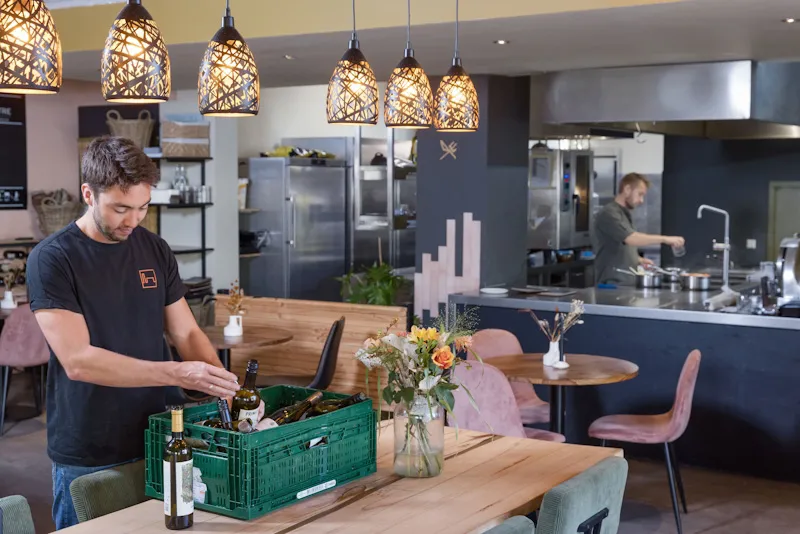
Businesses are separating their waste more effectively. Thanks to the Vereniging Afvalbedrijven’ campaigns ‘Doe alsof je thuis bent’ and ‘Aan de bak’, businesses are increasingly opting for additional bins alongside their residual waste container. The average number of bins per business site rose from 1.28 to around 1.55. This marks a clear step towards better source separation of business waste.
More than 5 billion kg of business waste is generated in the workplace every year, of which less than half is recycled. To change this, the Vereniging Afvalbedrijven launched the ‘Doe alsof je thuis bent’ campaign in 2023. Employees were encouraged to work with their managers to improve waste separation. In 2024, this was followed by ‘Aan de bak’, in which waste collection companies advise new customers to take at least two bins.
From campaign to workflow
Van Kaathoven is one of the companies that actively embraced the campaign. “It was already part of our customer conversations, but the campaign has helped us focus on it more,” says commercial manager Bas Jonkers. New customers are routinely offered two bins, while existing customers are actively approached. “It has now become a standard part of our workflow.” GP Groot inzameling is also seeing results. “Businesses care about sustainability,” says commercial manager Jordy Hoekstra. “At first, it was mainly the large companies, but sustainability has now reached SMEs too.” Customers increasingly see waste collection companies as knowledge partners. “We show them the tangible impact of their efforts.”
Financial benefits
Waste separation also makes financial sense. Residual waste is the most expensive stream and may become even more costly as a result of additional levies. Paper and cardboard is the most popular second bin, followed by glass or organic waste. PreZero notes that free collection of plastic packaging, beverage cartons and glass, funded by producers, has made separation easier since 2023.
Space, regulation and awareness
Not every business has room for several bins, particularly in city centres. Even so, the campaigns’ joint approach is proving powerful. “Now that the approach is working, we need to step up a gear,” says Harold Langens of PreZero. Better awareness, enforcement and stricter regulation are needed. Waste collection companies are investing heavily in awareness-raising, from waste quizzes to school programmes. Waste scans and sorting analyses give businesses insight into their waste streams. “There is still a long way to go before we achieve a circular economy,” Hoekstra concludes.
Question about this story? Ask your question
Keep following this
Get an email when a new story is published. No account needed.
- ThemeImproving waste collection and transport
- SubjectVereniging Afvalbedrijven