












First for the Municipality of Alphen aan den Rijn: first 3D-printed circular bridge
Alphen aan den Rijn has a 3D-printed bridge.
“It is the first composite bridge in Europe to be 3D printed. It is also the first bridge in the world to be fully circular!”, the municipality proudly reports.
Thermoplastic with glass fibres
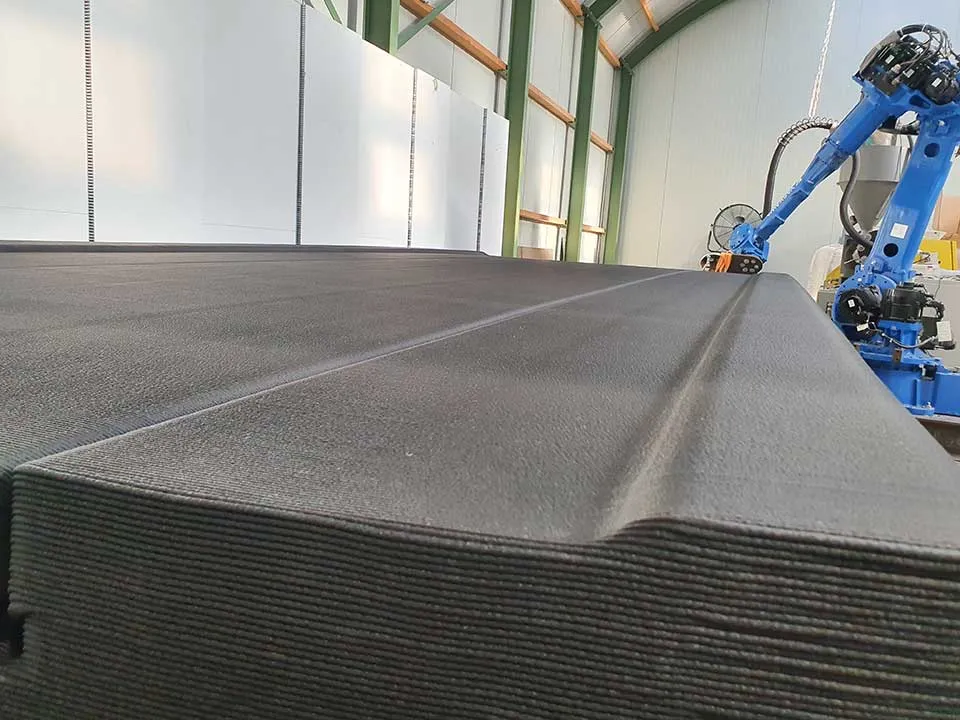
Thermoplast Composite Structures and Printbedrijf 10XL work with a thermoplastic whose exact name they are keeping under wraps for now. Thanks to its high chemical resistance, the material is widely used in the (petro)chemical and offshore industries for pipes and cladding. Unlike many other plastics, it is barely affected by UV radiation. It is also highly stable mechanically. Its mechanical properties remain constant up to a temperature of 140 degrees Celsius, after which its strength gradually decreases. Its melting point is 180 degrees, while the printer heats it to around 220 degrees. Composite Structures and printbedrijf 10XL mix short glass fibres into it before feeding it to the print head. Continuous reinforcement bars are not needed. As the material cools and shrinks after printing, it must be printed in one continuous operation. Otherwise, the coordinates will be slightly off and the print head will not know where to place the material. The 7-metre-long bridge for Alphen aan den Rijn was printed continuously over 90 hours.
The bridge is located near Vliestroom and Stortemelk in the Stromenbuurt. Over the past few months, Den Ouden Groep and Aannemersbedrijf Damsteegt have worked together to build this 100% recycled and recyclable bridge.
Den Ouden Groep and Aannemersbedrijf Damsteegt are both committed to incorporating sustainable innovations into their product and service offerings. This ambition aligns with the sustainability goals set out in the Municipality of Alphen aan den Rijn’s Sustainability Action Programme 2017-2020.
Driven by this ambition and their shared enthusiasm, the parties have worked hard over the past few months on the design, production and testing process. They were joined by Composite Structures and 10XL, companies specialising in 3D printing large objects.
100 years
One hundred years. That is how long Europe’s very first 3D-printed ‘waste bridge’ is expected to last at a minimum. So says Geert Siereveld, director of Composite Structures. His dream has become reality with the installation of a revolutionary pedestrian bridge on Vliestroom in Alphen aan den Rijn.
According to him, the structure has two unique features. On the one hand, the bridge was manufactured entirely using a 3D printer. On the other, it consists largely of recycled plastics, or what is commonly called plastic waste. This gives Alphen a European first, Siereveld says. “On a global scale, that combination is truly unique,” he says
The project involved close collaboration with 10XL, a specialist in 3D printing based in Dordrecht. But the idea came from Siereveld. “I didn’t invent 3D printing, and I didn’t invent bridge building either. But I did make the connection between the two.
The revolutionary bridge was finally completed over the past six months. Anyone concerned that a structure made from plastic waste might collapse will be reassured, says Siereveld. “We carried out a load test, covering the entire bridge with sandbags. That is equivalent to 65 people weighing 80 kilograms each.”
Reused granulate
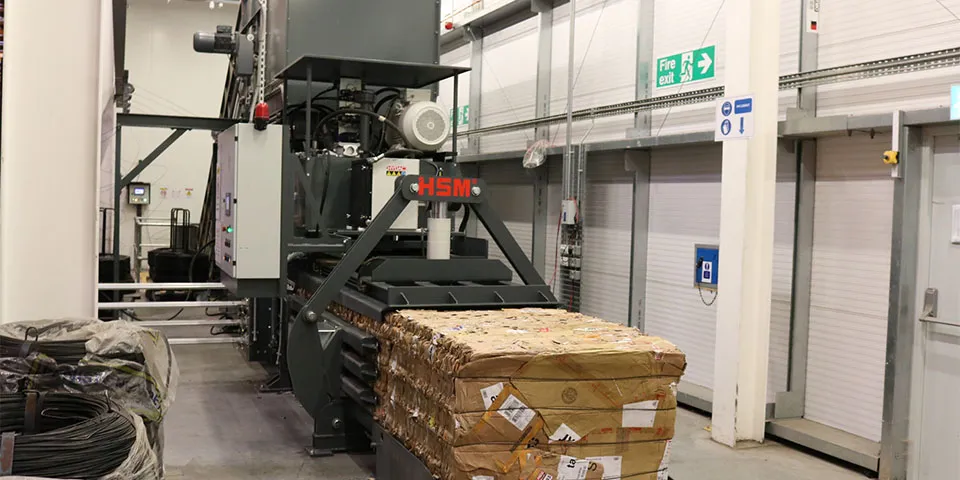
The bridge is the first composite bridge in Europe to be 3D printed. It is also fully circular, meaning it is made from 100% recycled raw materials and the printed bridge is also 100% recyclable. Reused granulate, consisting of a combination of synthetic polymers and glass fibre, is used as the raw material for the bridge. At the end of its service life, the bridge can be reprocessed into plastic granulate and reused as a raw material for a new application.
Over the coming years, Den Ouden Groep and Aannemersbedrijf Damsteegt will replace 24 bridges on behalf of the Municipality of Alphen aan den Rijn. After the first 3D-printed bridge is installed, they will assess which other bridges can be replaced with a sustainable, 3D-printed alternative.
Question about this story? Ask your question
Keep following this
Get an email when a new story is published. No account needed.
- ThemeCircular construction and demolition
- SubjectPlastic waste







