












Impact of Vlarema 9 on construction and demolition waste
Text Valérie CouplezImage iStock
It took some effort, but on 7 July the Flemish Government amended the Flemish Regulations on the Sustainable Management of Material Cycles and Waste. This brings Vlarema 9 into force. The amendment decree is still awaiting advice from the Data Protection Authority and the Council of State. One of the new key measures is a framework for the selective collection on site and subsequent sorting of various construction and demolition waste fractions. In this feature, we outline the main changes, insofar as they have been given concrete form, and hear from a company about the practical implications.
The Flemish Climate Plan 2021 to 2030 states that, by 2030, 50% of recyclable waste in household residual waste and comparable commercial waste must be kept out of the residual waste stream. On 5 November 2021, the Flemish Government approved a vision paper setting out additional climate measures. These raise the ambitions of the Flemish Climate Plan, with a target of effectively recycling 75% of the recyclable material still remaining in residual waste. Better source separation or thorough sorting after collection are important measures for achieving these targets. For commercial waste in general, clearer rules are being introduced on the conditions for the joint collection of a number of dry, non-hazardous recyclable fractions (paper and cardboard waste, wood waste, metal waste, rigid plastics and films) for subsequent sorting. However, fine-tuning this article in turn created legal uncertainty around the construction and demolition waste stream.
Separate collection of construction and demolition waste
A new subsection clarifies which construction and demolition waste fractions must be collected separately on site and which can still be recovered through subsequent sorting and sent for recycling. With this proposal, Flanders aims to close the construction materials loop as fully as possible. Collection on site and any subsequent sorting must therefore be geared towards reuse or material recycling. Given its specific composition and origin (construction and demolition sites), construction and demolition waste must first be collected and presented separately from other waste (household contents, commercial residual waste, etc.). Before the demolition or renovation work itself begins, contractors must collect separately all waste that is not construction and demolition waste and remove it separately from the construction and demolition waste.
More fractions to be sorted on site
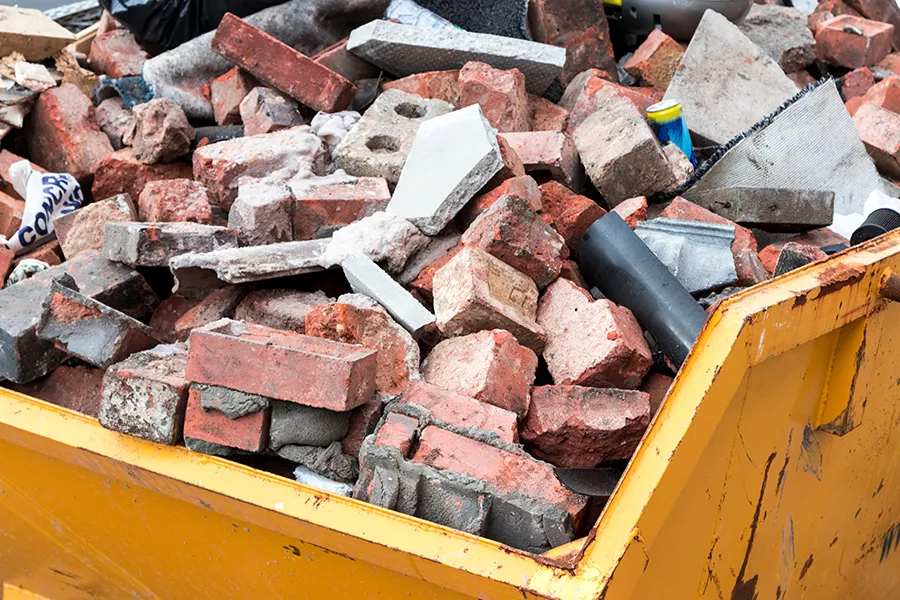
Flemish policy prioritises sorting and selective collection at source, as this produces the cleanest fractions and enables the highest-quality recycling. Article 4.3.2 therefore adds only fractions typically found on construction and demolition sites to the list of waste streams to be collected selectively. In addition to glass, metal, rigid plastics and wood, which were already listed in Article 4.3.2, the following typical construction and demolition waste fractions can also be recycled and returned to the materials cycle: inert rubble consisting of concrete rubble, masonry rubble or mixed rubble, aerated concrete, glass wool, rock wool, plasterboard and gypsum blocks, bituminous roofing or sealing materials. Separate collection on site is not required in certain cases. This applies to sites where separate collection at source is not possible or desirable due to limited space or for technical or safety reasons. In these cases, all dry, non-hazardous construction and demolition waste fractions may be collected together in the same container, provided that the mixed construction and demolition waste is subsequently treated as set out in the new subsection 5.2.16.
Charge commercial waste costs proportionately
Also relevant to the demolition and crushing sector, and indeed to all businesses, is the requirement to charge for commercial residual waste costs proportionately. In other words, the charge must reflect the weight of the residual waste collected. This encourages waste producers to present less commercial residual waste by weight. Weight-based charging is a highly effective measure, with proven results among households. Since businesses are generally even more responsive to price changes than consumers, an even stronger effect is expected here. The plan environmental impact assessment for the draft Local Materials Plan also points this out. According to the assessment, more than half of the expected reduction in commercial residual waste resulting from the plan’s measures is attributable to the specific measure of weight-based charging. Sorting will ultimately pay off.
Question about this story? Ask your question
Keep following this
Get an email when a new story is published. No account needed.
- ThemeCircular construction and demolition
- SubjectWaste streams







