












Almost 900,000 tonnes of food lost
Text Valérie CouplezImage iStock and OVAM
Tackling food loss a priority for Flanders and Europe
Food travels a long way before it ends up on our plates. From farmer to factory and from supermarket to consumer, around 900,000 tonnes of food are lost in Flanders alone. With a new campaign, OVAM wants to put the spotlight on the Kostwinners. These are organisations that each in their own way fight food loss and thus contribute to a greener, waste-free planet.
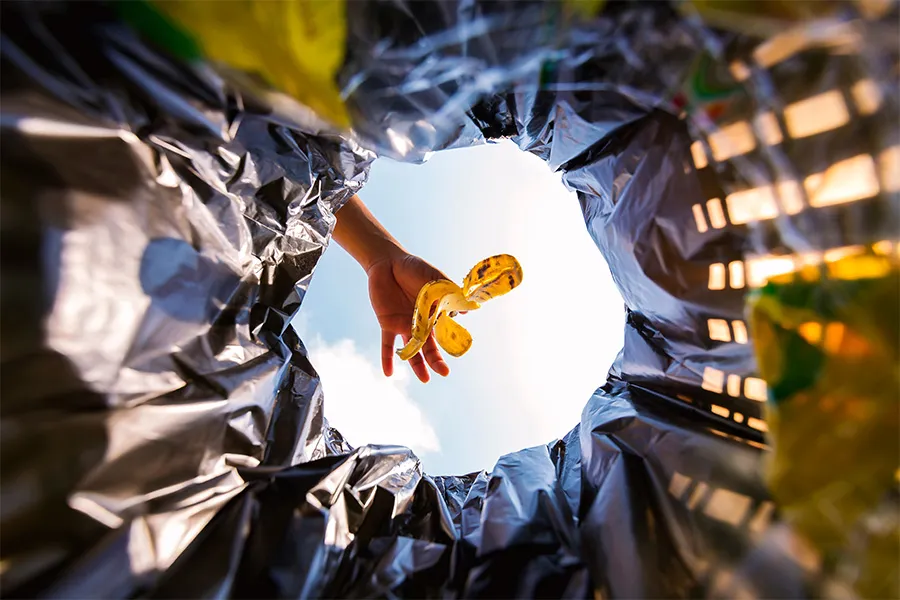
In Flanders, food loss amounted to 883,740 tonnes during the most recent measurement period. Of this, 73% is collected and valorised, but 27% is still largely incinerated as residual waste. That is a decrease of 2% compared with five years earlier. This concerns edible biomass, in other words food that people could simply have eaten. Peelings and plant residues, for example, are not counted. One third of the raw materials and products that we count as food loss is edible food for humans that ends up in the bin.
Giving priority
Food loss is a priority for Flanders and Europe because it has a negative impact on the environment, as it costs energy, water and other natural resources. It also raises economic costs for producers, distributors and consumers, and it reduces food security. Moreover, it is simply ethically wrong in a world where people go hungry. But food loss does not occur only in Flemish households. It occurs at horticultural growers, supermarkets, catering companies and restaurants. The whole chain, from farm to fork, is aiming to prevent 30% of food losses by the end of 2025, reprocess them as food or valorise them to a higher standard, compared with 2015. Donating surplus food via food banks and social organisations remains important. The emphasis is on prevention and valorisation throughout the entire food chain. The Action Plan on Food Loss and Biomass 2021-2025 (kringloop voedsel) is in full swing. At every link in the agri-food chain, as well as in research, policy and civil society, actions are under way to combat food loss and to valorise food loss where it cannot be avoided.
Already 73% recovered
Fortunately, the largest share (73%) of food loss in Flanders is recovered. This means that the lost food is put to another useful application, such as animal feed or materials like compost or biogas. In other words, Flanders is on the right track, but our ambition must be to limit food waste streams to a minimum and to make their valorisation increasingly high-grade. This contributes to the circular economy, but also benefits the climate. Instead of emitting CO2 by incinerating food loss, we retain CO2 in the soil through the use of compost or digestate and improve the soil's resilience to climate change.
Further measures
For this reason, OVAM and its partners will do everything in their power in the coming years to realise this ambition through the 'Action Plan on Food Loss and Biomass'. Three main lines are central to this plan: 'More prevention, less loss', 'better sorting and collection' and 'more high-grade valorisation'. In the coming years, OVAM will also take further measures with local authorities and private collectors to reduce the food waste mountain. Specifically, OVAM wants to:
- Further encourage food retailers to donate what is still fit for human consumption to food banks and social organisations.
- Adjust the frequency of residual waste collection, which encourages separate collection.
- OVAM will monitor companies to ensure that no more recyclable products end up in residual waste.
- In addition, OVAM wants to introduce collection of kitchen waste/vegetable, garden and fruit waste (GFT) from households where this is not yet the case in Flanders. From 31 December 2023, there will also be a mandatory collection obligation for residual food streams for all companies. This obligation already existed for supermarkets and large-scale kitchens, among others, but is being extended.
A business question for OVAM? Get in touch
Companies in this story

Keep following this
Get an email when a new story is published. No account needed.
- SubjectWaste streams
- CompanyOVAM







