Rotary kilns destroy PFAS with 99.9999% efficiency
Text IndaverImage iStock
Sustainable and efficient treatment of PFAS
Thanks to robust treatment methods and new investment, Indaver continues to meet its commitment to destroy PFAS in line with the very stringent new standards. The rotary kilns destroy PFAS molecules with 99.9999% efficiency. This is confirmed by air emissions measurements. The new, stricter permit conditions for wastewater discharges limit the total pollutant load to 2 kg per year. For PFOS, discharges will be less than 10 g per year. This provides a sustainable and safe solution for hazardous waste in our society.
For 35 years, Indaver has been providing solutions for waste streams generated by industry and society more broadly, for example in hospitals. The rotary kilns break down or destroy a wide range of molecules. Three factors ensure this breakdown: a high temperature of at least 950 °C (and an average of 1,050 °C), combined with a long residence time in the kiln and good turbulence (the rotation of the drum), which ensures that the waste is exposed to the fire from all sides. The plant is also equipped with an extensive flue gas treatment system.
Deposition levels forty times below the EFSA limit
To date, no validated method has been available for measuring any residual PFAS molecules at the chimney. At the request of the government, VITO, the Flemish Institute for Technological Research, therefore developed a method between October 2021 and the summer of 2022 for sampling flue gases and analysing them for PFAS residues. Indaver contributed to this research, enabling VITO to test the method on air emissions. Using a scientific model, the measured values are converted into deposition levels. In other words, the model simulates how much residual PFAS actually falls back to the ground. The study shows that the levels are forty times below the limit based on EFSA values (European Food Safety Authority) for the four main PFAS components.
Drastic reduction in PFAS residues in wastewater treatment
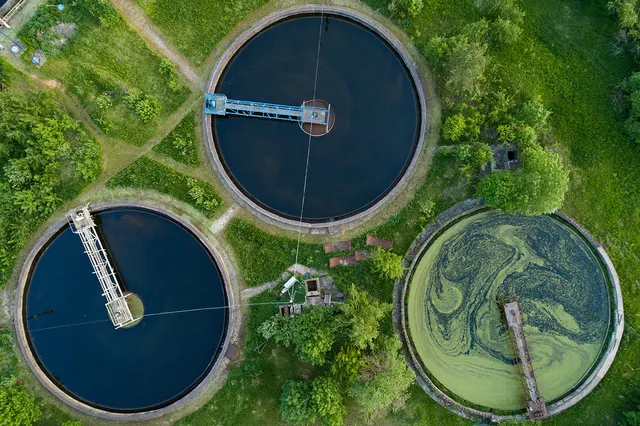
Based on the results of the emissions measurement campaign, a mass balance can also be used to calculate that the plant operates at 99.9999% efficiency. In this way, Indaver ensures that thousands of kilos of PFAS molecules are permanently removed from our society. The rotary kilns are equipped with an extensive flue gas treatment system. Washing the flue gases produces wastewater, which is treated alongside the site's other wastewater at the wastewater treatment plant. In recent months, the wastewater treatment plant has been expanded with additional activated carbon filters. There are now eight activated carbon filters in total, arranged in two banks of four, and replaced regularly. Recent analysis results confirm that the system is working well, particularly for all PFOS and the PFAS listed in the POPs Regulation. VITO is still investigating the Best Available Technique for capturing PFAS in complex wastewater.
Safe landfilling of PFAS-containing waste in a salt cell
Indaver also provides a solution for PFAS-containing waste for which incineration is not the most appropriate option. This waste is disposed of at a licensed landfill. In light of growing knowledge and new insights into the behaviour of different PFAS molecules, the treatment method for non-combustible PFAS-containing waste has also been revised. Indaver now stores the waste in separate salt cells at the landfill. A salt cell is an area where the waste is encapsulated separately to prevent water from seeping through. The landfill itself also has several impermeable layers, providing multiple layers of protection. The water generated during the process is incinerated in the rotary kilns.
Question about this story? Ask your question
Keep following this
Get an email when a new story is published. No account needed.
- ThemeSafe and clean processing
- SubjectPFAS pollution