












Waste sector makes a substantial contribution to European climate targets
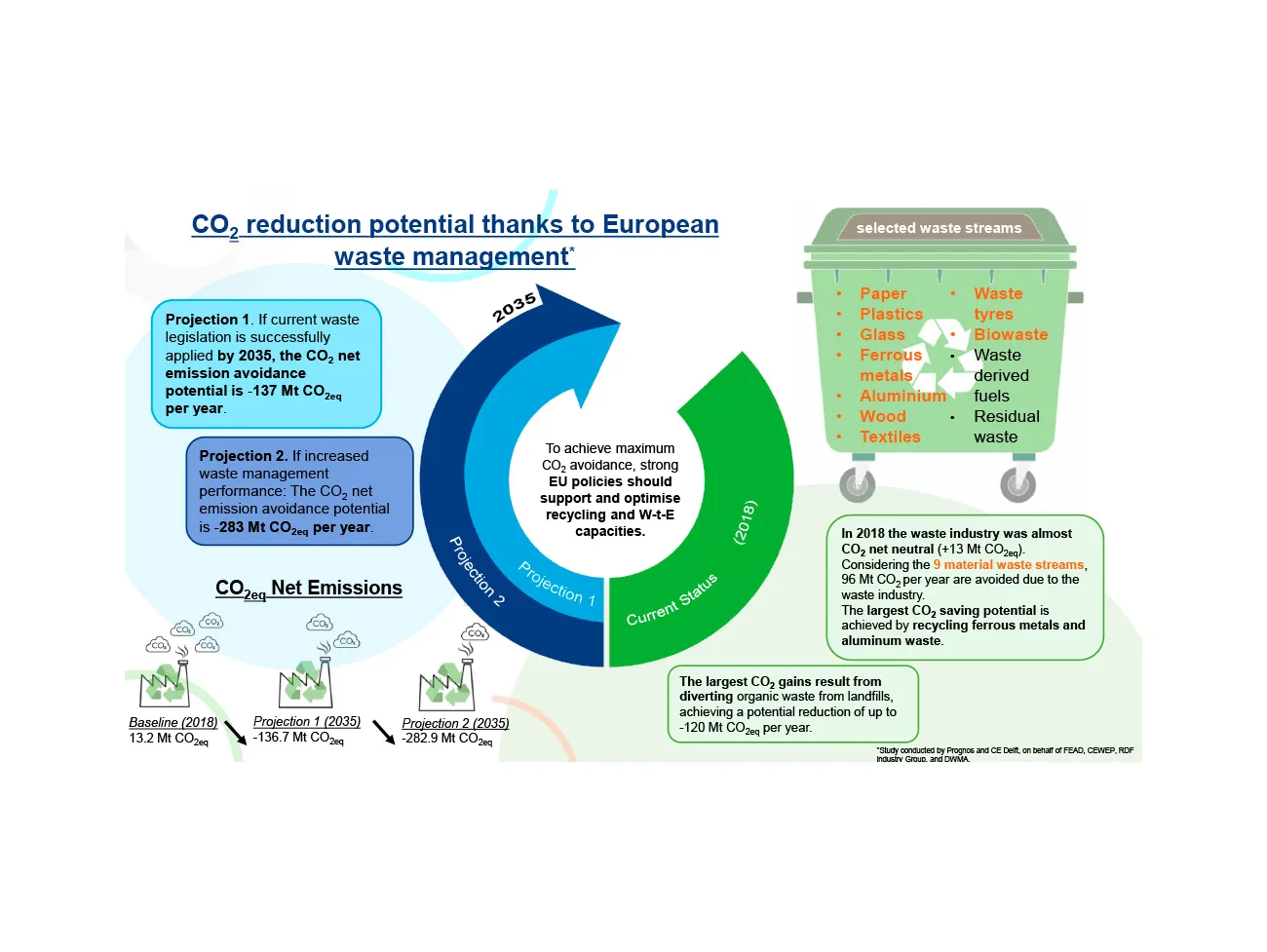
The European waste sector could save as much as 150 million tonnes of CO2 equivalent by 2035. Realising this potential requires the full implementation of existing EU legislation. With a more ambitious package, Europe could almost double its CO2 savings. This is the finding of a recent study by two renowned research institutes. The waste sector is ready to take on this climate challenge.
The study into the European waste sector’s climate potential examined ten waste streams: paper, glass, plastics, ferrous metals, aluminium, wood, textiles, tyres, bio-organic waste and residual waste/refuse-derived fuel. Together, these account for almost one fifth of the total waste stream. The study was carried out by European consultancy Prognos and Dutch research institute CE Delft.
Full implementation of current European legislation includes meeting the EU waste targets of 65 per cent recycling of household waste, a maximum landfill rate of 10 per cent and 70 per cent recycling of packaging material. According to the calculations, this would offer savings potential of 150 million tonnes of CO2. By comparison, that is almost half of Spain’s total CO2 emissions in 2019. Doubling the CO2 savings would require more ambitious policies. In addition to the current rules, this would mean higher recycling targets and keeping recyclable and combustible waste out of landfill, as well as, for example, requiring a percentage of recycled raw materials in production, introducing efficient rules for European waste transport and providing government support for separate collection. Cooperation between all stakeholders is essential. These include not only governments and waste companies, but also designers and producers at the start of the chain.
Andreas Krawczik, board member of the Vereniging Afvalbedrijven, stresses the importance of greater European cooperation to reduce cross-border CO2 emissions: “Governments and companies must join forces to realise the potential CO2 reductions. European policy must focus on integrated waste management to enable more recycling and energy generation from waste. Such European cooperation will help reduce Europe’s total CO2 emissions.” Cooperation can take the form of processing waste in the most efficient way and sharing knowledge and waste-processing capacity. Krawczik advocates linking this to the European Recovery Fund to support faster implementation of European waste rules. “Many countries will have to invest heavily just to comply with and implement current European waste legislation. Implementation will create jobs, deliver substantial CO2 savings and recover raw materials. All of these are highly relevant to Europe.”
Question about this story? Ask your question
Keep following this
Get an email when a new story is published. No account needed.
- ThemeCircular business under changing regulations
- SubjectWaste streams







