Turnkey sorting plants with Finnish robot technology
No waste processing company should still want to sort waste by hand, believes Wouter van der Pool, operations manager at the Dutch branch of the Avermann Group. “It’s difficult work, unhealthy work, mind-numbing work. In short, it’s a horrible job.” That is why Avermann is increasingly engineering and building sorting plants equipped with robots.
Van der Pool knows there is still much debate about the quality of sorting robots. “But the fact is, a robot doesn’t get tired. And when you’re standing behind a conveyor belt sorting by hand, sooner or later you can no longer tell the different types of plastic apart. Then you start making mistakes. We’ve tested this extensively using cameras in a sorting cabin.”
It’s no coincidence that sorting staff are becoming increasingly difficult to find in the Netherlands, forcing us to recruit them from countries further and further afield. “That’s something we shouldn’t want at all,” says Van der Pool. “And there’s no need to. A robot does the job better and, ultimately, more cheaply.”
That does not mean, however, that robotic sorting is not also dependent on how the waste is delivered. Van der Pool says: “Ultimately, a robot is only as good as the pre-sorting and the way the bulk material is handled and delivered.”
Relatively straightforward
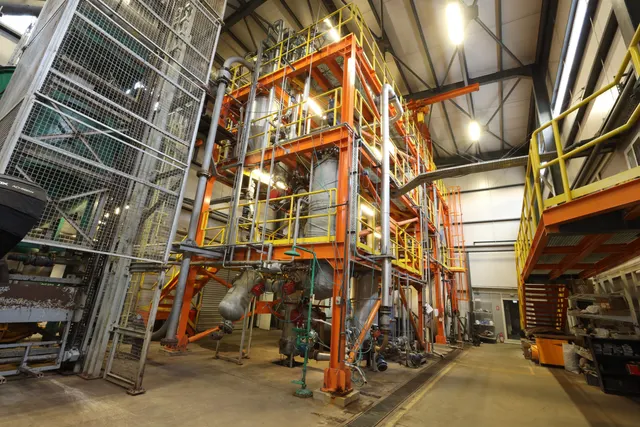
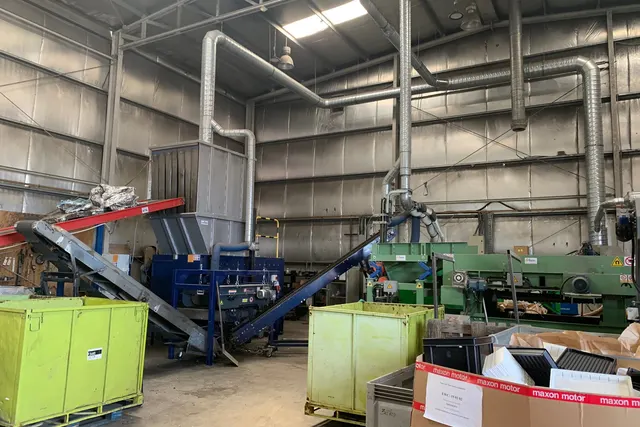
That is why Avermann builds relatively straightforward sorting plants using sorting robots from the Finnish brand ZenRobotics. “The plant is built from Lego-like modules and can be installed indoors or outdoors. Often, no planning permission is needed. The waste is tipped onto the belt. The walking floor serves as your bunker, where everything is tipped in as bulk material. Conveyor belts spread it out and turn the bulk material into a single layer. Then there is a screening stage, essentially a vibrating screen that shakes out the sand and fine material and spreads the rest. This leaves only the coarser pieces, which a robot can sort very well. A second vibrating screen can optionally be added to feed another robot. This means you can sort out all the recyclable materials: metals together, different types of wood together, different plastics, you name it. At the back, the fines come out, suitable only for incineration.” Van der Pool describes it as a fairly simple set-up. “It’s just a number of conveyor belts, screens and robots. In principle, everything can be installed in a tent, loaded and left to run automatically. Some customers fill it in the evening, and the plant is empty and ready for them again in the morning. And everything can be operated using an app on a smartphone.”
Smarter
Van der Pool emphasises once again that the process operator’s job is changing with the times. “Where sorting work was mainly done in the past by people with a lower level of education, there is now an increasing demand for well-trained operators.”
Moreover, artificial intelligence and machine learning are making the robots increasingly smart. “They can not only tell different types of plastic apart or sort out a bottle from a particular brand, but even make difficult decisions. For example, if a can is folded inside a plastic bottle, the robot knows to put it in a special ‘difficult choices’ bin. We humans simply can’t manage that at such speeds.”
Van der Pool believes that the reason only a limited number of waste sorters are using robots, despite this, is that they are somewhat wary of new things. “You certainly don’t need to avoid it because of the cost. Especially if you have sorting staff working shifts and are running 24/7, you’ll more than recoup the cost of a robot within a year. And robot technology has become much better than it was a few years ago. In 2021, there really is a choice. There are now a few large, reliable players on the market, including ZenRobotics.”
Question about this story? Ask your question
Keep following this
Get an email when a new story is published. No account needed.
- SubjectWaste streams