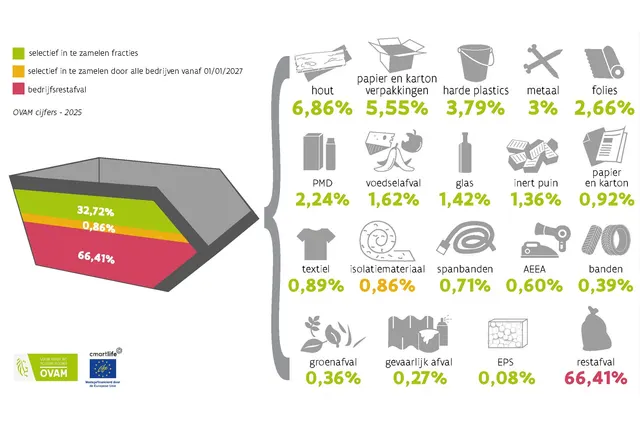
The hard facts [Edition 2 2023]
Text Valérie CouplezImage iStock
The saying goes that if you can measure it, you can manage it. That is why RecyclePro is once again bringing you figures on the waste sector in every 2023 edition. It is up to you to draw insights from them that can optimise your production process or boost your returns. This time, we take a closer look at textile recycling. Did you know that a new T-shirt has 70 times the environmental impact of a reused one? It is high time, then, to give textile reuse and recycling every possible boost.
More and more textiles are being collected in Europe. By 2030, the volume is expected to reach around 8.5 to 9 million tonnes. Good news? It is a mixed picture, because the share of high-quality garments suitable for reuse is declining. Today, 50 to 75% of collected textiles are reused, while 10 to 30% are destined for recycling. These proportions could well be reversed by 2030. Much of this is down to the lower quality of clothing.
Mechanical and chemical recycling
In the case of textiles, recycling usually means mechanical recycling into industrial wiping cloths, bedding or insulation material. However, these processes can also produce new yarns from recycled fibres: in other words, fibre-to-fibre recycling. This comes with significant challenges in sourcing materials that meet the required specifications. Furthermore, the fibres become shorter with each recycling cycle, until they are eventually no longer strong enough to be recycled. New technology uses chemical processes to recover valuable components that can be used to make new fibres. Much is expected of this technology in the coming years.
Reuse is better
Until then, however, prioritising reuse remains the most sustainable option. This is clearly demonstrated by the life-cycle assessment from a Euric study that examined garments of all quality grades. For both premium and B-grade clothing, new T-shirts were found to have 70 times the environmental impact of reused T-shirts. In terms of CO2 emissions, reusing either type saved more than 3 kg of CO2 per T-shirt. This is due to emissions from fibre production, on the one hand, and from the production of the T-shirt itself, on the other. Reuse has only a logistical impact in comparison. Reuse should therefore be prioritised over recycling when it can replace the production of new clothing.
Question about this story? Ask your question
Keep following this
Get an email when a new story is published. No account needed.
- ThemeMaking use of textiles and other waste streams
- SubjectHard numbers