The hard facts
The old adage says that what gets measured gets managed. So in every 2020 issue, RecyclePro brings you the latest figures on the waste sector.
It is up to you to draw insights from them that can help optimise your production process or increase your returns. Europe aims to reduce the amount of residual waste. But what do the figures tell us about household waste?
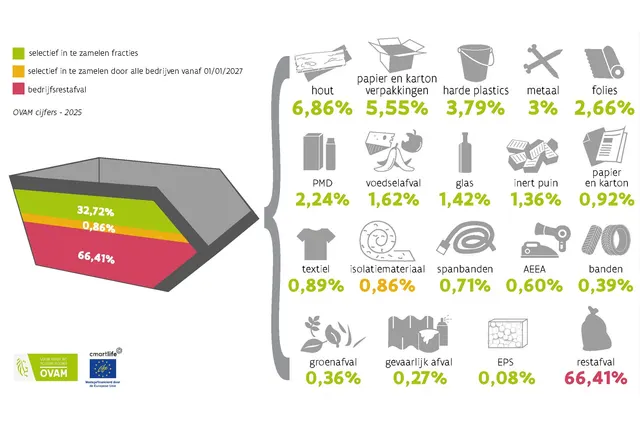
In 2019, a total of 3.2 million tonnes of household waste was collected in the Flemish Region. This includes more than residual waste alone: it covers all waste streams collected from households. Separately collected waste accounts for almost 70% of household waste. These figures have remained stable for the time being. The decline seen between 2008 and 2015, resulting from decreases in both separately collected waste and residual waste, has not continued. However, the amount of household residual waste has continued to fall in recent years, from 979,510 tonnes in 2015 to 950,985 tonnes. Since 2015, the decline in paper and cardboard, and construction and demolition waste streams has been offset by an increase in wood waste. The amount of PMD and plastic waste has also been on an upward trend.
Two-thirds of household waste sent for material recovery
In 2019, an average of 477 kg of household waste was collected per resident (334 kg of separately collected waste and 143 kg of residual waste). This amount fell by 44.5 kg between 2013 and 2019. Both fractions also declined, by 29.5 kg per resident for separately collected waste and 15 kg per resident for residual waste. In 2019, 66% of the total amount of household waste was sent to a material recovery facility: 44% was recycled and 22% composted or digested. A further 29% was incinerated with energy recovery, while 2.2% was landfilled. In addition, 2.4% of household waste went to a mechanical-biological treatment plant, and 0.3% was given further pre-treatment as small hazardous waste (KGA) before being recycled, landfilled or incinerated.
Question about this story? Ask your question
Keep following this
Get an email when a new story is published. No account needed.
- SubjectHard numbers