Greater emphasis on enforcement as a final step

The rules for commercial waste are clear, but they are not always followed properly. That makes it important to know exactly who is playing by the rules and who is not. Waste collectors, dealers and brokers are required to record companies’ sorting errors as non-compliances in a register. Companies that repeatedly break the rules can expect a targeted inspection. Fost Plus and OVAM allocated funds from the Halve Euro work plan to deploy two enforcement officers to inspect commercial residual waste, drawing in part on information from the non-compliance register.
Since the end of 2021, 881 inspections have been carried out at companies, according to the latest figures available from OVAM at the time of the interview. Sorting errors were found in 60% of cases. “Often, they were simple things,” says OVAM spokesperson Jan Verheyen. “In 51% of cases, PMD was still in the residual waste. It has been obvious for years that this fraction must be collected separately. Although sorting is often still done properly on the production floor itself, further along the chain the waste ends up in the wrong container somewhere. That really has to stop.” The performance requirements have also become stricter since the start of this year. The maximum quantities of waste materials that may still be present in residual waste have been reduced further. Companies would therefore be wise to focus on sorting waste properly at source.
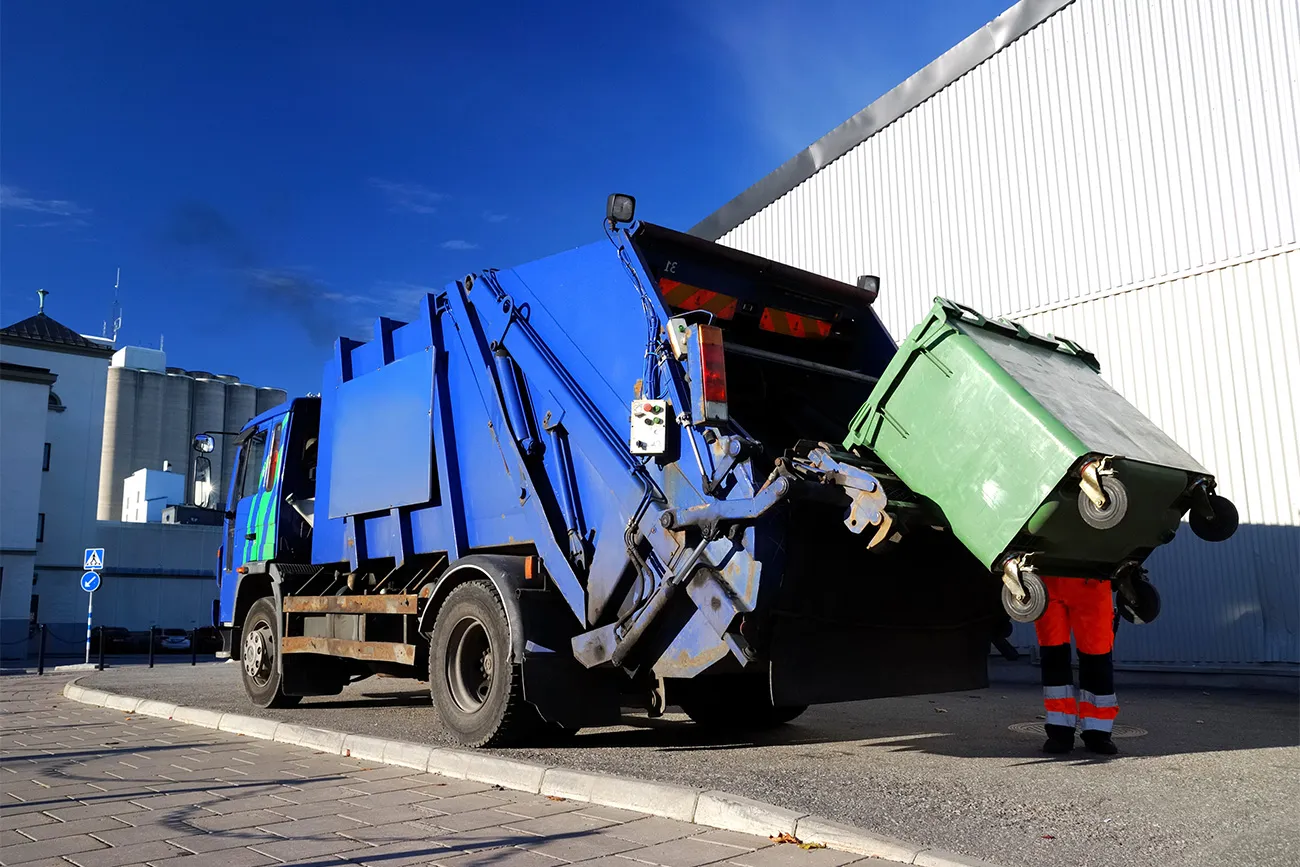
Raising awareness, issuing reports and imposing fines
When assessing commercial residual waste, enforcement officers distinguish between serious and minor sorting errors. They may also look at the contract with the collector, whether containers for separate collection are available, and sorting practices. Depending on the seriousness of the findings, various enforcement measures may be used. Often, a visit from an enforcement officer and additional information about the sorting obligation are enough to prompt companies to change their behaviour. “That is the best proof for us that awareness campaigns really do serve a purpose.” However, if raising awareness and providing support do not produce the required results, or if the sorting errors are very serious, this will lead to an official report and a fine. “In 65% of cases, the sorting error resulted in an official warning or even a formal report. In such cases, the fine can range from several hundred to several thousand euros,” Verheyen adds. “The aim is to send offenders a swift and clear signal when serious infringements are involved.”
Administrative checks on waste collectors, dealers and brokers too
The conduct of waste collectors, dealers and brokers is also monitored. Astrid De Man, Selective Collection of Commercial Waste at OVAM, says: “Every year, we carry out administrative checks to see whether the rules are being followed in this area too. Since 2021, we have carried out around fifty. In nineteen cases, we found something was not in order. In eight of those cases, this led to a formal report.” OVAM has no enforcement powers of its own, but it shares the results of these checks with the Enforcement Division of the Department of the Environment, which can take them into account when planning its on-site inspections. In 2022, the Enforcement Division carried out around ten in-depth on-site inspections relating to the collection and processing of commercial residual waste. So far, these have resulted in six formal reports and two warnings. Fines can be substantial. This year, the Enforcement Division will carry out even more targeted inspections of commercial residual waste collection. It will also check this consistently during other routine inspections of waste collectors, dealers and brokers and waste processors.
Een zakelijke vraag aan OVAM? Get in touch
Companies in this story

Keep following this
Get an email when a new story is published. No account needed.
- ThemeImproving waste collection and transport
- SubjectCommercial waste
- CompanyOVAM