












New research method quantifies litter levels: 1,324 tonnes of litter must be eliminated by 2030 to meet policy target
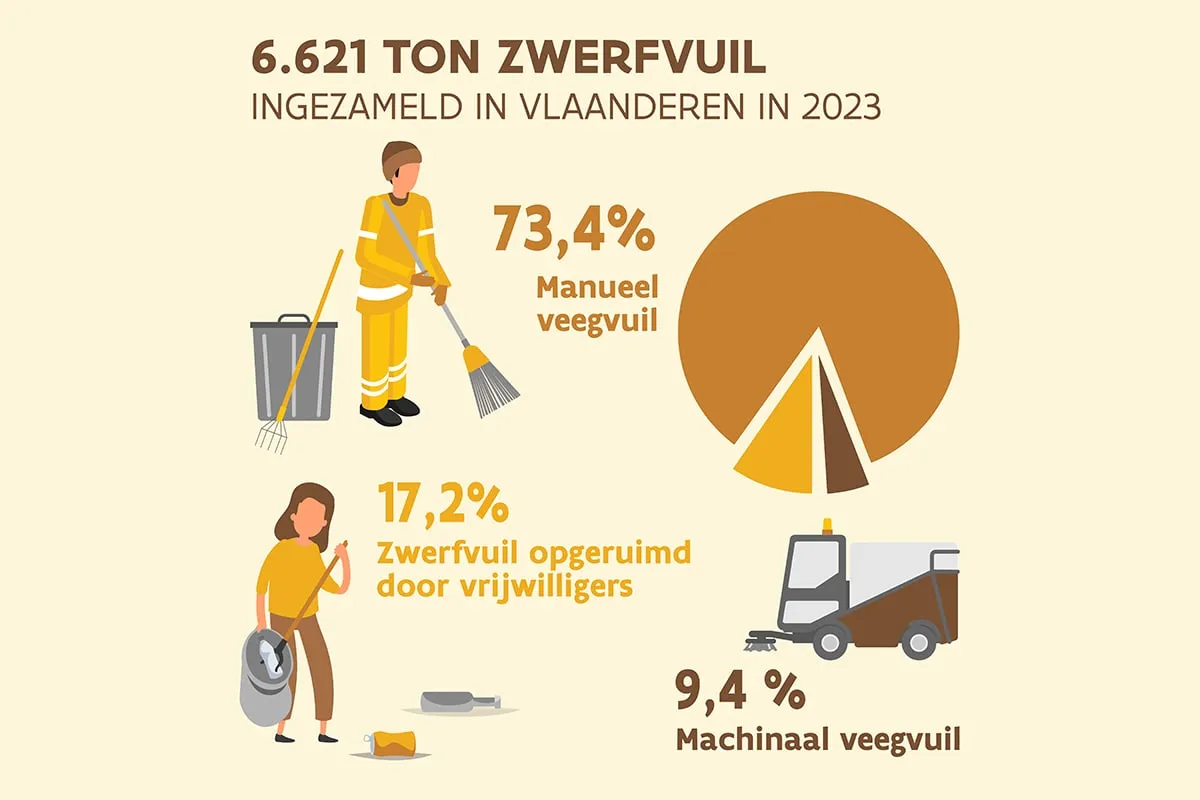
OVAM today published the report “Litter Monitoring in Flanders in 2023”. The report shows that 6,621 tonnes of litter were collected in Flanders last year, or 0.97 kg per resident. The Flemish Materials Plan 2023-2030 aims to reduce the amount of litter by 20% by 2030. Thanks to this baseline measurement, we now know that we will need to prevent 1,324 tonnes of litter in the coming years. Street sweepers clear 73.4% of the litter. Volunteers account for 17.2%. Sweeping vehicles clear the remaining 9.4%. In addition to litter figures, the new report also monitors the amount of waste correctly collected in street bins. In 2023, this amounted to 13,333 tonnes.
More accurate monitoring keeps a close eye on developments.
During the previous plan period (2016 to 2022), OVAM also monitored the amount of litter every two years. At the last measurement, in 2021, the amount stood at 18,171 tonnes, a decrease of 11% compared with the start of the period, rather than the 20% target.
Since this year, OVAM has been using a completely revised, more accurate measurement method: IZAS. This method shows that the quantities reported between 2015 and 2021 were substantially overestimated. There were several reasons for this overestimation. For example, the proportion of litter in mechanically swept waste was previously estimated at 20%, based on a one-off measurement. A recent study analysing a sample of 280 tonnes of mechanically swept waste from various intermunicipal organisations and different seasons revealed that litter accounts for just 1.22% of its weight, rather than 20%. This represents a difference of 9,556 tonnes compared with the figures reported previously.
In addition, cities and municipalities were not previously required to take part in the monitoring. 66% of local authorities participated in the previous monitoring exercise, in 2021. Today, monitoring is compulsory for all cities and municipalities, and they must all use the same method. This means, for example, that they must all apply the same standard for bulk density, unless they can demonstrate a deviation through measurements. Because of the major differences in bulk density used by municipalities, the estimate for manually cleared sweepings was found to be approximately 3,000 tonnes higher than in previous years.
The new measurement method means that the figures from this new baseline measurement cannot simply be compared with those from previous measurement campaigns. However, we can say that, without the corrections outlined above, the figures would still be in the same order of magnitude. This means that we will need to continue our efforts to tackle litter in the coming years. From now on, the new monitoring will therefore also be carried out annually. This will allow us to keep a closer and more timely eye on developments, and check whether we are on track to reduce the amount of litter by 20% (1,324 tonnes) by 2030.
In 2023, OVAM also carried out more than 6,000 field measurements to determine the number of pieces of litter per 100 m2 in different types of area. For a number of these types of area (motorway service areas, waste collection points, public transport stops, main roads, town-centre streets and pedestrian shopping streets), the target is also to reduce the number of pieces of litter by 20% by 2030. These field measurements will also serve as the baseline.
Volunteers play a significant role in the fight against litter
The IZAS report also explains how litter is cleared. The lion’s share is dealt with by ground staff: public cleanliness teams from cities and municipalities, park wardens, motorway service area cleaning teams, and others. They manually clear 73.4% of the litter. Sweeping vehicles used by our cities and municipalities account for 9.4%. The contribution made by volunteers is significant, with many receiving support from Mooimakers. Together, they cleared 1,139 tonnes (17.2%) of litter in 2023.
OVAM calls for an integrated approach to litter to continue
The fact that the new method for monitoring litter produces lower figures is no reason to let up. Overestimation of the absolute quantities does not change the fact that litter still has to be cleared 365 days a year, that its environmental impact must still be taken seriously, or that litter continues to irritate people in Flanders. OVAM therefore calls for the integrated approach to litter to continue, with a focus on prevention, fewer and better (reusable!) packaging solutions, broad communication and awareness-raising, litter-prone locations, appropriate collection infrastructure, the participation of volunteers and associations, and, finally, inspections and enforcement.
Een zakelijke vraag aan OVAM? Get in touch
Companies in this story

Keep following this
Get an email when a new story is published. No account needed.
- SubjectNews
- CompanyOVAM







