












First Flemish Biomassaplein now operational
Context
Circular economy, biomass, CO₂ reduction, sustainable economy, short supply chains.
These are familiar terms, often used in the fight for a liveable environment and a healthy climate.
Limburg, the greenest province in Flanders, is taking up this fight.
In several areas, the province is even a major player in the leading group of companies and institutions that take practical action and turn ideas into reality.
Limburg leads the way
Bionerga is a well-known and innovative player in Flanders when it comes to processing household and similar non-recyclable waste. The commissioning of a new biomass power plant in Beringen in 2020 is one example.
Flanders is also drawing widespread interest for its processing of kitchen and garden waste and PE film plastics (think of the Blue Bag and the Optimo project).
Nature is also a top priority in Limburg, where many organisations, including the Regionaal Landschap Lage Kempen, are active in this field.
The Regionaal Landschap Lage Kempen is a partnership between government bodies, nature conservation associations, agricultural organisations, heritage organisations, wildlife management units, private landowners and tourism associations. Its team works enthusiastically every day towards a clear mission: caring for the landscape, nature and heritage.
Biomassaplein
Nature needs not only to be cherished, but also managed. This is done, among other things, through ecological landscape management of the many hedgerows along Limburg’s fields and roads.
One result of this management is a large quantity of biomass. A new use has been devised for this woody residue, and it is now being put into practice at the Biomassaplein in Houthalen-Helchteren, the first of its kind in Flanders.
The initiative was taken by the Provincie Limburg (through the LSM channel), Bionerga and the Regionaal Landschap Lage Kempen.
Landscape management
The Regionaal Landschap Lage Kempen (RLLK) recognises the importance of well-managed hedgerows in the landscape. Hedgerows that are no longer managed become overgrown, monotonous and highly vulnerable.
Through targeted rejuvenation using coppicing and planting, RLLK ensures that hedgerows retain their biodiversity value, strengthen local identity, continue to form attractive linear features in the landscape and protect crops from wind erosion.
Together with several municipal authorities, RLLK mapped the hedgerows and drew up an integrated management plan that took all their functions into account.
Farmers and nature conservation associations also contributed to these plans.
Each year, a section of the hedgerows is managed in 50-100 metre blocks spread across the municipalities. This work can often be carried out by local farmers.
Processing at the Biomassaplein
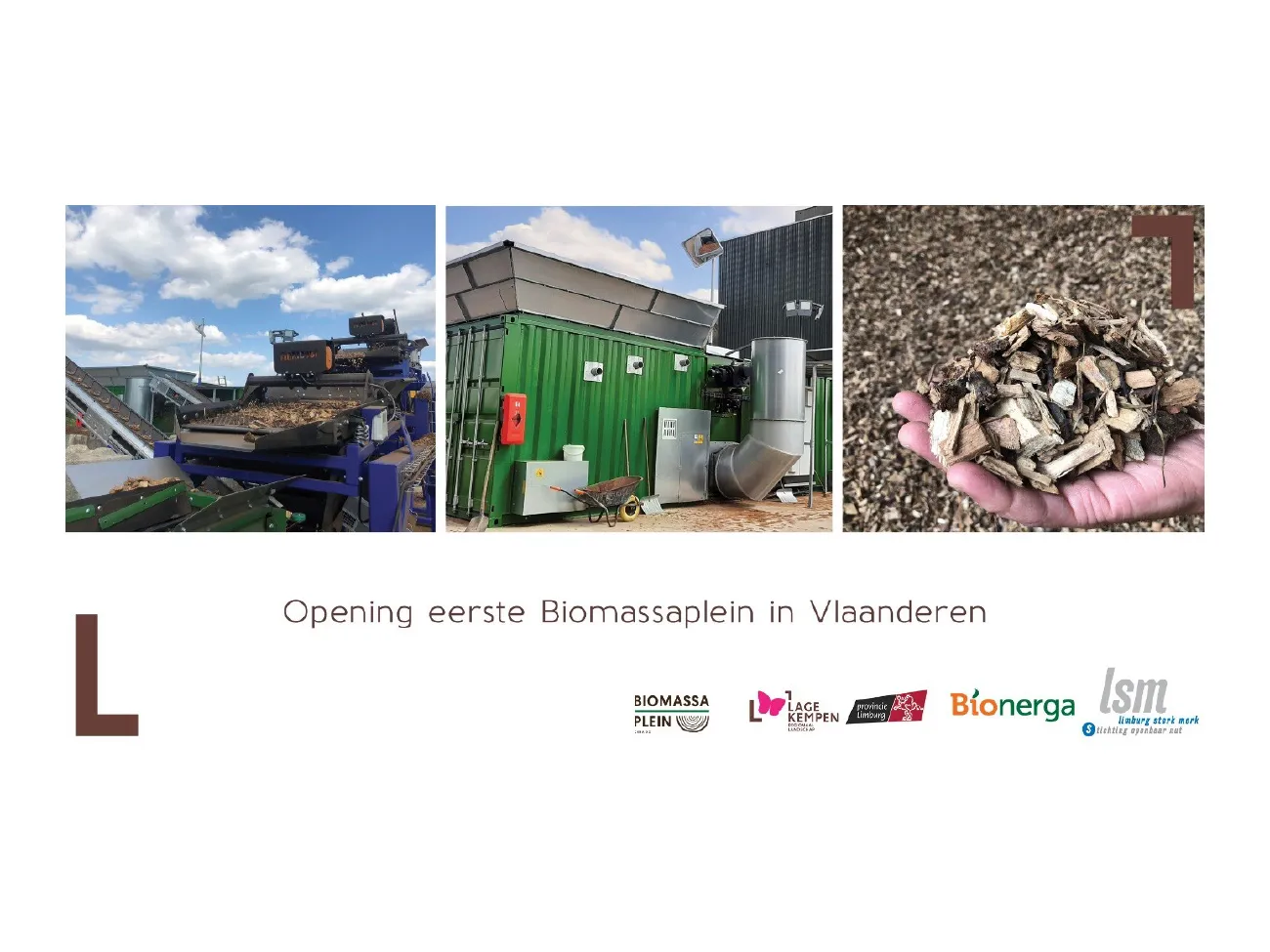
The Biomassaplein in Houthalen-Helchteren receives the woody residue from this management, delivered as woodchips in containers.
The Biomassaplein has a large heating system that is fuelled by the ‘unusable (for example, oversized) biomass fractions’. The system produces hot water, which can also be used to heat a large building as an alternative to gas or heating oil. Interested parties can visit the site to see the heating system.
At the Biomassaplein, however, the hot water is used to dry the fresh woodchips. Their moisture content is reduced from 50 to 20%. This active drying gives the biomass a considerably higher calorific value than passively dried woodchips.
At the end of the process, a screening plant removes metal residues, very fine fractions and oversized material, leaving high-quality dried woodchips that are marketed as an energy source.
The woody residue is therefore no longer sent abroad or treated as waste, but used as a raw material for heat. The end product is high-quality dried woodchips that can be used in local heating boilers, providing sustainable energy in the form of heat.
Who is interested? Municipal authorities that need to heat a wide range of buildings, including sports halls, swimming pools and cultural centres, as well as, for example, schools.
For them, this means no fossil fuels such as gas or oil and no CO₂ emissions, but a circular economy based on a short supply chain. Biomass from the local area becomes a sustainable energy source for the local area.
Question about this story? Ask your question
Keep following this
Get an email when a new story is published. No account needed.
- SubjectNews







