












Every old mattress deserves a new life
Text Saar BenteinImage Matras Recycling Europe
In 2012, Ruud Kortink and several enthusiastic entrepreneurs founded Matras Recycling Europe. “Old mattresses can be a circular product. There was a need for an efficient way to collect old mattresses and give them a new life,” says Kortink. More than ten years later, the company collects more than a million mattresses and has grown into one of the largest mattress recycling specialists.
Matras Recycling Europe was not born out of legislation, but out of entrepreneurship and a strong first partnership. Kortink: “During a work visit, we saw that Renewi was transporting its mattresses from the Netherlands to Germany to have them recycled there. That was their only solution. I immediately thought, there must be a better way.” Kortink set up a partnership. In its first year, Matras Recycling Europe recycled 120,000 mattresses from Renewi. It was the start of a successful journey.
Extended producer responsibility
According to Kortink, the sector has undergone enormous change over the past ten years. He describes it as a change in mindset. “In the past, when we approached a provincial authority, we were often turned away. Recycling a mattress then cost €1.50 per mattress, while you could have it collected with bulky waste for €1. Today, the market has changed. This is down not only to legislation, but also to citizens who expect their mattress to be recycled properly and not harm the environment,” he explains. According to Kortink, one piece of legislation that has had a significant impact on collection rates is the selective collection of mattresses, introduced in 2014 under the National Waste Management Plan. “Municipalities had to collect mattresses separately, but had difficulty finding a destination for them at incinerators. A mattress is high-calorific waste and therefore a very unsuitable product for an incinerator,” Kortink explains.
From 20 to 28 materials
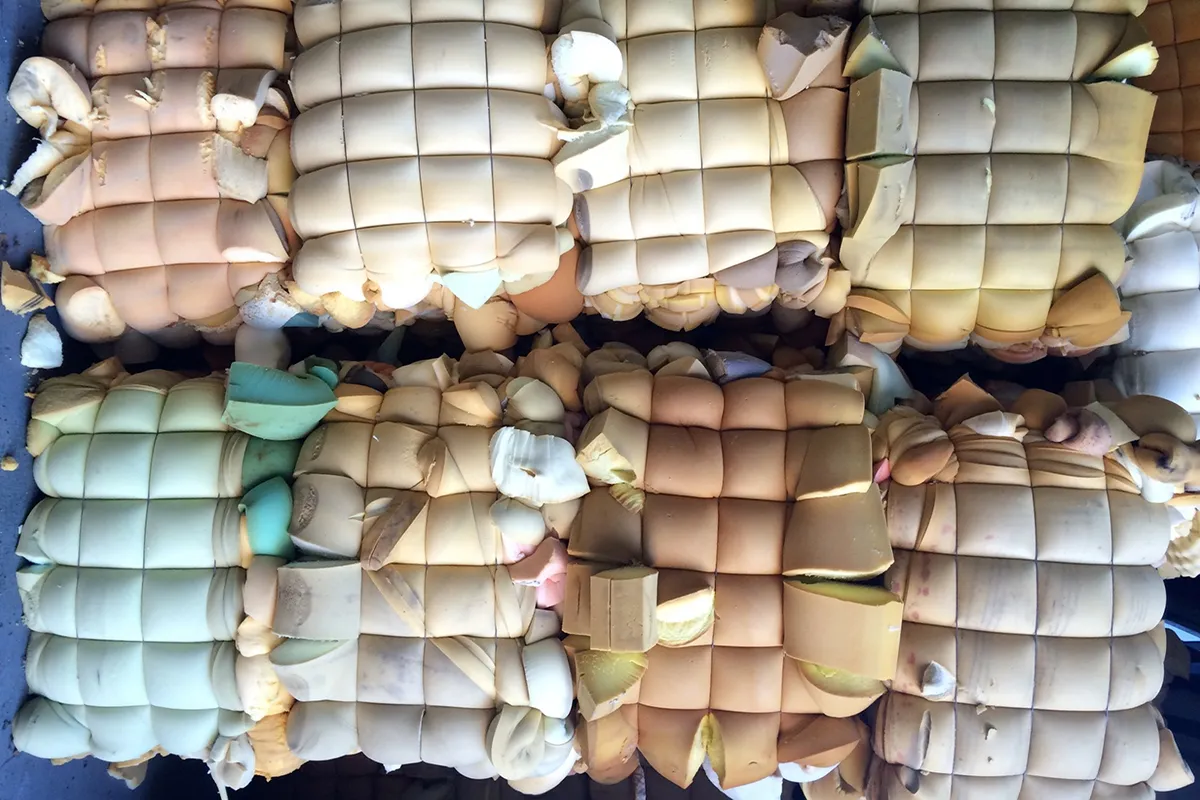
Today, Matras Recycling Europe recovers 20 different materials from mattresses, with the aim of increasing this number to 28 in the short term. “The more materials you can separate from one another, the purer the recycling process. This means that recycled waste materials can be put to better use in production,” says Kortink. This is important if the materials loop is to be effectively closed, one of Matras Recycling Europe’s ambitions. The company therefore actively seeks partners who can reuse recycled materials such as foam, textiles and steel.

New applications for rebonded foam
Separating more materials and putting recycled materials to use in other applications are important developments that are under way now and will continue to grow in the future. “You can’t keep putting all rebonded foam into insulation and damping materials. Other applications are also being tested today, such as using it in the furniture industry or as an intermediate layer in mattresses.” The mattress industry is working hard to find recyclable materials and new solutions. For example, Auping has made a mattress from recyclable polyester and steel, while other players are using thermoplastics. “There are many circular projects in the pipeline. Collaboration between all partners in the chain is central to this, and we want to play an active and crucial role.”
On track for 75% by 2028
Since its foundation in 2012, Matras Recycling Europe has achieved annual growth of around 20%. Its ambitions for the coming years are considerable. “Today, the percentage of mattresses recycled in the Netherlands is 50%. We want to reach a collection rate of 75% by 2028,” says Kortink. The company also wants to expand its system across Europe, for example to the United Kingdom and Germany. “The systems there are not yet up to standard. That’s a shame, because a mattress is a valuable source of raw materials. We manage to recycle 95% of a mattress. That is why every old mattress deserves a new life,” Kortink concludes.
Question about this story? Ask your question
Keep following this
Get an email when a new story is published. No account needed.
- SubjectNews







