NL | Digitalisation is no longer a vision of the future
Terms such as digitalisation and Waste Management 4.0 are no longer visions of the future. What was presented as the future at the previous IFAT in 2018 has already become reality at the world’s leading trade fair for water, wastewater, waste and raw materials management. Whether in logistics, customer communication or the production process, current developments show that an increasing range of digital technologies is available to optimise material flows and transform waste management into an efficient circular economy.
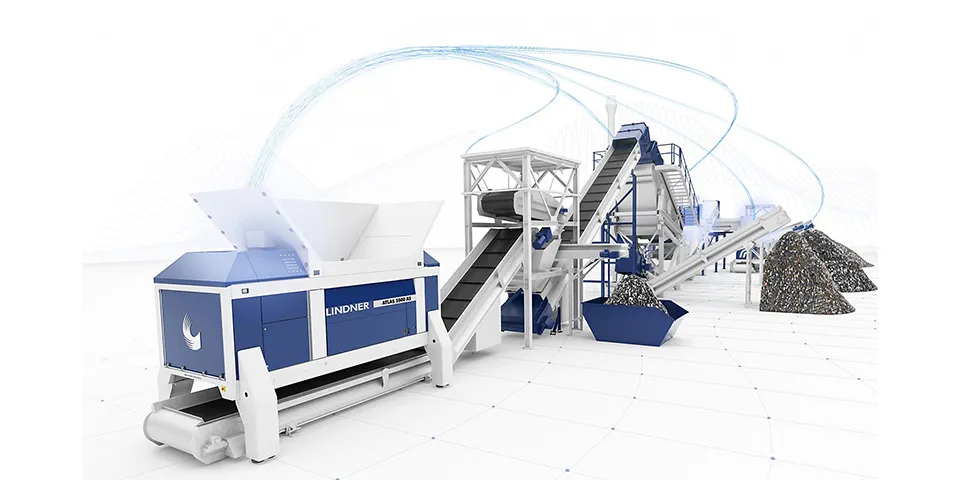
As a specialist in shredding technology and waste processing, Austrian company Lindner Recyclingtech therefore relies on intelligent system solutions for processing waste into valuable materials and producing high-quality alternative fuels.
Stefan Scheiflinger-Ehrenwerth, Head of Product Management at Lindner: “We have always been one of the pioneers in the recycling industry, which is why the mechanical components of our machines and systems are already highly developed. Digitalisation and the use of smart technology are now the next stage in this evolution. The theme of “Industry 4.0” has brought about an industrial revolution that will also significantly change the waste industry in the future. Our customers work with valuable raw materials. These must be processed into new products of the highest quality with maximum productivity, whether the result is the ideal fuel for energy-efficient power generation or the raw material for high-quality products made from recycled material.”
Building on this principle, at IFAT 2020 in Munich, Lindner will present the latest generation of its highly efficient Atlas pre-shredder, alongside intelligent system solutions that use digital technology to turn a waste processing plant made up of different system components into a smart factory.
Pre-shredding, or rather the optimal preparation of the delivered waste for the next step in the recycling process, is essential,” explains Scheiflinger-Ehrenwerth, continuing: “When it comes to secondary shredding, sorting, identification using NIR technology or online quality assurance, the right system dosing or distribution also plays an essential role, alongside the optimal particle size.
To achieve this, it is essential that the individual machines communicate with one another. By combining and intelligently using this data, you can easily get the most out of material flows. But more on that at the Lindner stand at IFAT.”
Question about this story? Ask your question
Keep following this
Get an email when a new story is published. No account needed.
- SubjectEvents