












CSRD reporting: leading by example
Text Valérie CouplezImage Vanheede

Vanheede first signed the West Flanders Environmental Charter in 2005. The company, headquartered in Geluwe, had already voluntarily committed to making sustainability one of the key priorities in its operations. The introduction of CSRD reporting is taking this a step further. “We have developed a framework that enables us to report the precise impact to each of our 16,000 customers. And 86% of that is based on operational data,” says a proud Kim Delvoye, marketing and communications manager.

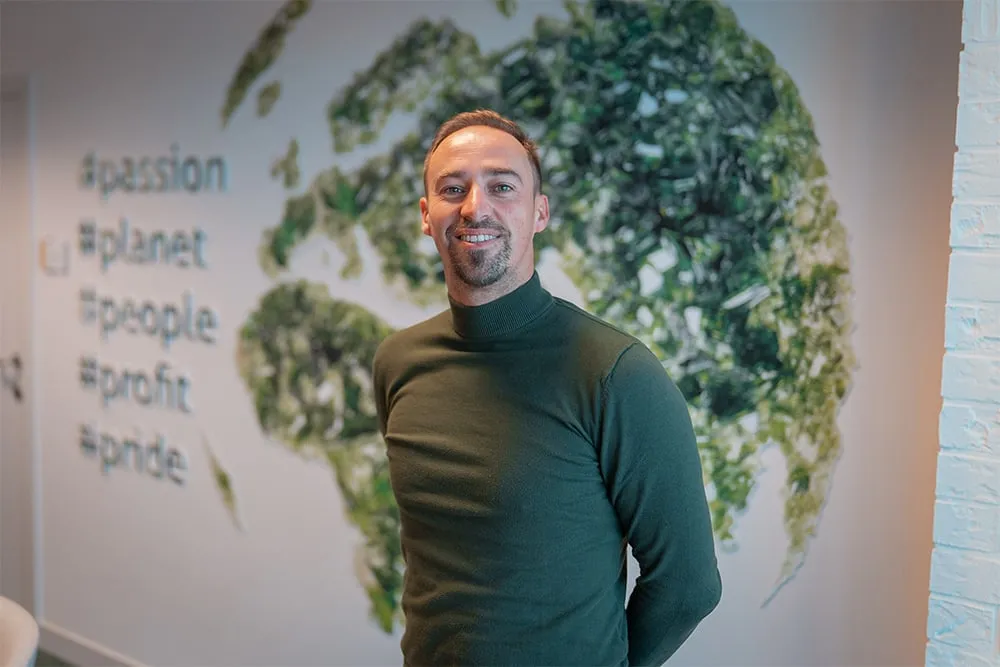
Vanheede’s latest annual report showcases the tool it has developed to calculate its environmental impact. It took more than three years to get the project off the ground. “Raising awareness was key,” says Delvoye. “It was about bringing everyone on board with the vision and the goal we are working towards.” Vanheede translates its environmental commitment into not three, but five Ps: passion, planet, people, profit and pride. “In that order, too,” Delvoye explains. “By pursuing our recycling business with passion, we take the planet and people into account. But only if the figures add up at the end of the day do we have the capacity to invest and innovate again. Pride is the sum of all this, enabling us to carry on with passion.”
A solid foundation in place
This also provided the motivation to lay a solid foundation for CSRD reporting, even though Vanheede will only be required to report under the directive from 2026. “This legislation requires you to be transparent about the impact your company and its activities have. In recent years, using our own operational data (86%, supplemented by 14% monetary data), we have calculated the precise impact of every step in our own chain, from collection to processing. The next step is to translate that data for each of our customers. It is an especially valuable tool for them, but also for us, as it helps identify where we can still improve our own performance,” Delvoye continues. For now, the calculations do not yet go down to the finest detail. “We cannot yet say exactly how much CO2 was emitted to collect one specific container. But that is the direction we want to take this framework in.”
Figures for every dimension
It has been a mammoth task, and one Vanheede is proud of. “As a waste management company, you naturally already have a lot of data. That can be an advantage, but also a pitfall if you try to tackle everything at once. Our company does not have a simple structure. There are the legal entities, business units, sites and 53 waste stream families. But we have managed to produce figures for every dimension.” It was far from straightforward. Delvoye is also keen to share the lessons learned. “This is really a story about everyone at Vanheede. To make it happen, we gathered data from every part of the company, supplied in a standard format. We then brought it together in a single source of truth and visualised it in a dashboard developed in-house. You also have to make the data accessible, so that everyone can see its value and make use of it.”
CSRD as a godsend
In time, this should result in lower CO2 emissions of its own. “Ultimately, we want to avoid three tonnes of emissions for every tonne we emit. We see CSRD reporting as a godsend, providing guidance on what to measure and how to report it. If you are serious about going green, your efforts must not, for example, drive up your energy intensity. Otherwise, you are simply swapping one type of emission for another. We monitor that balance closely. For these reasons, we also list investments in a separate category. Constructing a new building generates tonnes of CO2 emissions, but it can be an important step towards greater sustainability, because it can enable us to work better, more safely or more efficiently in the future. We include everything in our carbon accounting, of course, but when setting our own targets, we look purely at operational activities.”
Question about this story? Ask your question
Keep following this
Get an email when a new story is published. No account needed.
- SubjectNews







