












A second life for electric vehicle batteries
Car manufacturers are already doing a great deal to reuse batteries
The number of electric cars on Dutch roads doubled over the past year, and growth is continuing at pace. Manufacturers expect to sell at least 65 thousand new electric cars in 2020, taking market share towards 15 per cent. That increase also means a sharp rise in the number of end-of-life traction batteries. But there are good solutions.
Under the Battery Management Decree (Bbb), car manufacturers and importers are required to take back both starter batteries and traction batteries from hybrid and electric cars after use. By participating in the collective scheme, for which they pay a management contribution, they transfer responsibility for implementing this requirement to Auto Recycling Nederland (ARN), a partnership between BOVAG, RAI Vereniging, Stiba and FOCWA.
In practice, ARN arranges the collection and processing of end-of-life traction batteries with a negative residual value. These are typically Li-ion batteries.
ARN says that 90 per cent of the traction batteries it processed in 2018 were reused. They begin a second life, for example, as lighting columns for a runway, or in pleasure boats, allowing them to sail with zero emissions. They are also already being used as buffers to store energy from solar panels in residential areas.
Storage systems
For example, ARN supplies traction batteries to Peter Ursem car dealership. Staff first check whether the cells still carry a voltage, so that the traction batteries can be dismantled safely. The batteries cannot be returned to the automotive industry, as they have been rejected for use there. There are, however, many opportunities for reuse elsewhere. One notable application is storing solar energy. Reusing traction batteries is also a good solution for power supplies in remote areas. Arnhem-based Time Shift energy storage is another ARN partner that processes end-of-life batteries. The company develops energy storage systems using the old batteries, which are supplied to energy companies.
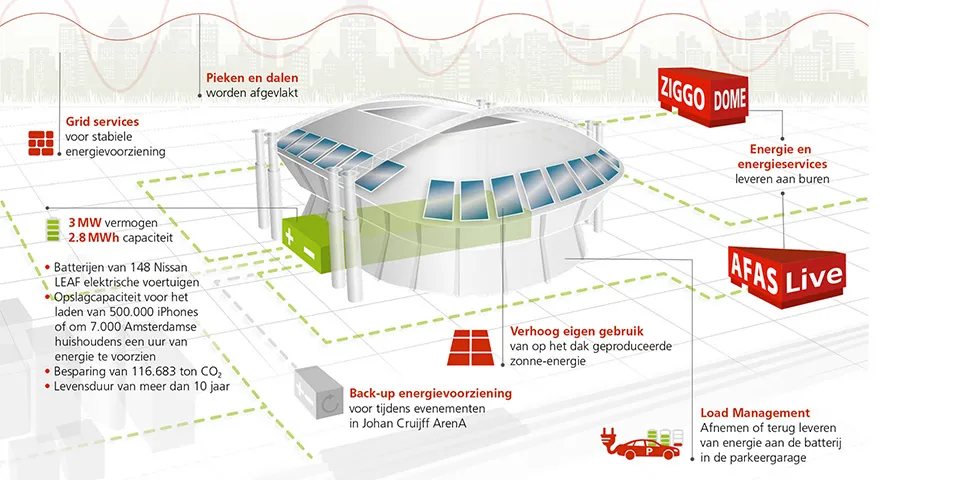
This has led to some great examples of reuse. Old Nissan Leaf batteries, for instance, are used in the basement of the Johan Cruijff Arena to store energy from the 4,200 solar panels on the Arena’s roof. A notable feature of this project is that all the energy from the solar panels is distributed to the batteries using direct current.
Another initiative is a sustainable residential area where 33 family homes, completed in summer 2019, produce more energy than they use. Net energy consumption is zero, thanks to excellent insulation and smart storage of heat and cold in the floors. Energy from the integrated solar panels on the roof is stored in household batteries, which together form a large energy buffer. The surplus is shared among residents. And 9,000 solar panels have been installed on the roof of Nissan’s European distribution centre, alongside old batteries used as an energy buffer.
Another example: ARN is running a pilot on Pampus island in which used car batteries play a key role in the island’s energy supply. The batteries store solar and wind power for later use. This gives the batteries a worthwhile and sustainable second life. When a battery pack is truly ‘empty’, it can be recycled. ARN says it can reuse more than 50 per cent of the materials in a traction battery.
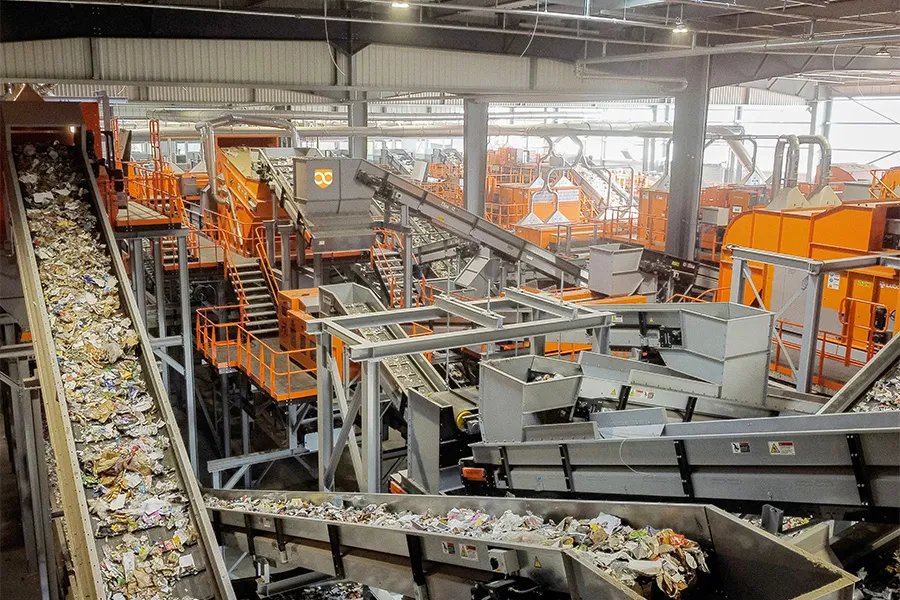
Battery Repair Centre at Peter Ursem car dealership.
Power banks
Despite ARN’s pioneering role, car manufacturers are also doing their bit to give batteries a second life. Hyundai is working with Finland’s Wärtsilä to reuse batteries, while Volkswagen has unveiled ‘power banks’ for electric cars. These are a precursor to flexible charging stations incorporating used car batteries. The advantage of such a ‘power bank’ is that it can be installed in places where electric cars cannot normally be charged, for example at festivals or events in remote locations. The power banks can be charged from the grid, as well as using solar and wind power.
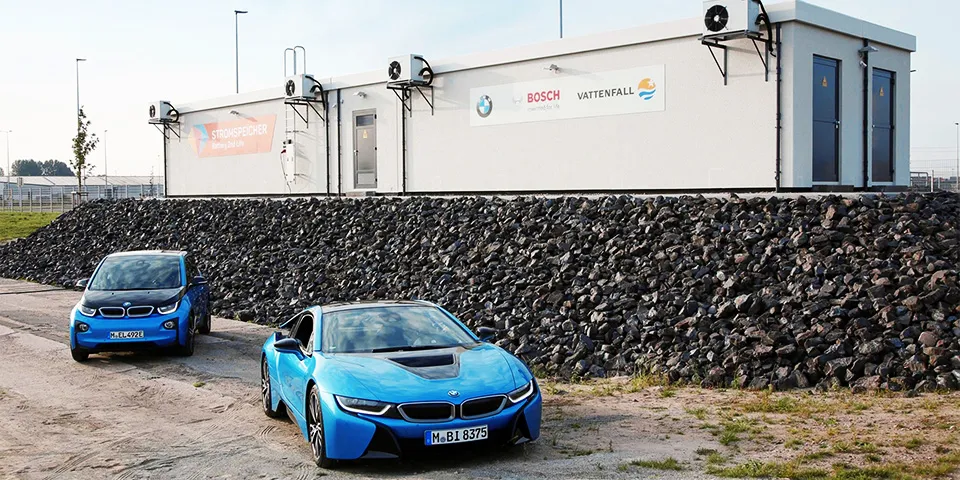
BMW has teamed up with Vattenfall and Bosch to build a facility near Hamburg using 2,600 battery modules from more than 100 electric vehicles. It has an output of two megawatts (MW) and a storage capacity of 2,800 kilowatt-hours (kWh). Vattenfall uses the stored energy to keep the grid’s 50 Hz frequency stable.
Question about this story? Ask your question
Keep following this
Get an email when a new story is published. No account needed.
- ThemeCircular processing of electronics and batteries
- SubjectNews







