Where can the residue from shredders go?
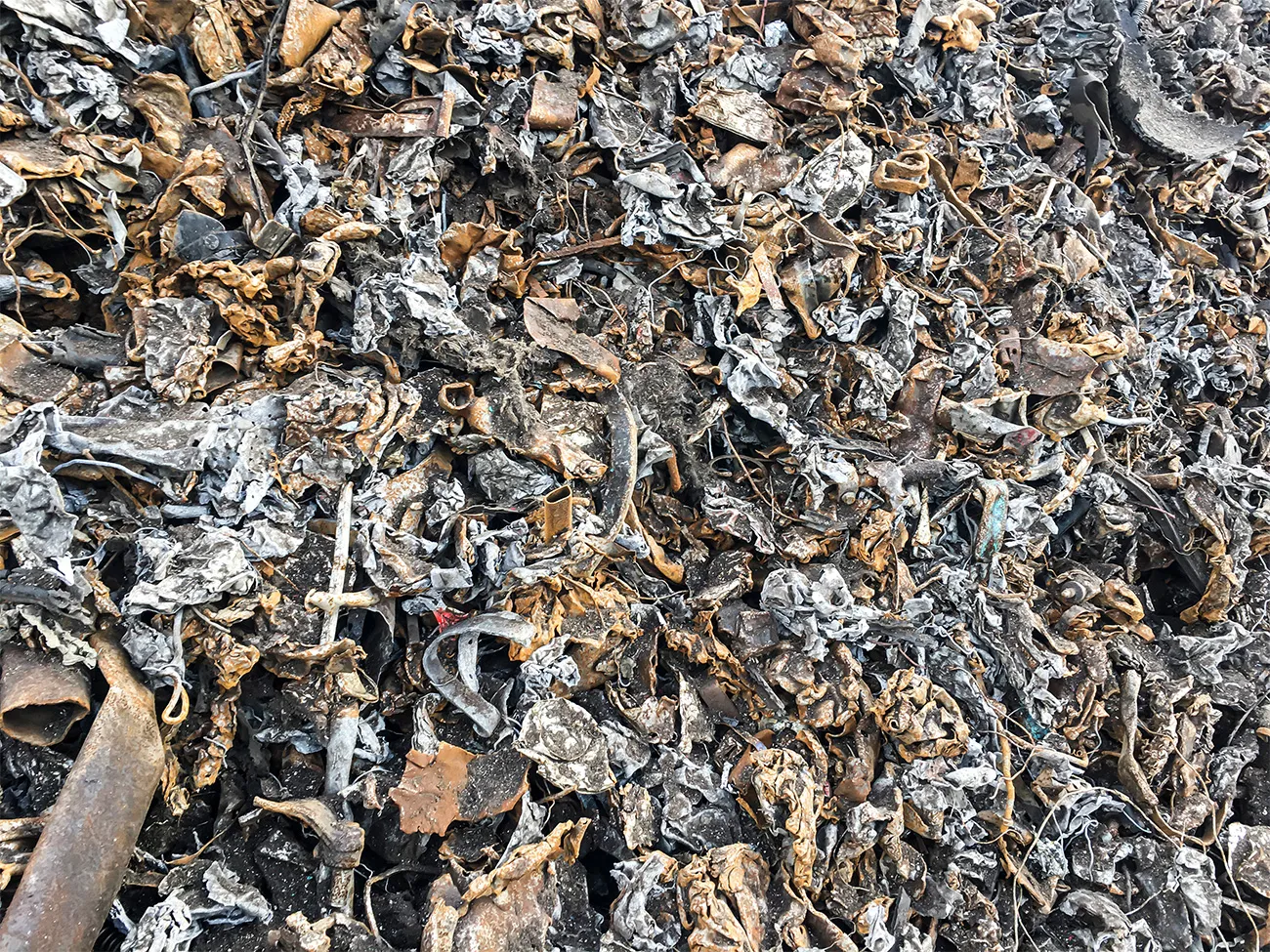
Material left behind in a shredder does not simply go to an incinerator or landfill. Flemish companies using Post-Shredder Technology (PST) are among Europe’s leaders in terms of technical capability. Even so, there are limits to what can be recovered today. This is clear from a study by Denuo and Deloitte. The call is therefore to freeze the reduction in levies due in January and avoid putting further pressure on this market, particularly as the impact of energy prices is also being felt heavily.
In 2021, Denuo and Deloitte updated the findings of their earlier study on PST, conducted in 2019. The study covered two areas. First, it provided an overview of the market, looking at the Flemish companies active in this field, the installations they operate and how these compare with those in neighbouring countries. Second, it examined which materials remain and how the markets for these streams are evolving.
The Flemish PST landscape
The Belgian PST market processes around 500,000 tonnes a year. Although these are not standardised processes and each installation applies its own know-how, they do have one thing in common: technically, Flemish installations are on a par with their foreign competitors. They are state of the art, or at least equivalent to facilities in the Netherlands, France and Germany. We are also seeing increasing use of artificial intelligence in mechanical processes to identify and recover materials as effectively as possible. For now, however, no major technological advances are expected. The biggest gains in recyclable materials have already been made. Recovering those last few percentage points requires enormous economic effort.
Sand fraction: few outlets
This is where the problem lies, as the second part of the study shows. PST produces five major material streams: iron, other recyclable materials such as plastics, a sand-like fraction, a calorific fraction and a final residual fraction. Finding viable outlets, particularly for the last three streams, is no easy task. In principle, the sand-like fraction could be cleaned for use in the construction sector, a market where it faces fierce competition from construction and demolition waste, among other materials. Moreover, the construction sector remains reluctant to use recycled sands because legislation is lagging behind. For example, recycled materials cannot be awarded a BENOR certificate. These sands are not recycled in the Netherlands or Germany either. In Wallonia, by contrast, they find a market in road construction, because different methods apply there.
Calorific fraction: incineration better than landfill
The calorific fraction can only be sent to a licensed incinerator. In practice, the only such facility in Flanders is operated by Indaver. In the past, however, companies could also explore options abroad. Flemish levies still applied, and they only had to pay the difference in levies. If processing cost €50 in Flanders and €30 in Wallonia, for example, they would only have to pay an additional €20 in Flemish levies. The new Programme Decree now abolishes this arrangement. In the same example, a company now pays €50 to Flanders and still has to pay €30 to Wallonia. It therefore has to pay twice. In the Netherlands, the situation is similar. Due to a lack of interest from incinerators, most of it ends up in landfill in practice. There is capacity for incineration in Germany. Finally, the options for the ultimate residual fraction are limited, both in Belgium and in neighbouring countries.
Conclusions
The reduction in the discount on levies is normally due to take effect in January 2023, falling from 40% to 30%. This is a significant blow to a market already under pressure from energy prices, wage indexation and falling metal prices on the world market. In this case, withdrawing part of the discount would not improve the recycling rate. The scope for further technological progress with these fractions is limited. It would be a shame if this led to the loss of the well-developed PST market in Flanders. It would also be worthwhile to encourage new applications, for example by updating BENOR standards, raising awareness in the construction sector about the use of recycled sand, and setting a good example as a government in public procurement.
Question about this story? Ask your question
Keep following this
Get an email when a new story is published. No account needed.
- ThemeSmarter use of machinery and plant
- SubjectShredders