












What is needed to recycle more plastics, and more effectively?
Demand for recycled plastics is increasing. This trend is no longer driven solely by high oil prices, but also by a growing number of manufacturers committed to sustainability and to using recycled materials in their production processes. Legislation is encouraging them to do so, as is the recognition that it can enhance their green credentials, which matters to consumers who are also paying greater attention to environmental concerns.
The waste and recycling sector faces a new challenge: securing enough high-quality waste material for recycling to meet rising demand for recyclate. We produce more than enough waste collectively, but it is not always collected, or it may be unsuitable for recycling and reuse.
Investment and ecodesign
Several changes are needed to keep meeting the growing demand for recycled plastics. Recycling companies, for example, can invest in even more efficient sorting and recycling technologies, enabling them to recycle more of the incoming plastics, and to do so more effectively.
More important, however, is the consistent application of ecodesign guidelines and principles. Ecodesign is essential to increasing recycling rates and improving the quality of recycled materials. Manufacturers should therefore be further encouraged to adapt their product designs so that their products are easier to recycle at end of life.
Progress with industrial packaging films
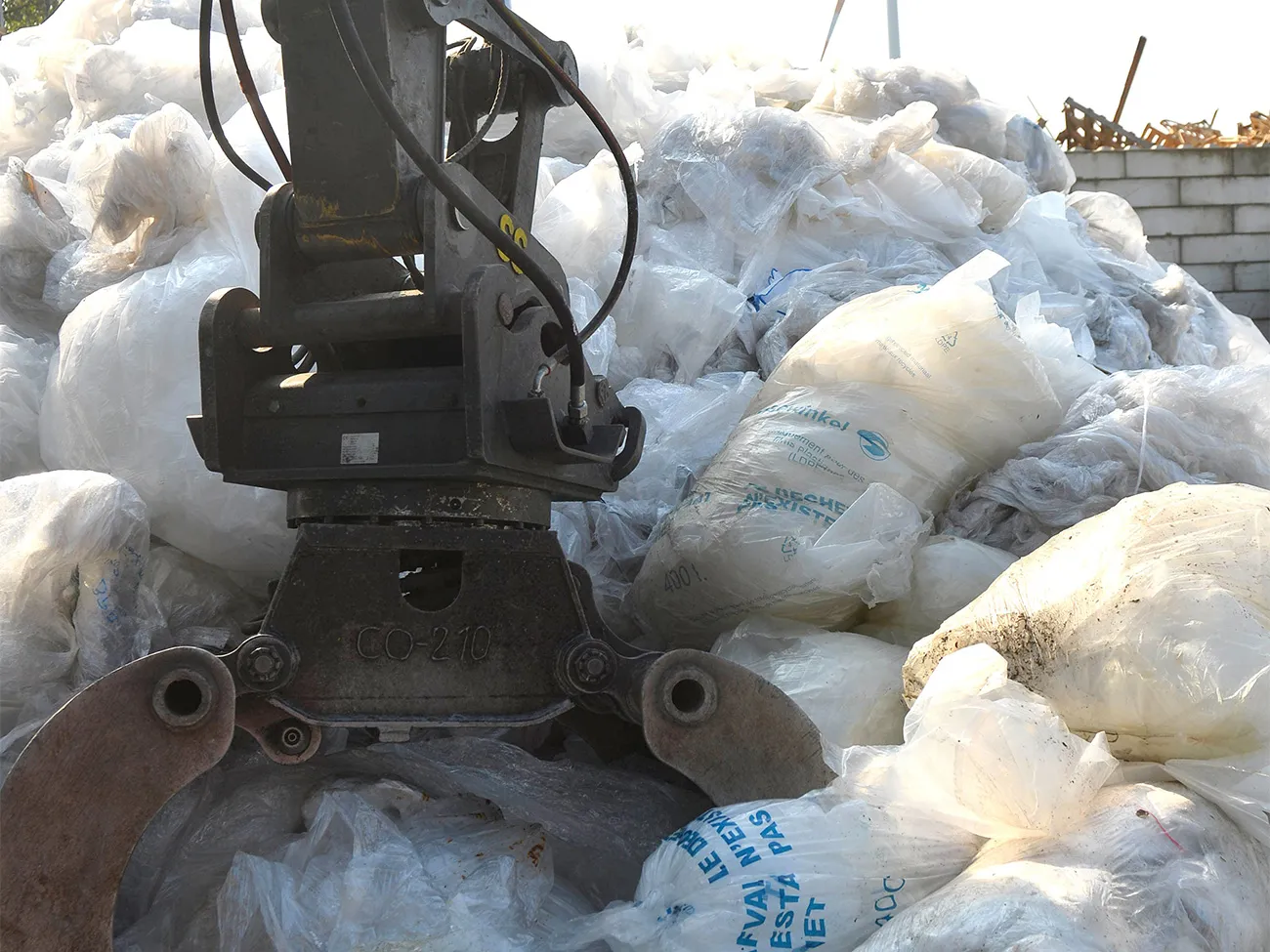
Plastics are marketed in a wide range of forms and for many applications. One of the most widespread is industrial packaging film. According to figures from Valipac, it accounts for almost 70% of all industrial packaging. To put this into perspective, around 70,000 to 80,000 tonnes of industrial packaging film enter the Belgian market each year.
However, 80% of all films are currently coloured, printed or both. This is good for marketing, but bad news for recycling. Adding colour or print means the films come out grey after recycling, severely limiting their potential uses. These ‘grey’ granules cannot be used again in the same original application. The packaging sector requires transparent films only.
A key ecodesign rule of thumb is to standardise material use as much as possible for a given application. Ideally, just one type of plastic is used, such as low-density polyethylene (LDPE) for packaging films. The use of another polymer, such as polypropylene, in the same application should be avoided as far as possible because the materials are difficult to separate afterwards. This creates a mixed, lower-grade waste stream.
The material thickness must also be taken into account. Manufacturers often make thinner films nowadays to save on material, for both economic and environmental reasons. But this is not always beneficial for recycling. A film must have a minimum thickness of 30 µm to be
recyclable.
The construction sector needs more ecodesign
The construction sector is also a major user of plastics and, consequently, a significant source of plastic waste. Here, too, there is plenty of scope for improvement through the consistent application of ecodesign principles.
For example, to meet higher insulation standards, polyurethane (PUR) or other insulating materials are often injected into slats for roller shutters and other construction materials, or wood is used as a filler. This brings together different materials that cannot be separated later, making them impossible to
recycle.
Another example is PVC window profiles. A short glass fibre is often added to the PVC compound in these profiles to make them stronger. This addition prevents the profiles from being recycled to a high standard, as the glass fibre cannot be removed during the recycling process. The short fibre also causes wear to recycling machinery. Using a long glass fibre would solve the problem, as it can be removed.
Product design must now include a circularity test
In short, ecodesign is a sine qua non if we are to achieve a circular economy. A circularity test should be a basic step in designing every plastic application and, more broadly, every type of product. At some point, a product will no longer be reusable, and it is important to have taken every possible step from the outset to ensure it can be easily dismantled and recycled at end of life, allowing valuable materials to be recovered and used to make new products.
Question about this story? Ask your question
Keep following this
Get an email when a new story is published. No account needed.
- ThemeMaking plastics and packaging circular
- SubjectDenuo







