












The road to clean, energy-efficient logistics
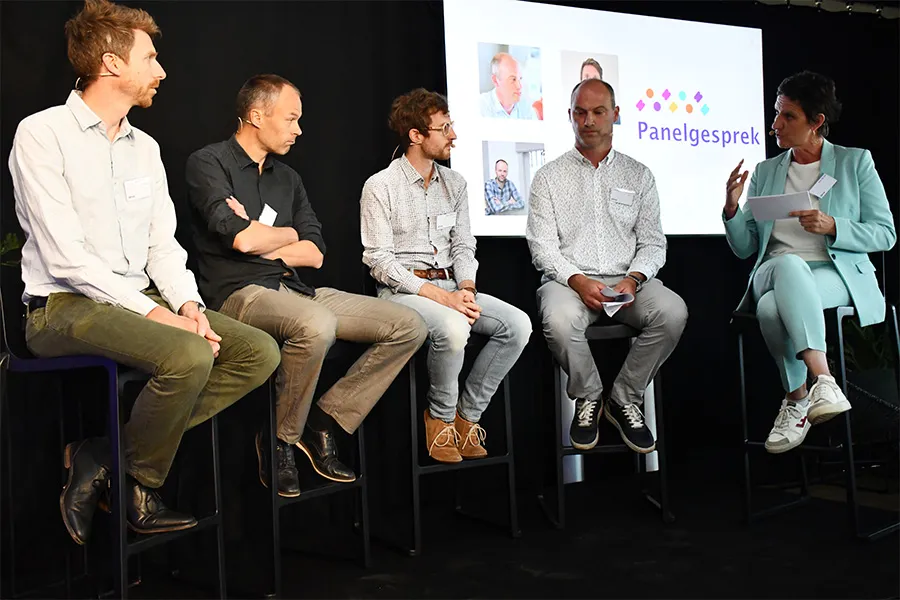
A second source of emissions attributable to the waste and recycling sector can be traced back to logistics. During a second panel discussion, various experts shared their views on the next steps waste and recycling companies can take. They included Alexander Desplentere (co-managing director, MOL CY), Merlijn Erbuer (business development manager, Virhya energy), Jean Mansuy (mobility expert, Canopea) and Steve Sel (regional manager, VIL). Here are the main conclusions.
To illustrate the need for more sustainable logistics, the CO2 impact of the transport sector in Wallonia was used as an example. The sector is responsible for 22% of CO2 emissions in the south of our country. Does that mean we should all immediately switch to electric or hydrogen vehicles? According to Mansuy, there are other levers we can use to make a difference. “For example, by avoiding empty miles. This can be done by bringing sorting and recycling closer together, or by optimising collection methods. We can then consider a different collection frequency that delivers the necessary environmental and economic benefits, or combine more waste streams in a single collection.” Mansuy also sees scope for greater collaboration between companies to take more vehicles off the road. “These are the first steps. After that, we can look at multimodality, which waste and recycling companies are already investing heavily in, and at other fuels. Not just for lorries, but also for the ships that transport waste by water.”
Avoiding miles
In other words, there is no single magic solution, but there are several ways in which waste and recycling companies can reduce the carbon footprint of their logistics operations. “Transport is all about the cost per tonne. That makes it harder to make the business case for shifting sorted fractions of post-consumer waste to water transport,” says Sel. “The best approach remains avoiding transport altogether. That is why tenders and procurement processes should take more factors into account than just cost, so that waste does not have to travel unnecessarily long distances to the processor.” VIL also advocates separating transport from processing. “The number of trips they can make depends on how long they spend in traffic. In other words, mobility is a decisive factor. Transport by water would require more buffering, which would also allow you to spread operations across the site and optimise processing. So look at the whole picture. And the business case can change. What was unaffordable yesterday may be worth considering today because of increased congestion
on the roads.”
Zero-emission electric waste collection vehicles
Yet waste companies today seem to be focusing primarily on alternative powertrains. The technology is already available. “The Netherlands is clearly leading the way in zero-emission waste collection vehicles. They already account for a third of sales there,” says Desplentere. He also sees more movement in Belgium now. “They are a realistic alternative. Battery capacity remains the biggest cost. For waste collection, energy consumption is estimated at 1.5 kW per hour. With current technology, 250 km per day is perfectly achievable and sufficient to meet requirements.” However, it is not all plain sailing. The problem lies with charging infrastructure. “In the best-case scenario, it is available, but under the current energy tariff structure it is prohibitively expensive to charge all the electric vehicles at the same time in the evening. Their quiet operation would make night-time transport possible, but you would need to find staff willing to do it. And that is an even bigger bottleneck.” What about hydrogen? “There are two operating in Antwerp and one in Brussels to test feasibility. The technology is ready. We can get started.”
Hydrogen is on its way
Engine technology is therefore ready for the switch to hydrogen, particularly for transporting larger volumes, where current battery capacities may still fall short. For now, the lack of infrastructure seems to be the biggest obstacle to wider rollout. But a lot of work is going on behind the scenes. Erbuer says: “At present, we are indeed not yet ready to deliver hydrogen to end users. We are currently building facilities in Zeebrugge and Terneuzen to produce green hydrogen, which should be operational within two years. We are building the electrolysers, but of course we need our colleagues at Fluxys to build the pipeline network so that hydrogen can be transported in an environmentally and economically sustainable way. Until that is in place, we can supply filling stations by lorry.” Erbuer is nevertheless convinced that electric vehicles offer everyone in the sector an easy first step towards zero emissions. “But of course, it goes further than that: the entire fleet and charging infrastructure need to be considered. So it will be a case of both-and, with complementary powertrains.”
Question about this story? Ask your question
Keep following this
Get an email when a new story is published. No account needed.
- SubjectDenuo







