












Lithium-ion batteries in waste streams: fire risks, insurance and solutions for the recycling sector
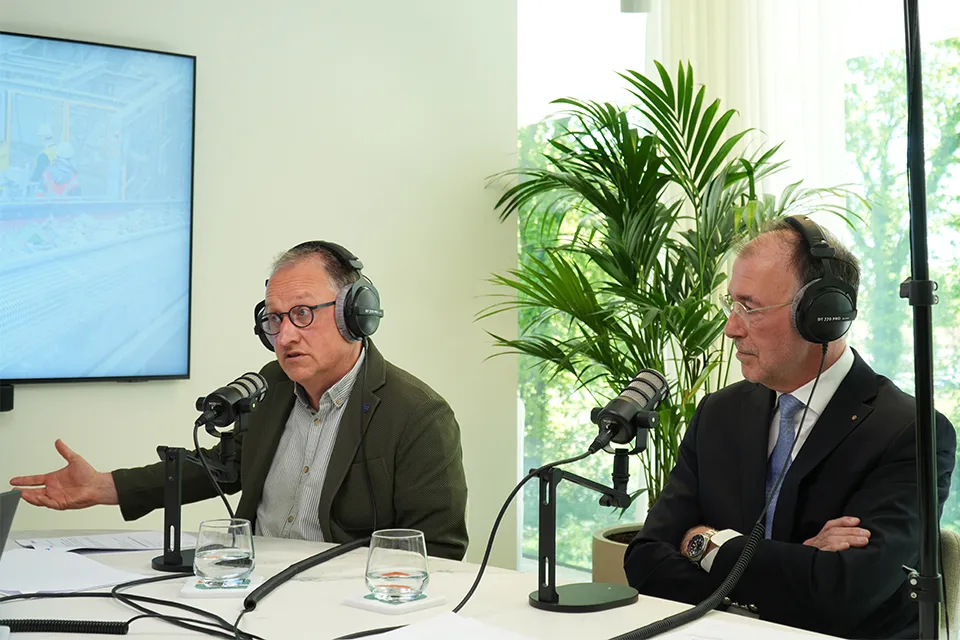
Host: Nele Roobrouck, Guests: Wim Pype & Paul Casier Lithium-ion batteries are causing an increasing number of fires in the waste and recycling sector. In this episode of Trash Talks, Wim Pype (Renewi), Paul Casier (Group Casier) and moderator Nele Roobrouck discuss the impact of battery fires on safety, insurability and business continuity. From incorrect collection and product design to prevention, regulation and the circular economy, this podcast offers an in-depth look at a growing problem in the recycling and waste sector.
Host: Nele Roobrouck, Guests: Wim Pype & Paul Casier
Lithium-ion batteries are causing an increasing number of fires in the waste and recycling sector. In this episode of Trash Talks, Wim Pype (Renewi), Paul Casier (Group Casier) and moderator Nele Roobrouck discuss the impact of battery fires on safety, insurability and business continuity. From incorrect collection and product design to prevention, regulation and the circular economy, this podcast offers an in-depth look at a growing problem in the recycling and waste sector.
Full transcript
All chapters (20)
- Introducing the topic of battery fires
- Group Casier and risk management
- Renewi and e-waste processing
- How often battery fires occur in the sector
- Lack of Belgian data
- From incident to structural problem
- Why lithium-ion batteries are dangerous
- Mechanical damage to batteries
- Insuring against battery fires
- Raising awareness among consumers and producers
- Legal responsibility and evidential challenges
- Possible solutions and producer responsibility
- The impact of a fire on a waste processing company
- How is a fire damage claim handled?
- Prevention, detection and training
- What message would you like to give the authorities?
- Key figures on battery fires
- Cooperation within the sector
- Closing message to consumers
- End of the episode
Introducing the topic of battery fires
Nele Roobrouck Welcome to Trash Talks, the podcast where we discuss current issues in the waste and recycling sector. Today we are looking at a very topical subject that is increasingly going up in flames, quite literally: lithium-ion batteries ending up in our waste streams. The impact is significant, both in terms of safety, for example for workers, and on business operations, with sorting lines being taken out of service. But it also affects insurability. How will I still be able to insure my business? And what is the financial impact of all this? The key question today is: is this a problem for the sector, or a systemic failure in the chain? I am delighted to discuss this with two experts: Wim Pype, International Sales Manager at Renewi E-Waste, and Paul Casier, CEO of Group Casier. Welcome to you both.
Paul Casier Good morning.
Nele Roobrouck Thank you for having us.
Wim Pype Thank you for inviting us here.
Nele Roobrouck But first, before we delve into the issue of fires, I would really like to hear what exactly your company does. Paul?
Group Casier and risk management
Paul Casier We started out as insurance brokers. To be completely honest, we come from a flax-trading family. Our great-grandfather was a flax trader, but we won't go into that story. We are still insurance brokers. Together with our business clients, we draw up an inventory of what needs to be insured. We advise them on feasibility, cover and excesses, and on setting clear, carefully considered expectations to present to insurers in order to find a suitable one. And when we do, we expect that insurer to meet its obligations properly. We guide and monitor the process, and, if at all possible, apply plenty of pressure to ensure the insurer is competitive as well. We serve clients throughout the country, and some have branches abroad, sometimes several, which we also support. We do this together with our network partners, giving us a presence in 120 countries. Since 2006, now 20 years, we have also been active in risk management. You might ask what that actually involves. I will briefly highlight three areas. First, we help businesses make a strong commitment to prevention. That will certainly come up today. We also explore alternative forms of risk transfer. Not everything can be solved with insurance, so sometimes other means are needed. And we sometimes advise clients on risks that cannot be insured, such as contract management or climate change.
Read the full transcriptCollapse transcript18 more chapters
Renewi and e-waste processing
Nele Roobrouck Wim, you work at Renewi.
Wim Pype Yes, perhaps I should start by introducing Renewi. Renewi is a pure waste-to-product company. Our aim is to protect our world and environment by giving used and discarded materials a new life. Renewi is active in recycling and waste processing across a range of streams. We refer to these materials as streams. They include both commercial and industrial waste. Our core business is to return materials to the chain as safely and as high-quality as possible. That involves a great deal of mechanical processing and logistics, but unfortunately also an increasing number of fire risks. We also play a connecting role in the circular economy, bringing partners and stakeholders in the sector together to develop new solutions. This helps our partners and clients achieve their sustainability ambitions, with a tangible impact on people and the environment. Renewi is no small player. I can give you a few figures. We operate mainly in Belgium and the Netherlands. We have around 120 sites and 6,000 employees. Our customer base numbers around 150,000. In our previous financial year, which ended on 31 March, we returned 6.4 million tonnes of circular materials to the market. So that is quite a lot. We operate in four countries. I have already mentioned the Netherlands and Belgium, but we also have several sites in France and Portugal. Our company is made up of two main sectors or divisions. Commercial waste is the largest, alongside the Specialities division. E-waste falls under Specialities, and I am commercially active in that area. It processes discarded electrical and electronic equipment. The other two Specialities businesses are Maltha, which recycles glass, and Mineralz & Water, which cleans and processes soil, rock and water. I work in the e-waste sector and am responsible for commercial activities. Our sites are in the Netherlands, Belgium and France. The plastics recovered from e-waste are very important to us. We have set up a separate company for this, where we aim to put the plastics back to use at the highest possible quality. I am also personally very involved with fires and firefighting. I am a fire officer and station commander in the municipality where I live. So, professionally, I deal with battery fires, but at the same time I also try to tackle them.
How often battery fires occur in the sector
Nele Roobrouck This is going to be fascinating, with two professionals at the table. But let us start with the day-to-day reality. We often hear and read in the press about fires at waste processing companies. Wim, can you give us an idea of how often you and your peers, because of course today we are not talking about just one company, have to deal with this kind of fire?
Wim Pype Let me put it into perspective. Battery fires are no longer exceptional. This is no longer a matter of isolated incidents, but a structural safety problem. At some facilities, we are no longer talking about one or two cases a year, but a weekly occurrence. Sometimes they are quickly brought under control and remain small, with a foreman putting them out straight away, but sometimes they are very serious and have a huge impact. Most of these fires do not start because we process batteries, but because batteries end up in the wrong waste stream. You all know the greeting cards with a little button cell inside. Or people put toys in the PMD stream, even though they contain electronics with batteries, or put them in general waste. Batteries do not belong in those streams. A single item, such as a vape, a toy or an electric toothbrush, can be enough to burn down an entire sorting line. There is one example that I have thought about a lot and that affected me personally. It was the major fire at our plant in Wandre, near Liège, in August 2023, some time ago now. We think it was caused by a power bank. It was mechanically damaged, causing an internal short circuit and thermal runaway. Anyone who has dealt with a battery fire will know that term. Within a second, one square metre was on fire. Less than a minute later, the entire bay was ablaze. It was an extremely aggressive fire. To make matters worse, the heat caused the metal roof structure to collapse. The fire was still raging, and spread across all the other bays. It was a real inferno. It was a major wake-up call for us. Looking at the problem across Europe, I have gathered a few figures. In France, the number of fires at waste processing facilities linked to lithium batteries doubled between 2019 and 2023. In Austria, there were 180 to 250 fires a year at waste processing facilities attributed to these batteries. In Germany, listen carefully: up to 30 fire incidents a day in collection vehicles and processing facilities, with lithium batteries confirmed as the cause of 80% of them. In the United Kingdom, more than 1,200 battery-related fires were reported in refuse lorries and waste sites in 2023. That was a 71% increase on 2022. I do not really have any figures for Belgium. I do not think they are very clear either. But they will certainly be in line with those of our neighbouring countries.
Lack of Belgian data
Nele Roobrouck It is true that it is very difficult to find figures for Belgium. We think there are two reasons for this. First, it is difficult for a company to come forward, because of the link with its insurer. But another reason is that the fire service does not keep records, and it seems I have almost come to the right person to talk about that. The authorities do not keep records either. It would be very useful for us, as a sector federation, to have a clearer picture so we can respond more effectively. But let me turn to you, Paul. What are you seeing in practice? Is the number of cases increasing?
Paul Casier Let us not beat about the bush. In most cases, waste is simply fuel. That already gives you one element of the fire triangle. Along with fuel, you only need two more things: oxygen, which is present in all these businesses, and an ignition source. So, much more than when we were scouts and played with matches, recycling companies are now being overwhelmed by ignition sources that are present everywhere, legitimately or otherwise. Many of our clients admit to having fires very regularly, sometimes as often as weekly. And many incidents never reach the authorities or the insurer because companies deal with them proactively, feel some shame about them and do not want to admit it to one another. But from the contacts we have, we know that weekly fires are not unusual for certain businesses.
From incident to structural problem
Nele Roobrouck So, from what I’ve heard, we are almost at a turning point. In the past, say in the 1920s and earlier, this happened now and then. Today, though, we have to say it is no longer an annual occurrence but a daily one. It is also becoming a structural problem. But if we look at the number of fires, Wim, they are difficult to control. And I’m talking about the sheer number of them as well. So we can say that there is a cause: the battery is in a waste stream where it simply does not belong. What can be done to address these causes?
Why lithium-ion batteries are dangerous
Wim Pype Yes, you’re talking about the cause of the fires. Lithium-ion batteries are the main cause of these major fires. Let me explain why they are so dangerous. They are a very good invention, technically impressive. They have a very high energy density. They are compact and powerful, and are designed to deliver energy when the consumer or user needs it. But those properties also make them extremely vulnerable to damage. What makes a lithium-ion battery so insidious is that it is normally safe to use, but once it has been mechanically damaged, you have a huge problem. In the waste and recycling sector, lithium-ion batteries have created a new type of fire risk that is fundamentally different from conventional industrial fires. The cause is not an external ignition source or a faulty installation, but high-energy, self-contained power sources or ignition sources embedded in our incoming waste streams. What happens technically? When the separator between the anode and cathode is damaged, an internal short circuit occurs, triggering a self-sustaining process. The moisture in the air also contributes to this, leading to thermal runaway. This is a self-reinforcing chemical process in which temperatures within the cells can locally rise to somewhere between 600 and 1,000 degrees. When the cell decomposes, the gases released are also flammable. They also generate oxygen-rich decomposition products. So it is the perfect recipe for a fire to develop extremely rapidly. And as Paul already pointed out, everything around the cell is fuel. It starts pyrolysing immediately, creating the perfect cocktail for very large fires. And that short circuit is exactly what can happen during recycling. Lithium-ion battery failure is almost always caused by mechanical stress. In the waste sector, we work with heavy forces. We use wheel loaders to store waste in bunkers. We may use cranes for pre-sorting. Then, whether or not it has been sorted, we tip it into collection bins. It then goes through our line, where it is screened, broken up and reduced in size. All of that is inherent to the process, and it is not wrong. It is standard practice. But these conditions are inherent to waste processing and cause mechanical pressure on the batteries.
Mechanical damage to batteries
Nele Roobrouck We can say that every one of these steps can damage a battery. It does not belong in the waste stream, of course, but it can be damaged when the waste is broken up. Pressing it can create another opportunity for a spark.
Wim Pype Yes, lithium-ion packs are made up of cells, each of which is a small battery in itself. Fires are relatively rare while a battery is in use. Every so often, a battery in a bicycle or something will spontaneously catch fire. This can happen, for example, if it has been left discharged for too long or has not been charged sufficiently, but it is relatively uncommon. The problem really arises when batteries reach the end of their life and come under the kind of mechanical pressure I mentioned, putting the cells under physical stress. The separators start to tear, and then all hell breaks loose.
Insuring against battery fires
Nele Roobrouck Paul, if I can turn to you. How does an insurer deal with a risk that is so hard to predict and manage? A battery arrives at a company in a waste stream, and the risk then lies with that company.
Paul Casier The problem is that it is no longer a risk. It is a certainty. Once the battery is there, it is simply a matter of time. The question is not whether it will catch fire, but when. Insurance depends entirely on uncertainty. If there is no uncertainty, there is no insurance, because damage is certain to occur. An insurer looking at this will ask: why should I collect a premium when I know there will be damage, that I will have to pay for it, and that it will far exceed the premium I have received? So the uncertainty has gone. We are in a situation where we have to consider how a company will deal with the damage when it occurs. Today, that duty and heavy responsibility rest with recycling companies. If you can still get insurance, the insurer will ask: what are you going to do? You know a fire will break out. What will you do to reduce the number of incidents and limit their impact? How will you try to sort the waste so that you can intercept some of the batteries and reduce the frequency of incidents? But once a fire starts, what resources do you have to tackle it? Do you have water? Automatic fire suppression systems? An in-house fire brigade? These are entirely different questions, and they are now specific to this sector. That explains why it is so difficult to tempt insurers. In the past, conventional insurers would say: all right, the risk is uncertain, so I can charge a premium and pay out for any damage. Now it is certain that a fire will break out, and the focus has shifted completely. It is on the responsibility, and the very heavy responsibility, borne by the company’s management. If you think you can still pass the risk on to an insurer without doing anything, I think you are going about it the wrong way. Insurance prices have gone up fourfold, fivefold, sometimes more. And the range of insurance cover available is still shrinking.
Nele Roobrouck So it will not be easy for a waste processing company without fire-prevention measures and targets, and so on, to secure a premium from an insurance company.
Paul Casier Correct.
Raising awareness among consumers and producers
Nele Roobrouck Let me come back to Wim. As we have said, the battery is in a waste stream where it does not belong. Are members of the public and businesses who collect batteries and put them in the wrong place, whether in the PMD bag or among paper and cardboard, sufficiently aware of the impact a wrongly sorted battery can have?
Wim Pype We have to be honest: the mistake is often made at the start of the chain, while the damage occurs at the end. Let me be clear about that. Consumers and businesses are often unaware of the impact and the risks. Batteries are small, integrated into products and quickly disappear into residual waste. Producers design products with batteries, but do not always pay enough attention to what happens at the end of their life. Those products then end up at our facilities, where our staff and infrastructure bear the risk. Our people are genuinely exposed to serious risks. This is not a sustainable situation, especially from a safety point of view. It is not economically viable or socially acceptable either. More than 80% of battery fires start because of incorrect collection or poor product design. That figure may seem high, but it is down to insufficient consideration during product design. So this is a product design problem from the outset. It is not a waste problem. I have also looked up some figures from Bebat. Bebat shows that a collection efficiency of 90% is achievable among consumers. But that only applies to conventional batteries. The real problem is built-in batteries.
Nele Roobrouck We are probably talking about our mobile phones, smartphones?
Wim Pype Yes, batteries that are glued in place. That creates an additional problem. But the main issue is built-in batteries. 80% of all lithium-ion batteries are fixed inside the device. They are difficult to remove. I challenge you all to try and remove a lithium-ion battery with a screwdriver or something. It is difficult.
Paul Casier And not without risk.
Wim Pype And not without risk, yes. Then there are batteries that are glued in place, particularly in mobile phones and smartphones, but also in tablets and earbuds. They are technically very difficult to dismantle. Then there are the large lithium-ion packs, such as those in e-bikes, e-scooters and power tools. More and more drills are fitted with high-capacity batteries. Home batteries are another example. So that is a problem. Finally, there are the invisible batteries. Many toys and gadgets, and e-cigarettes, contain an invisible battery. People think these things just work, but there is a little battery inside. Those are the four main areas where the problem lies.
Legal responsibility and evidential challenges
Nele Roobrouck Wim, I asked you earlier about human action: a battery is sorted somewhere and ends up in the wrong place. But Paul, from a legal and financial perspective, where does the responsibility lie in a case like this?
Paul Casier If we look at battery users, there are currently no, or insufficient, standards to address incorrect sorting or misuse. It is very difficult to tackle. This is also a societal problem. We are taking a number of steps, but it is a long road. We know that from the efforts made so far. What we do see further down the chain is that certain processors will penalise their collectors by refusing a load or issuing a fine if it does not meet reasonable expectations. But progress on that front is still difficult, and the only legal recourse is to argue that the duty of care has been breached. That takes us into the Civil Code. In the absence of penalties, that is what you have to rely on. But tackling or even addressing careless behaviour presents quite a few problems. Too few people are still aware of what batteries can do. We are making good progress with various campaigns, but we need to reach a societal consensus. And once there is a societal consensus, the courts will follow by imposing penalties for antisocial behaviour. The other issue is even more difficult: the problem of proof. Where was a particular battery collected? If you want to point the finger at someone and say, ‘You are responsible’, you will have to gather quite a lot of evidence to do so. We already have solutions such as waste collection lorries fitted with cameras. The areas in which collections take place can be identified. The waste streams are recorded, and the camera footage is retained. I would not say it is a drop in the ocean, but it is certainly a very good step in the right direction. At present, though, it is still too piecemeal. And we will, as I will certainly come back to in a moment, need to take an all-of-the-above approach. But of course we must address the societal aspect and raise public awareness. Only then will we be able to hold people accountable for careless behaviour.
Possible solutions and producer responsibility
Nele Roobrouck So sorting companies and their employees are at constant risk. Especially the employees, too. We really should not shy away from saying that. But what are the possible solutions? You mentioned a design problem earlier. Should we bring producers into the conversation more and say, ‘Look, we in the waste and recycling sectors can see what the problems are. Producers, take a look at our findings’?
Wim Pype Yes, definitely. We need to sit down with producers more often. That is a challenge. I get the impression that producers are not particularly keen to listen, but I think things are starting to improve. I think it is important to have a modular design. That means batteries should be easy to remove. They should be glued in less, or not glued in at all. There should also be less screwing involved. But we also need better collection. There need to be more collection points. A separate waste stream should be created for vapes or e-cigarettes, power banks and toys containing these kinds of batteries. I would also highlight safe storage and transport. We need to use certified containers and insulate the terminals so that the positive and negative terminals cannot come into contact. People working in this sector need proper training. And stronger regulation is very important. Europe needs to introduce requirements, for example, to make batteries removable. We also need to strengthen EPR. I will come back to that later. Then there is another important point. I think various parties are already working on this, but we need to make consumers aware. Everyone knows that paper and cardboard need to be collected properly, which helps reduce tree felling and benefits the environment. But consumers also need to understand that batteries do not belong in residual waste. There need to be campaigns about batteries and how to collect them correctly in dedicated collection bins. And finally, there are measures businesses can take. Companies like those I work with also need to pay close attention to safe storage, proper compartmentalisation, processing incoming stock as quickly as possible, and traceability. I think these are the key points that need attention throughout the chain.
Paul Casier I fully agree with Wim’s ideas. The producers of products today are not really concerned about these risks. They just act as if nothing is wrong. But, for example, a rule could be introduced at European level for the single market, requiring all batteries to be replaceable by definition. That would make the system circular, and when they reach end of life, the batteries could be separated and easily removed from the devices they are in. So you could promote circularity and the safety of downstream users at the same time. Users are still particularly careless when disposing of items, even batteries. Just imagine the pressure on, for example, construction and demolition waste collectors. They go out early in the morning to place a container where demolition work is taking place, and are quick to collect it again. Because if you leave that container there for even a little too long, you can imagine what ends up in it and all the work they have to do to sort the material.
Nele Roobrouck And by that you probably mean the neighbours or other people in the street?
Paul Casier Anyone passing by. Any opportunity is a good one to dump material instead of taking it to the recycling centre. Utterly careless. I have another anecdote. I was at a company to have its electrical installation inspected. It was an official inspection, and I will not name the inspector. We were carrying out both a low-voltage inspection and thermal imaging with a camera. The camera was not working. The inspector picked it up and hit it a few times to get it going. It worked for a moment, then stopped again. He opened it, took out the battery and bit on it to activate the energy, then put it back in the camera. So, people need to know what that energy can do, what the chemistry can do, what is in a battery, and yet still be unaware of what their actions can cause. But we have to be realistic. Yes, we need to raise public awareness. Yes, we need to talk to producers. Unfortunately, waste will always be a matter of regulation. Regulation is needed, but a tsunami of batteries is coming. They will remain on the market for decades to come. There will always be a residual risk. So collectors and processors will also have to make the necessary investments to detect and sort batteries and tackle fires. Unfortunately.
The impact of a fire on a waste processing company
Nele Roobrouck And going back to the fire itself. You said that you had a fire in 2023, Wim. What did that mean in practical terms for your operations? Did the whole company, the sorting line, grind to a halt? How did the staff cope? I imagine it must have affected them quite badly when you had that fire?
Wim Pype Absolutely, absolutely. Fortunately, our plant was not affected because we store our stock far enough away from our buildings. Unfortunately, the entire stock and the various bunkers were lost. The roof over them also came down completely, simply because of the intense heat. That was the damage. The damage came to around €1 million. But it is not just the fire and the costs. We also have downtime, repairs to carry out, and often very lengthy discussions with government authorities and inspection services, as well as discussions with the local community. The people living nearby are certainly affected too, and they call for action. So are the other companies on the industrial estate. Our customer contracts are disrupted. At a certain point, you have to shut your doors because you are busy fighting the fire. That brings the entire supply chain to a standstill. Our partners have to look for solutions. We have to get our emergency plan out and put it into action. There is an enormous amount to deal with. We cannot deliver our finished products either. Our downstream processors come knocking and ask, ‘When can I get my material?’ New permit applications become more difficult. That affects new tenders we are bidding for. The application is made more difficult too, because you have to come up with an action plan. And so on. The financial impact can mount very quickly. The cost of a small fire might be a few hundred euros, or perhaps a few thousand, but larger incidents like ours can result in damage of €1 million or several million euros. The amount can vary. As I said, I did a little research. In France, fire damage costs range from €199,000 to €1,300,000. New plants also have to invest up to 20% of their construction costs in fire prevention. So 20% of that capex goes on fire prevention. Insurance premiums also rise significantly, if we can still get insurance at all. So it affects not only us financially, but also our continuity. Authorities are also becoming increasingly strict, and rightly so. They are demanding more in terms of fire prevention. That is also having a major impact on our capex. But finally, I want to add that the impact on our people is just as important. They work every day in an environment where they know there is a risk. One incorrectly sorted battery can have serious consequences. That also takes a mental toll. We can see that in our people. They know this could happen here. It is not a question of whether it will happen, but when. You can do everything possible to prevent it, but sooner or later it happens at every waste or recycling company.
How is a fire damage claim handled?
Nele Roobrouck And when the fire breaks out, when everything is ablaze, let’s put it that way, you move on to handling the claim, and as the insurer you get a call very quickly saying, ‘Help, there’s a fire.’ Paul, could you give us an idea of the procedures that are set in motion? I think many listeners are not really familiar with them yet. How exactly does it work? What is covered? How do you handle a fire?
Paul Casier If the insurance has been properly prepared, and we do make a point of that, we are unlikely to have a problem with cover. You try to arrange 100% co-insurance, so that the entire risk is covered. And we are unlikely to have an incident where an insurer says: I will not pay out, because it is not covered. Fire is the most straightforward risk for an insurer. It is also one of the oldest forms of insurance, alongside natural disaster insurance, incidentally. The first natural disaster insurance policies date back to the 1920s. Normally, there is not much debate about that. When a fire breaks out, of course, the first priority is to get all hands on deck to try to fight it, put it out and, above all, limit the damage so that it does not spread. With a firefighter sitting next to me, I do not think I need to explain that. The aim is to contain it to the area where it started, accepting the risk that whatever is burning there may be lost, but making sure it does not spread any further. At the same time, the company is already looking at ways to limit certain types of damage that may result from the fire. The process with the insurer is complex and takes a long time. It takes a long time because it continues until the damage has been fully repaired and compensation has been paid. Repairs can sometimes take more than a year, because there may simply be no contractors available for certain projects, or the machinery may not be available for delivery. The complexity also stems from the fact that experts, highly qualified people, come to the site to assess the extent of the damage. They do not necessarily have to wait for quotations. They have so much experience that they can estimate the scale of the damage, and they will also try to reach an agreement with the insured, the company, fairly quickly on its extent, so that they can move swiftly on to investment and repairs. The first few days are very much about firefighting, assessing and estimating the damage. The estimate can also become somewhat complex later on. Usually, this takes a few months. If the company needs money, the insurer will pay advances that can easily amount to 75 to 80 per cent of the estimated damage. Experts are not the only people involved. The authorities also get involved. Wim has already mentioned that. You might not expect it, but the very first issue is firefighting water. What happens to the firefighting water? Imagine that the damage occurred on the border between two countries or two regions, where regulations differ. That adds another layer of complexity. So you have not one, but two authorities coming to deal with the same problem. The authorities will assess the extent of the environmental damage and regulate or issue directives on the measures that need to be taken. And, of course, when repairs are carried out, you may need an environmental permit to do the work, because sometimes the damage is so extensive that you have to go through the permitting process. And when I say extensive, I am glad Wim has mentioned more modest figures, but among our clients, looking at the past five years, claims have ranged from €1.5 million to €5 million. That is the order of magnitude we have seen. Larger claims do occur, but they are very exceptional. But the figures are certainly between €1.5 million and €5 million. Insurability ultimately rests on a very simple principle: you have to act as if you did not have insurance. So everything you do to make that process as straightforward and manageable as possible should follow this philosophy: if I did not have insurance, what would I do to get my business up and running again?
Prevention, detection and training
Nele Roobrouck Right, getting it up and running again. But we said that prevention is better in principle. Wim, you invest heavily in prevention. Can you explain what that involves? I imagine detection systems, procedures and staff training?
Wim Pype Yes, prevention covers a very broad range of measures for us. In general, we invest heavily in it. There are many different technologies. Think, for example, of thermal cameras, rapid detection systems, gas and smoke detection, separate fire zones, compartmentation and automatic fire suppression systems. I could list many more. We also store very large quantities of water, what we call high-flow water storage. We have adapted and extensive procedures, and provide ongoing training for our staff. That is all great. But on the other hand, we also have to look at the partners we work with. We really need to put strict acceptance procedures in place. We have to make it very clear to the parties delivering material to us what is and is not acceptable. We find that if we relax our controls for a while, the quality of the incoming material stream deteriorates. So we have to stay on top of it constantly. We also hold fire drills, which are important. We train people so they know what to do in the event of a fire, and from time to time we also run these fire drills and internal exercises with the fire brigade. I look at this from two perspectives. From the company’s point of view, we invite the fire brigade and ask: could you include this in your training plan? Come and practise at our site so you know where the hydrants are, whether they are available, where there is open water and which pumps are best to use. We recently held exercises like this at our site in Liège. On top of that, we invited civil protection to use high-flow pumps to bring water from the canal to our site. So that is one area we often focus on, but the scope is broad: from suppliers and people to acceptance procedures and exercises. New systems are also being developed that use AI, camera systems, X-ray systems and certain sensor technologies to detect batteries in waste. This includes batteries in ordinary waste, commercial waste or residual waste, as well as batteries in electronic waste. As far as I know, these technologies are not yet suitable for use at industrial scale. I am aware of a major GRINNER project, supported through the Horizon Europe 2025 project. It has now been completed. It was presented to our colleagues in Romania at GreenWEEE. In theory, it looks good. It was also tested under ideal conditions, with electronic waste neatly spread out on a table. The system works very well in itself, but there is still a long way to go before it can be used at industrial scale. X-ray and AI systems are expensive and have to be integrated into existing systems. All the different e-waste streams need to be validated. That is extremely complex. And small batteries often fall below the detection thresholds of metal detectors. That is a challenge we still face. There are also regulations governing X-rays and radiation safety. It is important that the regulations support us in this area and are applied correctly from the outset. In the e-waste sector, we work closely with our customers and try to guide them on how e-waste should be handled safely. We have various action plans and improvement plans with them. We regularly carry out spot checks on materials sorted at their facilities, and we also inspect materials when they arrive at ours. We need to make sure sorting centres are sufficiently aware of the fire hazards. At our own sites, we also have a number of mitigation measures in place. Alongside the technical measures, these include compartmentation, and keeping the amount of stock in any one bay to a minimum. We also organise our operations so that processing capacity is high enough to handle incoming material as quickly as possible. For example, material delivered to us must be processed within 24 hours, so that the risk is removed. We also train staff in how to deal with a fire developing in a pile of waste. You can pour a huge amount of water on it, but ultimately that will not put the fire out. The firefighting capacity is not sufficient to suppress the energy released by the exothermic reaction. So we teach staff a tactic for keeping the fire as small as possible. That means using wheel loaders to remove the pile and then extinguishing it. We also need to explain this to the fire brigade. Firefighters receive general training, but fighting waste fires is a specialism. So we need to work closely with the fire brigade to explain how it should be done. Those are some of the preventive measures we take.
Paul Casier Wim has already emphasised prevention at length, and he speaks from experience in two different roles. That makes this discussion particularly instructive. But thorough, sustained prevention is the key to obtaining insurance. Do not expect to manage without prevention and a proper approach. And from what Wim has said, 50% of what is done involves management and people management, talking to stakeholders, organising yourself, putting procedures in place, learning to manage a catastrophe and talking to stakeholders. None of that has anything to do with capex. It is not about investing in firefighting equipment, let alone automatic firefighting equipment, or investing in detection systems on your sorting lines. Prevention and effective firefighting are essential conditions for obtaining insurance. Because only then, and your question contains part of the answer, does the element of uncertainty return. Whether the fire was caused by an employee’s mistake or by a third party, the cause of the fire is the incident itself, but it has become uncertain again. So efforts to prevent and fight fires, together with good management, are the way to secure insurance.
What message would you like to give the authorities?
Nele Roobrouck Wim, Paul, imagine you could go to the authorities, to the office of whichever minister, whether in Flanders, Wallonia, at federal level or in Brussels, or even to the Netherlands, where they now have a government too. What message would you want to give them?
Wim Pype Yes, I’ve given this a lot of thought and have tried to make a few notes to share here. But I’ll start with the general picture. My message to policymakers is quite simple: this requires an approach across the entire value chain. As I’ve said several times, we need to work closely with our partners. Raising awareness is very important, but at European level we need to look at the whole value chain. Producers need to take greater responsibility, not just for collection, but also for fire safety at the end of a product’s life. So make ecodesign mandatory. Require batteries to be removable, harmonise European rules and support fire safety standards for batteries. Make collection systems for all batteries consistent and accessible, so that incorrect disposal becomes the exception rather than the norm. Also ban the collection of things like e-waste in large bulk containers. Always collect it in small containers. Don’t focus solely on logistical optimisation and cost reduction. Collect this waste stream in small containers. We need a European framework that provides structural support for prevention, damage costs and insurability, so that the vital circular economy does not grind to a halt because of safety risks. I’ve summed this up in a closing message calling on the European Commission to take urgent action on three points. First, a Battery Fire Prevention and Recovery Fund: a new European fund financed through the EPR contribution, or extended producer responsibility. It would invest in fire prevention technology and improved sorting systems, compensate for damage and emergency response costs arising from battery fires, help stabilise insurance costs and fund awareness campaigns. The second point is a deposit-refund system for lithium-ion batteries. This would cover all portable lithium-ion batteries, including built-in batteries, which is why they need to be easy to remove. It would provide a financial incentive to return batteries correctly. This system is already in place in Austria and Germany, where it is producing positive results. I think it is crucial to include this refund system in the collection targets. The third point, which is also extremely important, is a ban on disposable products containing batteries. Disposable e-cigarettes, textiles with lights, gadgets containing batteries, greeting cards with batteries: ban them. Ban these disposable products. I know Belgium and France already have national bans, but make it European, make it EU-wide. That is essentially my message, or my request, to government.
Nele Roobrouck Paul, before you answer that question, I noticed you frown at the first item, the fund, and then you started laughing.
Paul Casier I was thinking of the fund because the idea has been raised within the sector of setting one up as a substitute for fire insurance. But that is really just an idea on paper. Wim quickly moved on to a fund with resources, and came up with the very good idea of using it to invest in prevention and firefighting, possibly in the form of grants or interest-free loans. But that needs to happen at source. At present, producers and consumers get all the benefits and bear none of the costs. The recycling sector bears all the costs. If we could impose a small levy at source across Europe, we would have the resources to distribute the costs and benefits more equally. So he stole my thunder, but then again, as they say, great minds think alike. I have a lot of admiration for his contribution today.
Key figures on battery fires
Nele Roobrouck Wim and Paul, you’re going to the European Commission together to make the case for your three-point plan. I’d love to come along. Wim, you’ve mentioned a great many figures today, an enormous number. They’ve mainly been figures from our neighbouring countries and elsewhere. But what figure would you like to highlight now, the one that you feel best sums up this issue?
Wim Pype Yes, that’s a good question. I haven’t prepared an answer. A figure that really stands out. I think if you look back at the fires we’ve faced, 80% are caused by lithium-ion batteries. That figure stays with you, not just here but in other countries too. The fact that lithium-ion batteries account for 80% is something we need to address.
Nele Roobrouck Paul, is there a figure that you feel keeps coming up in this discussion or is particularly important?
Paul Casier I’m going to be a little provocative, because I haven’t mentioned this figure yet. If you’re thinking about insurance and are able to get cover because you have put good management measures in place, including prevention and firefighting, you should still be prepared for a large excess. That excess is at least €250,000. This means that for every fire loss, including damage to the business, you have to cover the first €250,000 yourself. That is the standard today, the norm. Many companies have higher excesses, from €500,000 to several million.
Wim Pype Absolutely, absolutely. I can confirm that too. Of course, if we try to factor those excess amounts into our pricing, we also have to compete with our rivals. So it’s a complex issue.
Paul Casier We need to create a level playing field. That is the main thought I took away from preparing for this discussion. It would be wrong to gain an unfair competitive advantage by cutting back on prevention and firefighting. Some companies make a great deal of effort and do things properly, across the board: socially, environmentally and in terms of business continuity. Others gain an advantage at their expense. We really need a level playing field and an understanding that everyone has to pull in the same direction. We need a certain level of maturity in how we deal with this problem. That will put us on the shared path towards insurance.
Cooperation within the sector
Nele Roobrouck That almost answers my next question: how can the waste and recycling sectors support one another? Having the two of you here together is already a good example, but how could you take this to a higher level and get the message across to the whole sector? How could you help drive that forward?
Wim Pype I’m looking at producers again. I think they’re missing from the table here. They need to contribute to design for recycling, design for disassembly and design for safety. That’s important.
Paul Casier I completely agree.
Closing message to consumers
Nele Roobrouck We’ll have to invite you both to another event in the future to make sure this issue gets the attention it deserves. Right, I’d like to finish with a final question. I was thinking: what would you say to consumers? We’ve already heard from the producer. Wim, you’ve just mentioned three things again. Is there anything else you’d like to say to consumers? Should they think twice or use products differently?
Wim Pype My message to consumers is simple. A battery should never go in general waste. That may seem like a small detail, but it’s what makes the difference between doing the right thing and getting it wrong. Putting it in general waste or not can literally mean the difference between a normal working day for our staff and a devastating fire with serious consequences for our employees, including enforced technical unemployment, and much more. It affects society, the value chain and ultimately the environment too, as we’ve discussed in relation to water. So yes, this can make all the difference. Remove batteries from devices before throwing them away and take them to a collection point. Never put a battery in paper recycling, PMD or general waste.
Nele Roobrouck A clear message. Paul, what’s your closing message?
Paul Casier Mine was a little softer, but no less clear, and it follows on from what Wim has just said. My first message would be: choose more sustainable, circular products. So it’s a slightly broader context, but this is the way forward and there is no alternative. And sorting waste properly is a commitment to society.
End of the episode
Nele Roobrouck I’d like to end this conversation on that commitment to society, because one thing is clear: lithium-ion batteries are essential to the future. The drive towards electrification cannot happen without batteries. We have to live with them, but above all, we have to sort them correctly. Thank you, Wim and Paul, for this enjoyable conversation, and see you at the next Trash Talks.
Companies in this story
Keep following this
Get an email when a new story is published. No account needed.
- ThemeCircular processing of electronics and batteries
- SubjectDenuo
- CompanyBebat vzw







