












Asbestos under control: why safe disposal remains an essential link
Some waste streams can be recycled. Others must above all be managed safely. Asbestos clearly falls into the latter category. Although Flanders has been working for years to make its buildings asbestos-safe, the amount of asbestos-containing material in our society remains enormous. This raises a crucial question: where should all this material go? At OVMB in Ghent, they have a clear answer. With a new asbestos cementation line, the company is investing in the safe, controlled treatment of non-bonded asbestos fibres. But behind this installation lies a broader message for waste and recycling policy: some materials need a safe final destination.
OVMB (Oost-Vlaams Milieubeheer), part of the Eiffage group, has built up considerable expertise over recent decades in the acceptance, treatment and safe disposal of complex waste streams. From its sites in Ghent, including the landfill and treatment operations on J.F. Kennedylaan and the Oudetragel site, the company plays an important role in handling hazardous and difficult-to-recycle materials. This experience laid the foundation for a new investment project. After years of experience with a pilot plant, the Eiffage group decided to invest in a full-scale installation for treating non-bonded asbestos. The installation has been fully operational since early 2026. “The installation is the result of more than ten years’ experience with our pilot set-up,” says Nadia Casier, deputy director of OVMB. “That period allowed us to refine the process step by step and ultimately build a robust installation that fully meets safety and environmental requirements.” With this investment, OVMB is positioning itself as one of the few operators in Belgium able to safely treat this complex and hazardous waste stream.
Asbestos: a legacy of millions of tonnes
Although the use of asbestos has been banned in Belgium since 2001, the material remains widespread in buildings and infrastructure. According to recent figures, an estimated 3.18 million tonnes of asbestos are present in buildings in Flanders alone. Most of this is bonded asbestos, for example in corrugated sheets, slates or pipes. These materials can be removed relatively safely as long as they remain intact. But a smaller and more hazardous proportion consists of non-bonded asbestos, such as pipe insulation, plaster layers or adhesive residues. In these applications, asbestos fibres can be released easily, posing a greater health risk.
OVMB’s new asbestos cementation line
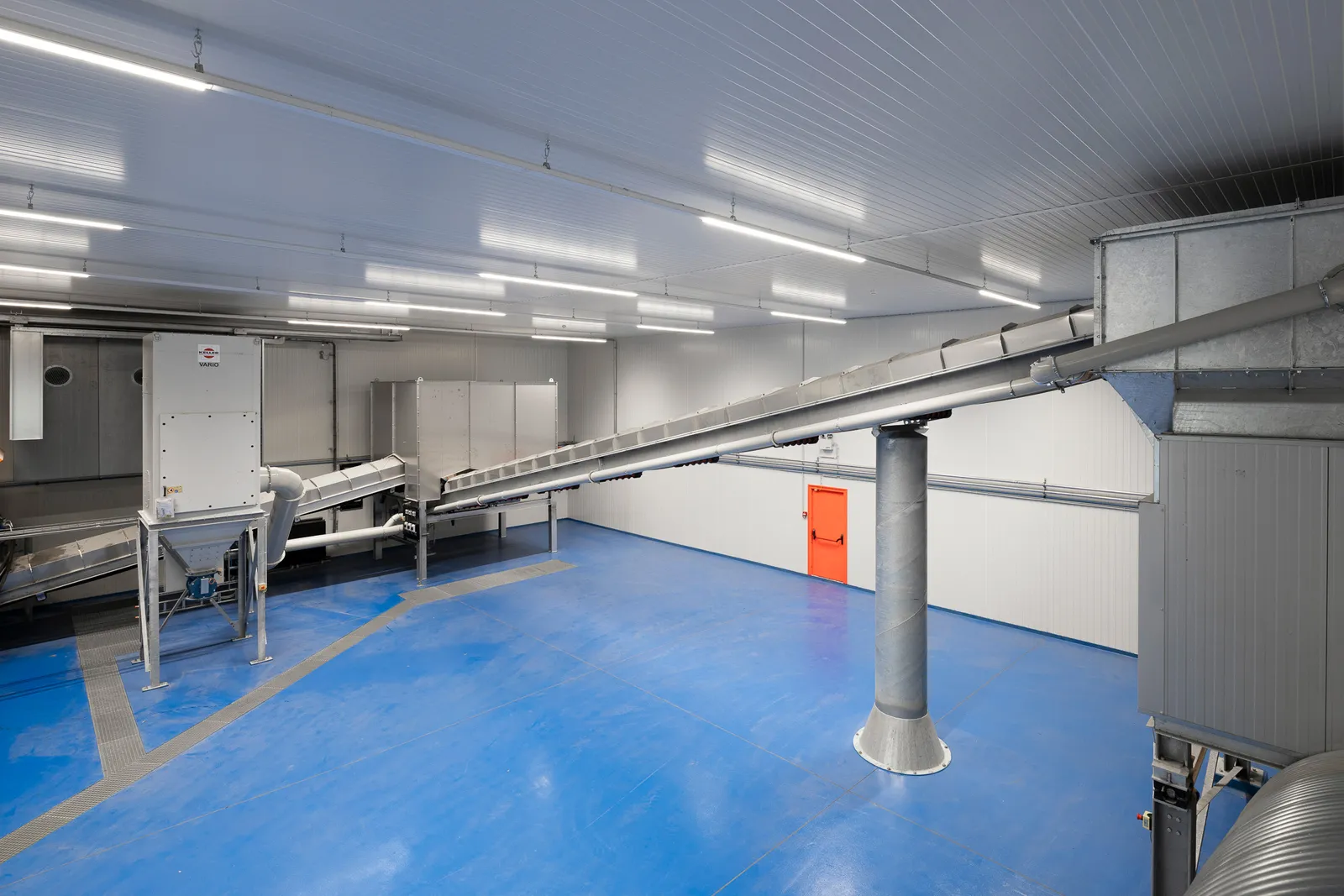
To treat this complex waste stream safely, OVMB developed an entirely new installation at its Oudetragel site. It was designed using experience gained with an earlier pilot plant. Waste containing non-bonded asbestos is first received and then mechanically reduced in size in an enclosed area. The released fibres are then mixed with cementitious additives and water, binding them in a stable matrix. Once cured, the material is bonded and can be safely sent to landfill. The installation operates as a hermetically sealed process, with safety at its core. “No one enters the hermetically sealed area during treatment,” Casier explains. “Everything is done mechanically and under powerful extraction. As soon as a door is opened, the installation shuts down automatically. Safety is absolutely the top priority here.” The installation has a capacity of around 2,000 tonnes per year, making it an important link in the treatment of non-bonded asbestos in Belgium. There are only two specialist treatment installations for this waste stream in Belgium: one in Geel, operated by Rematt, and now one at OVMB in Ghent.
Circularity where possible, safe disposal where necessary
The circular economy is now central to European and Flemish waste policy. Recycling and the reuse of materials rightly take priority. But not every waste stream can be returned to the product cycle. Asbestos is the clearest example. There is currently no safe, economically viable recycling technology for this material at industrial scale. “For some materials, recycling simply isn’t an option,” says Casier. “Our job is then to make sure they are treated in the safest way possible.” Denuo therefore advocates continued attention in waste policy to so-called safe sinks: facilities and landfills needed for waste streams that cannot be recycled or pose a permanent risk. “Landfills are often the final link in the chain that no one likes to talk about,” says Casier. “But they are absolutely essential for materials such as asbestos. Without that capacity, you simply cannot solve the problem.”
Investing in long-term safety
With its new asbestos cementation line, OVMB is helping to make Flanders asbestos-safe. At the same time, the project shows that the circular economy is not just about recycling, but also about safely managing materials that cannot be reused. “We see this as a long-term investment,” Casier concludes. “As long as asbestos remains in our society, we will need installations capable of treating it safely.” Perhaps that is ultimately the most important lesson: a sustainable waste chain needs not only circular solutions, but also reliable final destinations. And companies such as OVMB play a crucial role in providing exactly that.
Question about this story? Ask your question
Keep following this
Get an email when a new story is published. No account needed.
- ThemeSafe and clean processing
- SubjectDenuo







