












Working together on smart deposit return: project under way and on schedule
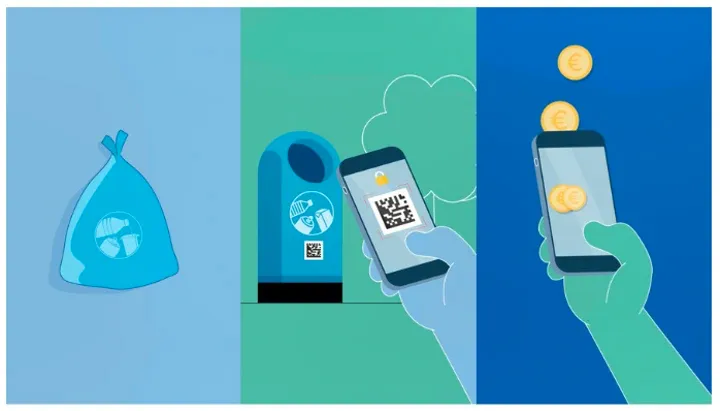
The Regions aim to collect more drinks packaging through a deposit return system and, in doing so, reduce litter. Drinks producers and retailers share that ambition and want to achieve it with a smart system that is easy for everyone to use, both at home and on the go, and that builds on Belgian consumers’ successful sorting habits using the blue bag. With the launch of “Working together on smart deposit return”, the sector, together with its respective federations Fevia and Comeos, and Fost Plus, is taking the next steps towards testing such a system in practice and, where appropriate, implementing it in 2025. A series of tests and pilot projects is therefore in the pipeline.
Our country has a collection system for drinks packaging, the blue bag, that is already among the best-performing in Europe. However, too much drinks packaging is still lost, including through litter. Companies that produce drinks or place them on the market are determined to collect every drinks container sold, using a future-proof and efficient system that makes it easy for everyone, at any time, at home and on the go. The sector also wants to anticipate Europe’s ambitious targets for recycling and the use of recycled material.
Smart deposit return as a way to make it easy to collect more drinks packaging together
Over the past 25 years, Belgians have developed the good habit of sorting packaging at home using the unique blue bag system. With the launch of the “Working together on smart deposit return” project, the sector is developing a complementary digital solution that builds on this approach and anticipates changing consumer habits. The principle is that consumers get their deposit back by scanning to prove that they have put their can or bottle in the blue bag or blue bin.
A deposit return system must be easy for every Belgian, regardless of age, background, digital skills, place of residence or income. By complementing sorting at home with public blue bins, citizens will have the simplest way to get their deposit back anywhere and at any time. Such a smart deposit return system is not only highly innovative, but also the most efficient way to collect more drinks packaging together.
A series of tests and pilot projects is getting under way
If the Regions decide at the end of 2023 to introduce digital deposit return, the ambition is to have it operational during 2025. The sector has drawn up a plan to develop such an innovative digital solution in 2023. The plan has also been discussed with the authorities and other partners. As part of it, a series of tests and pilot projects is now in the pipeline, covering the different aspects of such an innovative digital solution, including its effectiveness in tackling litter. Citizens will also be involved.
The first pilot projects will get under way in Flanders in the coming weeks. The first will take place in a closed setting at two locations: Corda Campus in Hasselt and KBC’s head office in Leuven. External partners Litterbits (the consortium comprising Twintag, Verhaert Masters in Innovation and Cegeka) and Unbox will each test a number of key elements needed for smart deposit return to work properly: unique codes on drinks packaging, the functionality and user-friendliness of an app, correct disposal of drinks packaging, and the robustness of the proposed systems for fraud prevention and personal data protection. Pilot projects will then take place in semi-open and open settings, where additional aspects will be tested, including the impact on litter and user-friendliness for specific target groups.
Tests and pilot projects will also take place in Wallonia during the year. Discussions are under way with the Minister’s cabinet to tailor these tests and pilot projects specifically to the concerns and priorities of the Walloon Region.
Corda Campus Hasselt pilot project figures:
- Corda 3 building (Cegeka office) and shared campus catering locations
- 5,000 employees
- Approximately 6,000 drinks (plastic bottles and cans) with unique codes expected
- 20 specially designated bins to prove correct disposal
- Pilot project live from 23/05 to 23/06
KBC Leuven pilot project figures:
- 1,800 employees
- Approximately 8,000 drinks (bottles and cans) with unique codes expected
- 60 identification codes at collection points to prove correct disposal
- Pilot project live from 30/05 to 23/06
Question about this story? Ask your question
Keep following this
Get an email when a new story is published. No account needed.
- SubjectNews







