












Wood waste: are we getting all we can out of it?
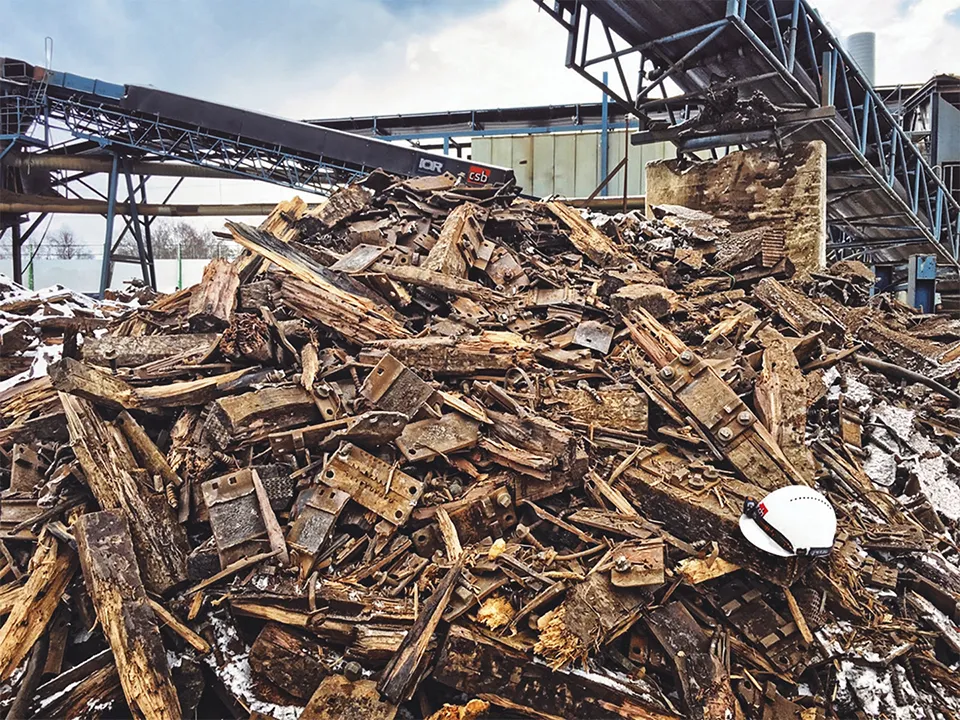
‘Never waste a good crisis’ is a phrase often heard during these coronavirus times. Perhaps we should also hear this one more often: ‘never waste good waste’.
Efforts are made to recycle wood waste and recover energy from it wherever possible, but a great deal of potential energy is still lost, particularly from C wood. The technology to do this safely is already available.
Not all wood waste can be treated alike. As its properties can vary considerably, it is divided into a number of categories. A wood is untreated and non-hazardous. B wood is treated, but uncontaminated and non-hazardous. C wood (such as railway sleepers) is treated, contaminated and considered hazardous. Clean A wood is mainly recycled, while energy is recovered from treated B wood wherever possible. In some cases, C wood can be cleaned up. It is then crushed and the smallest fractions (0/5 to 0/10) are separated out, as these fine particles contain most of the chemicals and hazardous metals. The fine fraction goes to a waste processor, while the remaining wood can be processed further as B wood. This is a labour- and investment-intensive process. IQR shows in Sweden that it can be done more efficiently.
From railway sleepers to energy
IQR now offers solutions for converting waste into energy efficiently and in an environmentally friendly way, but this was not always the case. The company was founded in 1979 by Thomas and Jill Karlström and was originally called ‘Svenska Slipers’, or ‘Swedish Sleepers’. It recovered Swedish railway sleepers and sold them to horticulturalists and other interested parties, giving them a second life. However, many of the sleepers were damaged. The company wanted to investigate whether energy could be recovered from them. This led to heated discussions about creosote, the preservative used to protect railway sleepers. Many studies later, it became clear that there was no danger if they were processed correctly, at the right temperature, in a suitable industrial incineration plant. IQR revised its mission and decided to stop selling railway sleepers, so that the creosote would no longer end up in the soil. From then on, it would process old railway sleepers solely to generate energy, which would then be fed into the Swedish district heating network.
Pioneer in energy recovery
More and more railway sleepers from around the world were arriving at IQR. This put the plant under pressure, prompting IQR to develop a new system with greater capacity that was also less susceptible to wear caused by the large amount of iron in the railway sleepers. This led to the FlexHammer™ crusher. It is one of the few crushers that can reduce a railway sleeper in size and process it further into fuel in a single step. The machine is highly resistant to iron and efficiently filters it out using robust metal separators from Elme Magnets. In addition, crushing produces few fine fractions, so the most contaminated particles are not released in an uncontrolled manner. When regulations on incineration became considerably stricter, IQR had to adapt its system once again. It developed a two-stage incineration plant that meets the strictest European standards. The upgraded plant processes around 90,000 tonnes of European railway sleepers each year. Since 2016, IQR has also been using its expertise to support companies that want to convert waste materials into energy sustainably. It does this with high-speed crushers capable of handling heavy-duty work, always tailored to the type and volume of waste material.
Local processing of C wood
IQR is represented in the Benelux and France by CSB Waste Solutions. Managing director Stefaan Paulus would also like to see C wood converted into fuel more locally. “IQR shows that it is absolutely possible to convert C wood into energy safely and efficiently. Transporting wood waste to the authorised processing plant in Sweden is a step in the right direction. At least something is being done with it, but the transport certainly does nothing to improve our environmental footprint. Wouldn’t it make more sense to process it locally? The technology, knowledge and expertise are there; all that is lacking is government support. It would be great if we could also feed the energy generated here into a local district heating network. If the waste stream is converted into energy locally, and that energy is used to provide businesses and homes with heating and hot water, we will be one step closer to an environmentally friendly way of life. We will be making use of energy that would otherwise risk going to waste.”
Question about this story? Ask your question
Keep following this
Get an email when a new story is published. No account needed.
- ThemeCircular construction and demolition
- SubjectNews







