












Woitzel cuts costs by choosing the right options
Cost savings in the recycling of construction and demolition waste
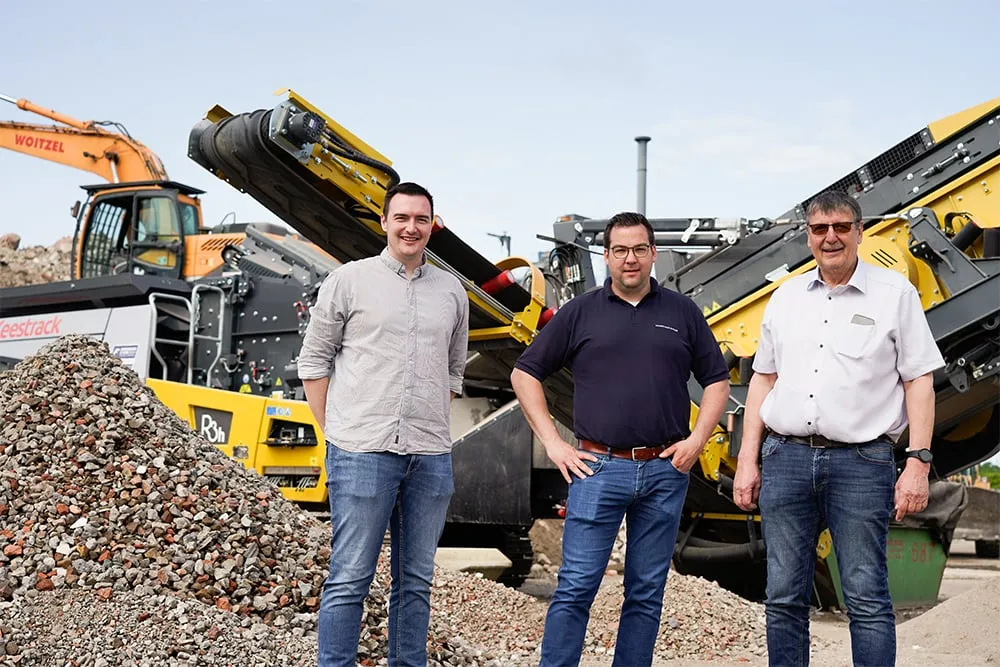
The German company Manfred Woitzel GmbH & Co specialises in earthworks, demolition, recycling and waste disposal. Founded by Manfred Woitzel in 1956 as a quarry, the company has evolved into the business it is today. It collects, transports, stores and recycles various “waste” streams, such as construction and demolition waste, soil and household waste, using its own sorting facilities. All with skill and expertise.
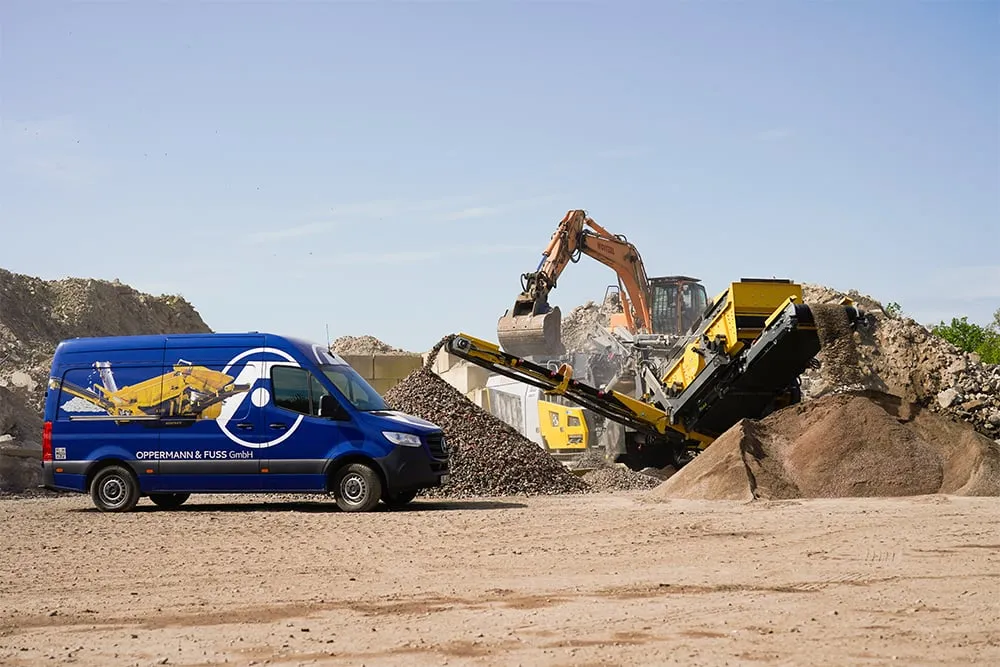
This article focuses on Woitzel’s demolition and recycling site. Construction and demolition waste arrives at the storage and processing site through the company’s own container service, from its own demolition projects and from deliveries of construction and demolition waste to the site. The third generation is now looking for ways to improve the company’s efficiency and profitability. Jannik Woitzel and his uncle Uwe Woitzel therefore contacted German Keestrack distributor Oppermann & Fuss to find the best solutions.
Investing smartly by choosing the right options
Until the end of last year, Woitzel had 2 crushers. One jaw crusher at its storage and processing site for recycling construction and demolition waste, and one impact crusher used on its demolition projects, transported from one demolition site to another. As Woitzel has 2 Keestrack K4 screening plants and an S5 stacker, it was already in contact with Oppermann & Fuss. Its sales representative, Julian Pollmeyer, assured the company that the renowned quality and service of Keestrack screens would also apply to its crushers.
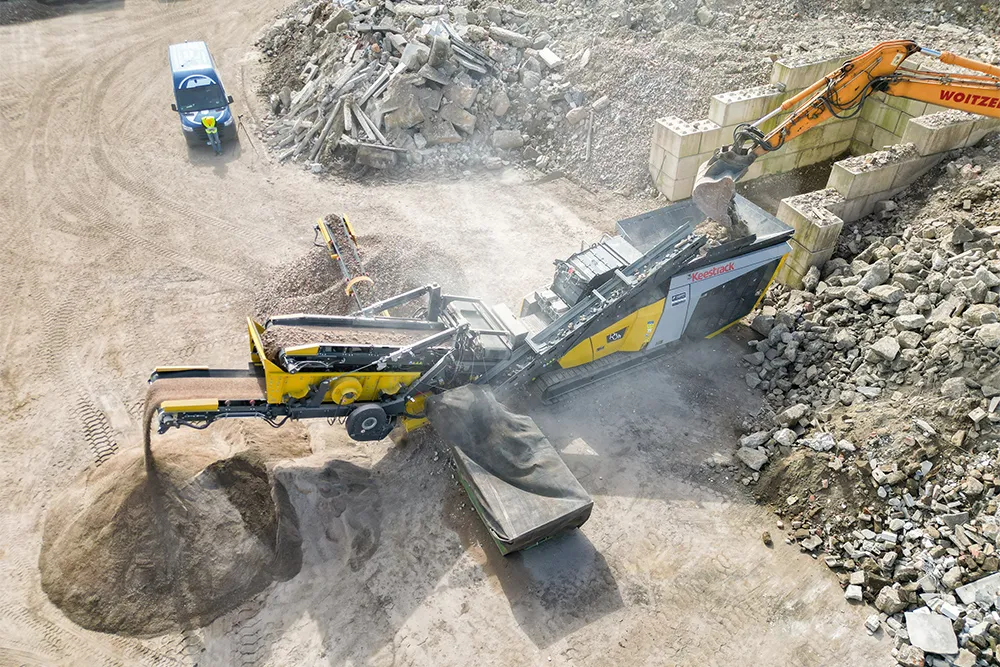
“Woitzel chose the Keestrack R3 impact crusher with a double-deck afterscreen and optional wind sifter,” says Uwe Woitzel. “The Keestrack machine saves us fuel because it is much more economical than our previous jaw and impact crushers. The 2-deck afterscreen, with its return conveyor, saves space, is easy to dismantle and can be transported to demolition sites without a permit. This means the crusher is used both at the storage and processing site and at the demolition site itself. The fully equipped machine is effectively 2 machines in one, which saves us a lot of money in our operations,” adds Jannik Woitzel.
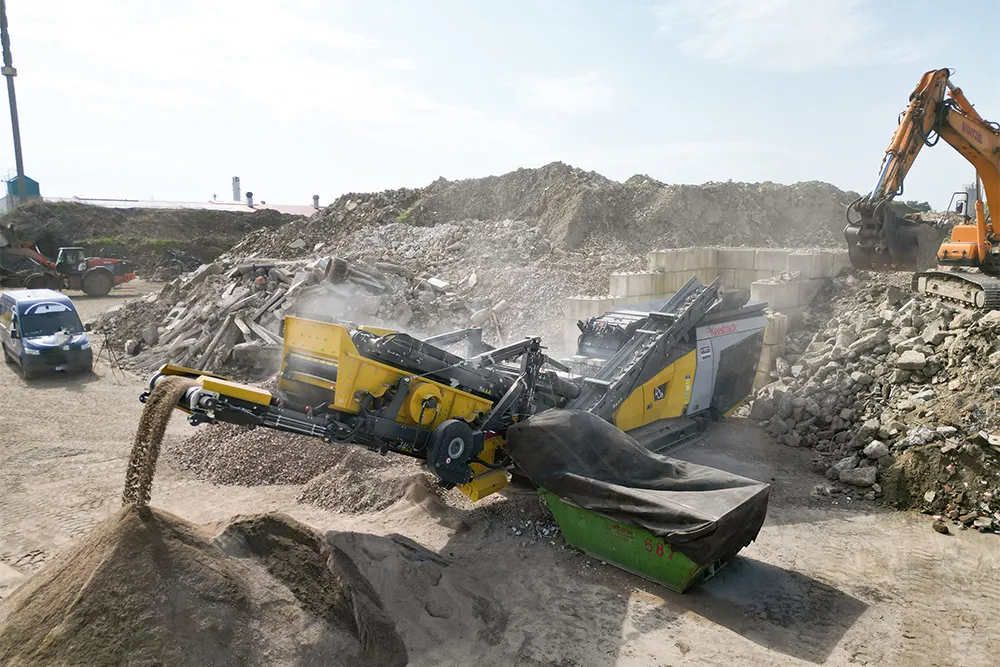
At its storage and processing site, Woitzel produces RC-1-certified 0/8mm & 8/45mm material. The smaller fraction is used as crusher sand, while the larger fraction is used as a stable base, for example in road construction, with high drainage capacity. The R3 runs for up to 6 hours a day and produces around 160 t/h. Adding the S5 stacker to the production process allows further savings, as the stacker cuts fuel and labour costs for the wheel loader.
The innovative R3 impact crusher has unique safety features, including a safety key system. The R3’s design has also won several European design awards, including the most prestigious, the Red Dot award. The crusher is very compact and easy to transport, and is also available with fully electric plug-in drive, with a capacity of up to 250t/u.
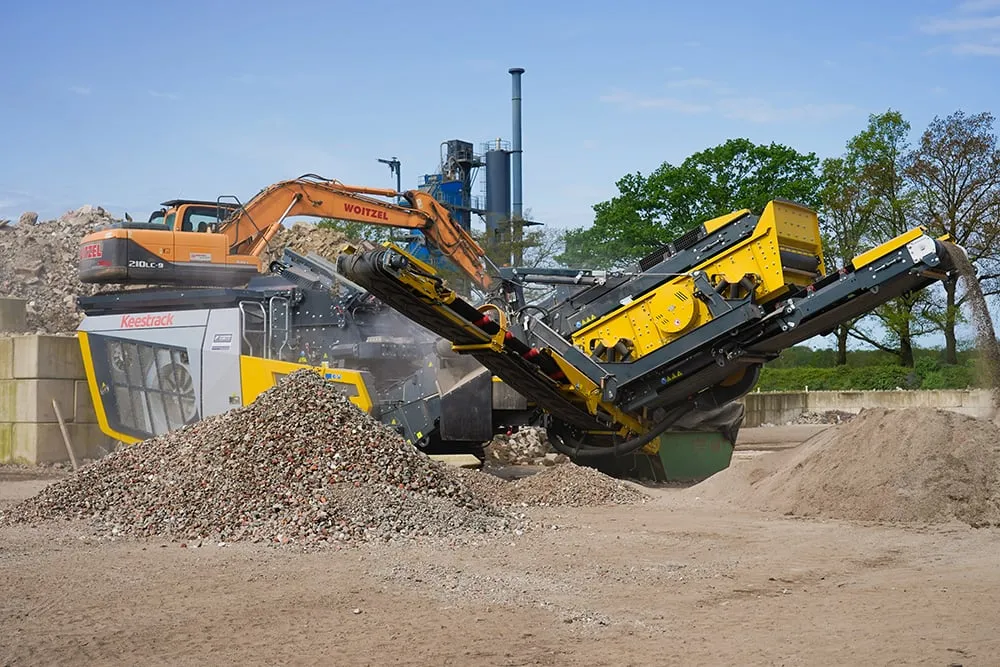
The R3 is equipped with a vibrating feeder with a 1,200 mm x 920 mm pre-screen that optimises crushing results and minimises wear. The asymmetrical inlet opening allows oversized material to turn before entering the 770 mm x 960 mm (HxW) crusher feed opening. The high-inertia rotor, with a diameter of 1,100 mm and a width of 920 mm, produces high-quality end products with minimal wear.
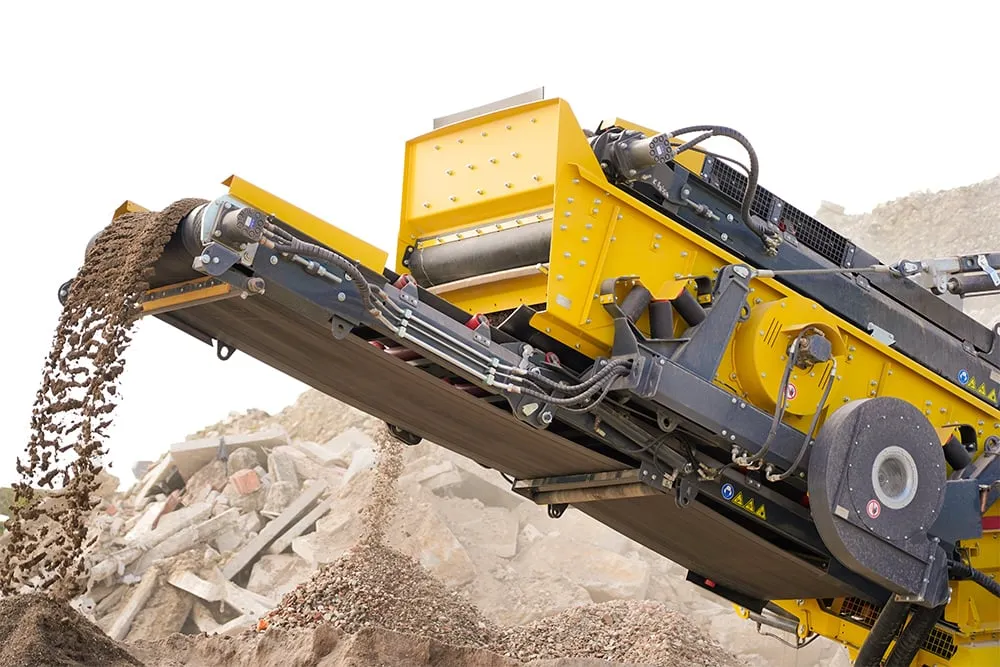
The crusher operates in a closed circuit with a recirculation conveyor and a 3,100mm x 1,400mm double-deck precision screen, producing end products of defined sizes. The installed wind sifter removes contaminants such as plastic, wood or paper, while the overband magnet separates valuable metals. The R3 weighs ±33t, including all options.
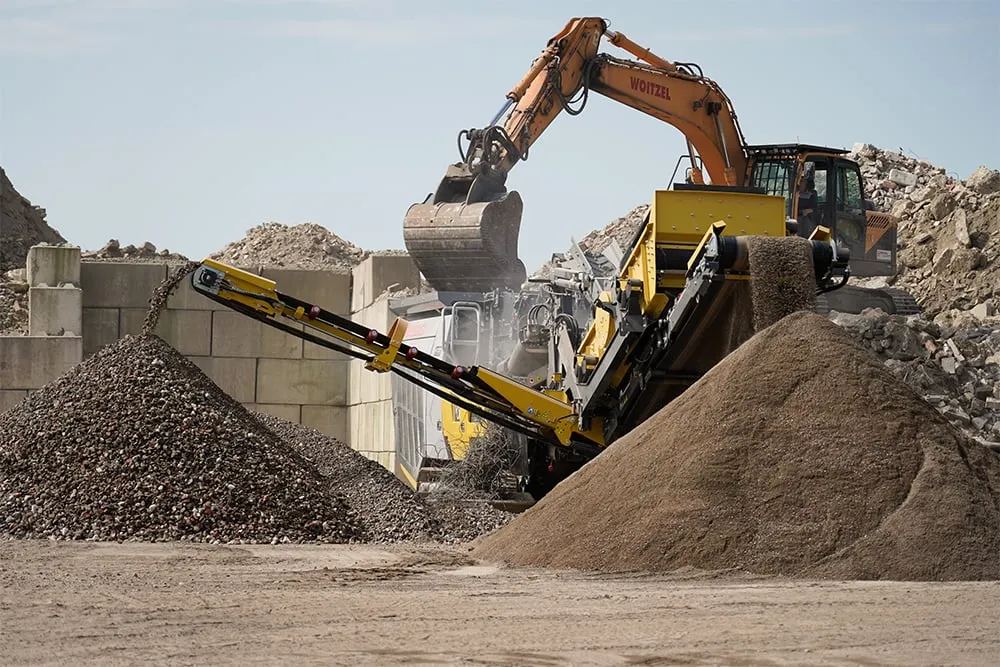
The R3 is also equipped with a remote control, allowing the operator to run it from the safety of the excavator cab. The R3 has an integrated water spray system that can be used if dust levels become too high during production. It is also fitted with a Keestrack-er UMTS/GPS system. This telematics system provides real-time data and analysis, as well as the machine’s exact location. All aspects can be monitored remotely and, if necessary, software updates can be carried out remotely. Diagnostic tests can be run on all components, including the feeder, crusher, afterscreen and conveyors. The Keestrack-er also helps Oppermann & Fuss plan maintenance, keeping the machine in optimal condition and increasing uptime.
Question about this story? Ask your question
Keep following this
Get an email when a new story is published. No account needed.
- ThemeCircular construction and demolition
- SubjectNews







