












What about asbestos? Is there still room for it?

Not all waste can be recycled. Asbestos, for example, can currently only be landfilled. Now that Flanders has stated its ambition to be asbestos-free by 2040, landfill volumes are expected to rise significantly in the coming years. They already amount to 130,000 to 150,000 tonnes a year. But is there enough capacity to landfill it all? We asked Sven De Mulder, project leader and team manager for asbestos at OVAM.
Asbestos can be handled in two ways. Householders take it to recycling centres in sealed bags. Contractors must arrange delivery to landfill sites themselves. The key requirement for both is to ensure that the asbestos is in hermetically sealed packaging. It can only be accepted at a Category 1 landfill site. “These sites are specifically licensed to accept hazardous waste. However, a separate cell for asbestos-containing materials can also be provided at Category 2 landfill sites. OVAM assesses landfill capacity as a whole over a ten-year period. This allows us to avoid acute problems and prevents us from being backed into a corner. Flanders has landfill capacity comparable to that of the Netherlands.” At the end of 2018, the total permitted remaining capacity at Category 1 landfill sites was approximately 6 million m³, or about 7.8 million tonnes. This should be sufficient for the next sixteen years. Landfill capacity is spread across five locations: Beveren (Indaver), Antwerp (Indaver), Ghent (OVMB), Houthalen-Helchteren (REMO) and Roeselare (Vanheede Landfill Solutions).
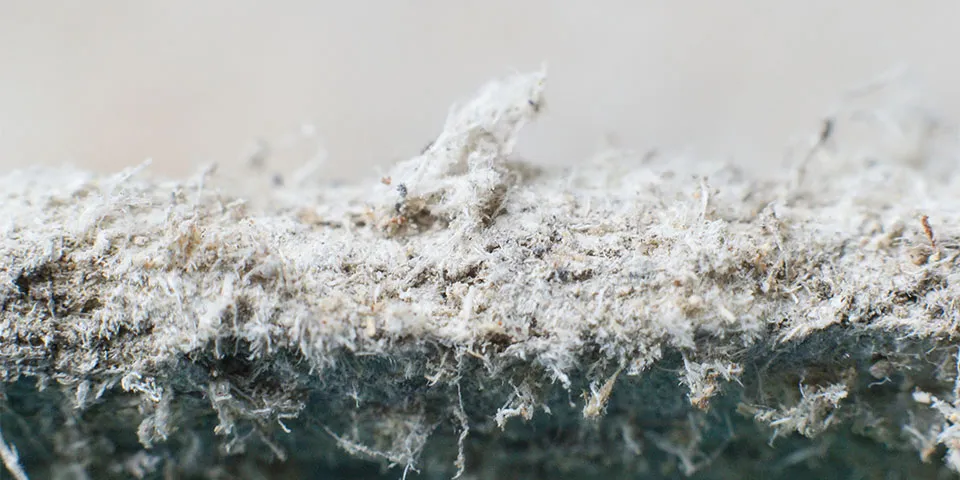
Asbestos owes its popularity to the indestructibility of its fibres. The challenge is to separate them from their binder.
Asbestos landfill capacity not at risk
More than 2 million tonnes of asbestos-containing materials will be released in the coming years as a result of the asbestos phase-out policy, as well as routine demolition and dismantling. A further 2.5 to 3 million tonnes must be added to that figure to account for organic matter and moisture, as well as asbestos-contaminated residual waste generated during the demolition and cementation of non-bonded asbestos waste. For now, however, this waste may not be accepted at the REMO landfill site. It was full, and the permit for an expansion was annulled just before the summer. Should we now be concerned about a shortage? De Mulder: “The temporary or permanent loss of the REMO site will of course have an impact, but for now there is no need to revise the minimum landfill capacity threshold. We review landfill capacity plans every year as a matter of course, so that we can intervene in time. There is still enough space for the coming years. We also want to keep pushing the boundaries of what can technically be recycled. The challenges are mainly logistical. Companies that used the REMO site, particularly those in Limburg, the Antwerp Campine and Flemish Brabant, will now have to travel many kilometres further to landfill asbestos.”
Recovering the binder as a raw material
Asbestos can still be landfilled, but OVAM is keen to do more with it. It conducted its own study into the state-of-the-art technologies available worldwide for converting asbestos fibres into a harmless material. “Asbestos owes its popularity to the indestructibility of its fibres. The challenge is to separate them from their binder, so that the binder can at least be reused as a raw material,” says De Mulder. “There are some promising studies, but for the technologies to be usable, they need to be sufficiently mature and remain affordable. It is OVAM’s role to encourage research and, where necessary, facilitate it, because there is a lot happening at the moment. However, it will take at least another five years for the research to make sufficient progress and for relevant operations to get under way. Applications will undoubtedly focus on asbestos cement. It accounts for the bulk (90%) of what is landfilled today.”
Question about this story? Ask your question
Companies in this story

Keep following this
Get an email when a new story is published. No account needed.
- ThemeSafe and clean processing
- SubjectNews
- CompanyOVAM







