












Wettest year drives increase in household waste in 2024
Today, OVAM published the reports “Household waste in Flanders 2024” and “Litter monitoring in Flanders in 2024”. Household waste amounted to 2,973,614 tonnes in 2024, or 433 kilograms per resident. This represents an increase of 13 kg per resident, almost entirely due to increases in green waste, organic waste, wood waste and PMD waste. OVAM is not concerned by the increase, which was to some extent expected, as 2024 was the wettest year since measurements began. Residual waste remained stable at 125 kg per person. The amount of litter collected rose by 5.3%, from 6,621 tonnes to 6,969 tonnes. The news from the recycling front was positive, however. 71% of household waste was collected separately. A record 64.9% was actually recycled.
- Absolute litter figures higher, but its share of waste generated outdoors is falling
- Record recycling figures
More waste due to wet weather
According to the KMI, 2024 was the wettest year since measurements began. The impact is reflected in our waste figures. Wet weather leads to more leaf and plant growth, and therefore more green waste and organic waste: 55,000 tonnes more than in 2023, to be precise. Other increases included wood waste, PMD and WEEE … All the figures are available at: https://ovam.vlaanderen.be/cijfers-huishoudelijk-afval
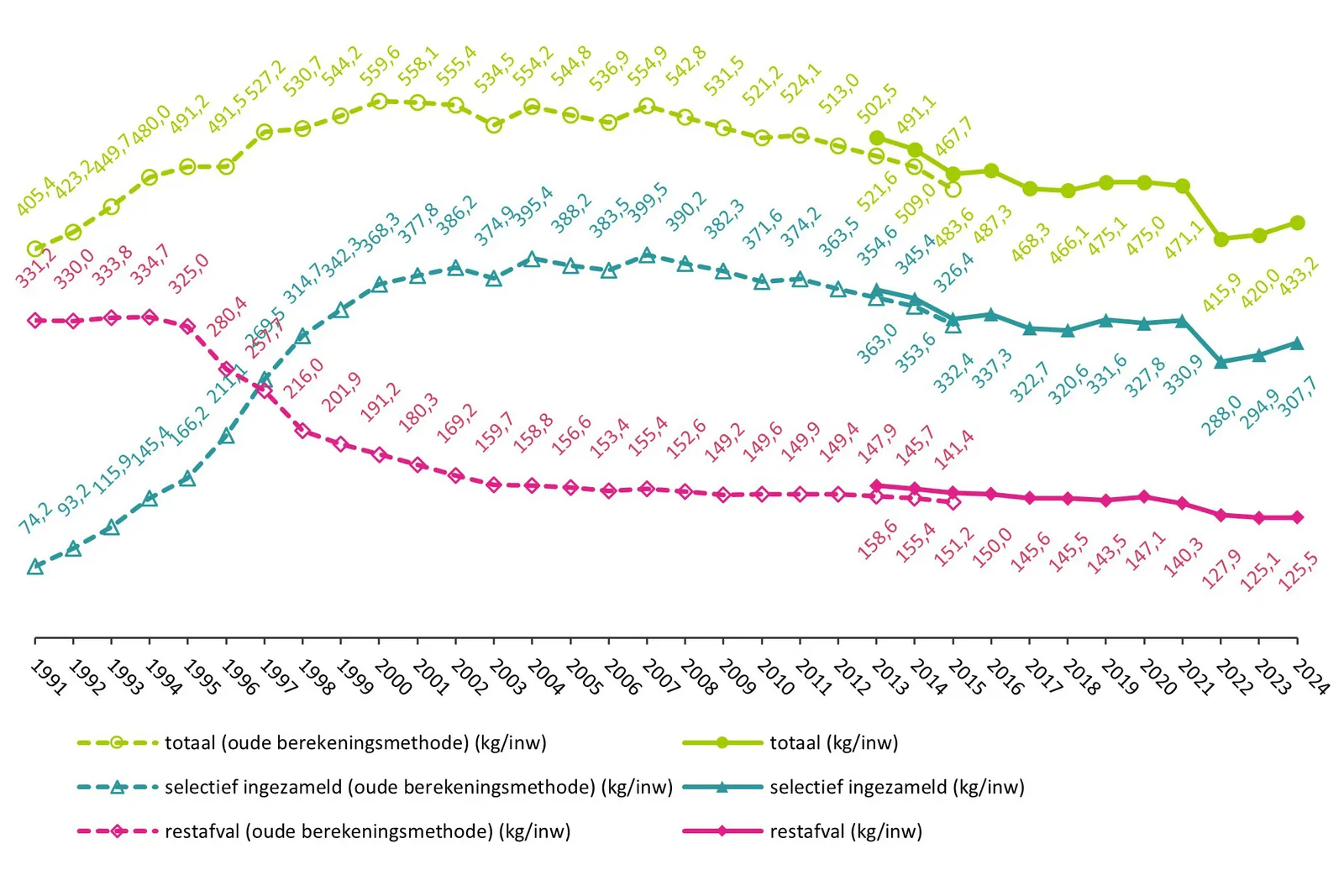
Residual waste remained stable at 125 kg per person. Residual waste consists of household waste, bulky waste, and street and sweepings waste sent to incineration. The Flemish Government aims to reduce this amount to 100 kg per resident by 2030, so that as many materials as possible can be recovered and recycled. The decline seen in previous years therefore did not continue. Extra efforts will be needed in the coming years, primarily from cities and municipalities that have yet to meet their residual waste targets. Short- and medium-term opportunities include introducing organic waste collection across the board (67 municipalities have been granted an extension until 1/1/2026 at the latest to start collecting organic waste), further awareness-raising on PMD sorting, introducing weight-based differentiated tariffs, setting appropriate tariffs and applying stricter acceptance criteria at recycling centres.
Flemish Minister for the Environment Jo Brouns: “Many municipalities are in the midst of a transition. Introducing weight-based differentiated tariffs and separate organic waste collection takes time, but is essential to producing less household waste. The higher, uniform incineration levy for all waste streams reinforces this policy. It encourages better sorting and more recycling, and ensures that those who pollute more contribute more.”
More separate collection and record recycling figures
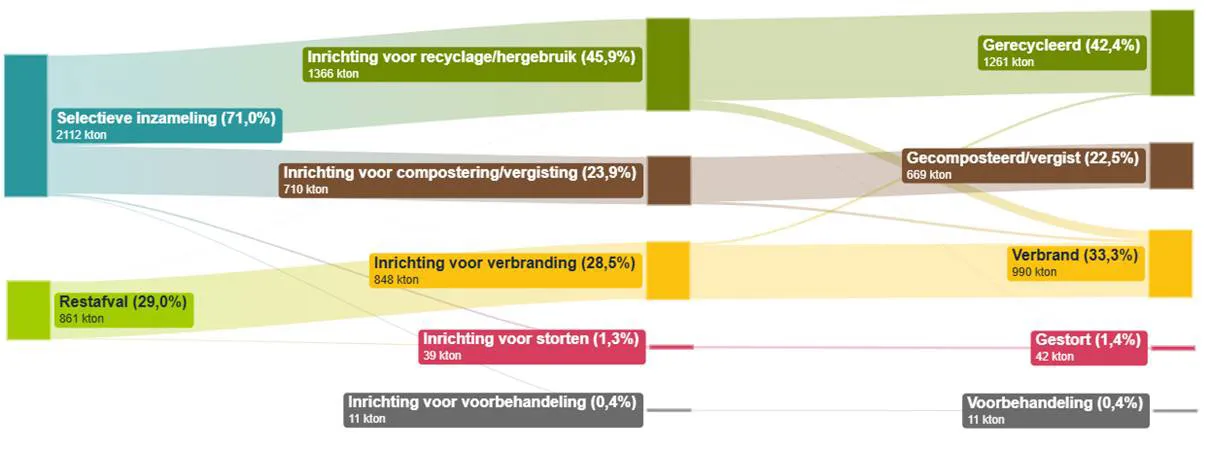
The separately collected fraction rose significantly in 2024 (as noted, mainly due to wet weather). Separately collected fractions accounted for 71% of the total. After deducting fractions not collected separately for recycling but to ensure environmentally safe processing (1.3%, e.g. small hazardous waste, asbestos, …), and losses in the recycling and composting process (4.8%), the recycling rate comes to 64.9%. That is a record! The recycling rate was 63% in 2023 and 61% in 2022.
More litter clean-up reported and more ‘out-of-home’ consumption
The results of the 2024 litter monitoring were published alongside the 2024 household waste report: https://ovam.vlaanderen.be/resultaten-zwerfvuilmonitoring For the second year running, Flemish local authorities are required to report how much litter they clear up and collect (IZAS).
In 2023, the amount was 6,621 tonnes. In 2024, all local authorities together reported 6,969 tonnes, an increase of 5.3%. For now, this increase remains limited. As this is only the second measurement, it is too early to speak of a trend. Further monitoring in the coming years will provide greater clarity on longer-term developments.
Although the absolute figures show a slight increase, the relative picture is positive. Within the total weight of on-the-go waste, the share of litter on the ground is falling (from 33% to 29%), while the amount of waste correctly disposed of in street bins is rising (from 67% to 71%).
Een zakelijke vraag aan OVAM? Get in touch
Companies in this story

Keep following this
Get an email when a new story is published. No account needed.
- ThemeMaking plastics and packaging circular
- SubjectNews
- CompanyOVAM







