












Trends and developments in attachments: ever greater precision in working and measuring
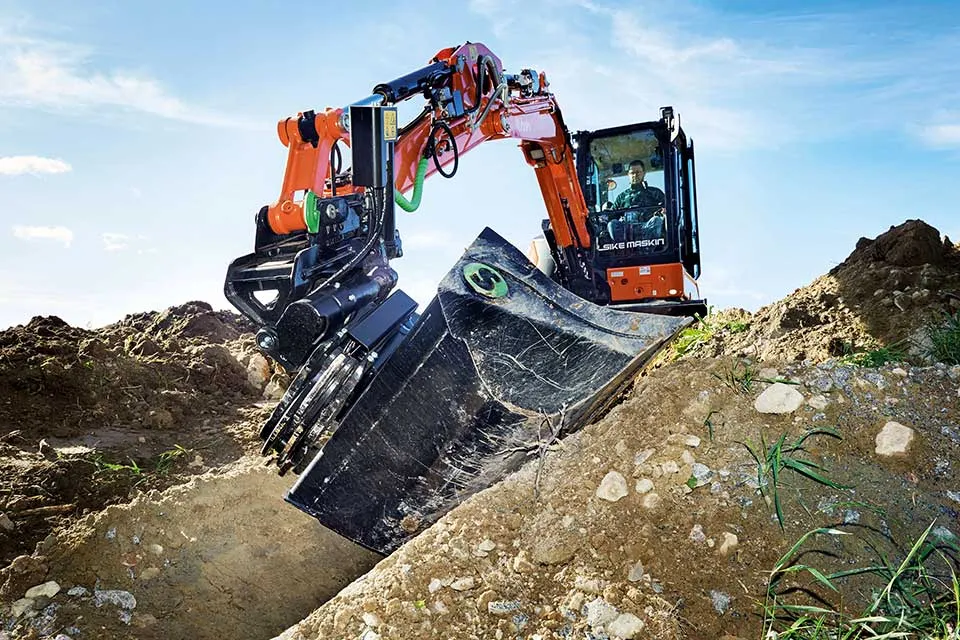
Developments in attachments are moving fast. Whereas in the past the motto ‘bigger is better’ was sometimes heard, many innovations today are less about using brute force.
In 2021, efficiency, service life, fuel consumption and safe working are higher on the innovation agenda. This is leading to some remarkable product developments. In this article, which is by no means exhaustive, we look at a number of trends and developments, illustrated with striking examples from the market.
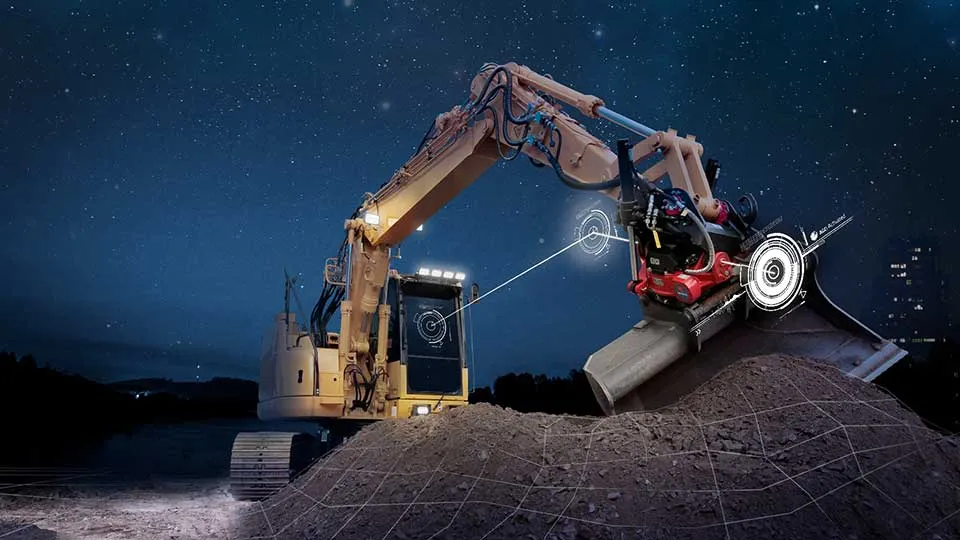
Almost all attachment manufacturers now offer a booster, power booster or amplifier. The names differ, but the technology behind them is the same: an integrated hydraulic system that temporarily increases the hydraulic pressure, giving a massive boost in force. This comes in handy when crushing or cutting large chunks of concrete or huge pieces of steel. Hydraram calls its system Powerbooster and has incorporated it into its demolition shears and pulverisers. The manufacturer says a maximum peak pressure of no less than 750 bar can be achieved. It also significantly shortens cycle times, allows attachments to be lighter and increases force by a quarter. And working faster can deliver considerable savings in fuel and emissions of harmful substances such as CO2 and nitrogen. NPK also uses a Powerbooster. This integrated pressure booster activates automatically as soon as the pulveriser encounters back pressure. As a result, NPK attachments are much faster and more powerful despite their relatively low oil flow, while the excavator’s other hydraulic functions remain unaffected. The machines are also much more compact, lighter and easier to use. Rotar prefers to call its system a Ramplifier. Rotar amplifier technology responds to resistance. When this exceeds the machine pressure of 250 bar, output doubles, giving 500 bar and rising to 700 bar. The Ramplifier is fitted in the piston rod of both cylinders. Demarec has equipped its range of scrap shears, pulverisers and combi shears with the patented Dema Power-System 2.0. Its double-acting differential technology gives the attachments very short cycle times and 20% extra force, thanks to pressure chambers in the cylinder. According to Demarec, the increase in capacity can be as much as 30%.
Tiltrotator
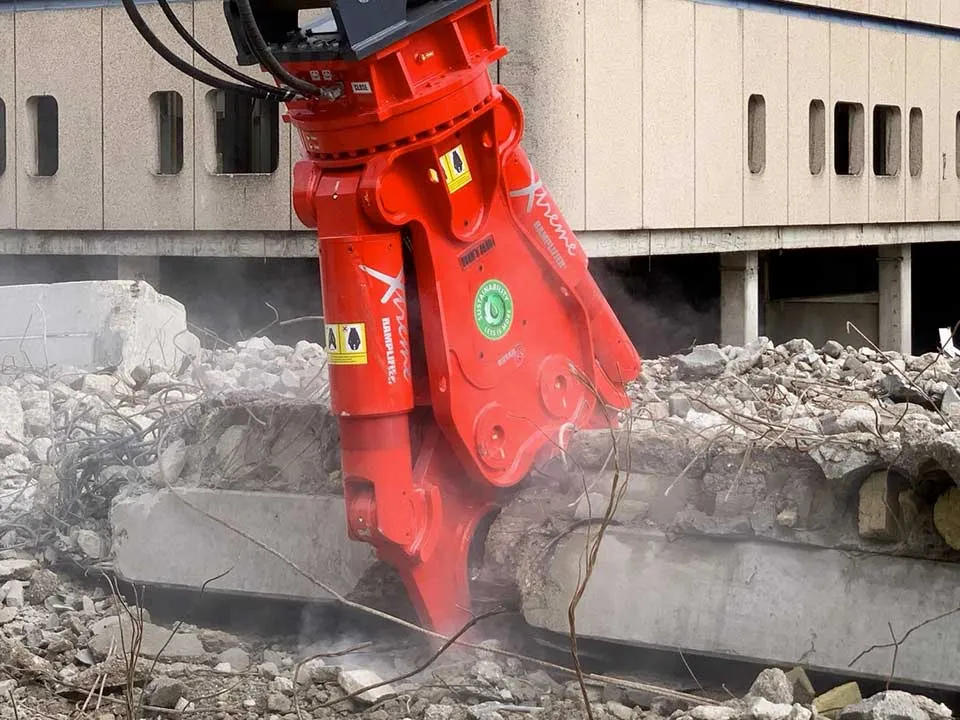
The names vary, but the technology stems from the same invention, which was used mainly in the Scandinavian countries in its early years but has since become indispensable in the Low Countries too. We are, of course, talking about the tiltrotator, swingrotator, swingotilt, mRoto, Nox or Rotiltor. Initially used mainly in earthmoving, the demolition and recycling sectors have also embraced the technology. A tiltrotator means an excavator has to be repositioned less often to get into the right position. This significantly boosts productivity. The market leaders are Rototilt, Engcon and Steelwrist, but SMP, HKS, Pladdet and Kinshofer are also major players. A relatively recent development is the increasingly common direct connection between tiltrotators and machine control systems, enabling automatic tilt functionality. Engcon developed such a system with Leica Geosystems, while Rototilt joined forces with Trimbe. It gives operators full control over the attachment’s tilt and rotation angles. Combined with precise positioning, this saves time and fuel. The new technology makes the operator’s job considerably easier, as the bucket’s position and orientation are always visible, regardless of how it is turned. The result is significantly more efficient and precise working.
‘It can rightly be called revolutionary that Rototilt and Steelwrist have decided to launch a joint initiative’
Quick couplers
Fully automatic quick coupler systems are just as commonplace as tiltrotators. They mean operators no longer have to leave the cab to attach a different attachment to the boom. In recent years, an increasing number of manufacturers have added an automatic quick coupler system to their range.
The market leader and pioneer is OilQuick. Steelwrist, Engcon and Rototilt followed suit, and Lehhoff also manufactures them. Initially, quick coupler systems were made mainly for larger machines. Steelwrist SQ fully automatic quick couplers can even be supplied from the factory on Volvo crawler and wheeled excavators weighing between 13 and 35 tonnes. More recently, Steelwrist and Rototilt have also introduced quick coupler systems for compact machines. Last year, Steelwrist launched the S30 quick coupler, and this month Rototilt announced a further expansion of its fully automatic QuickChange system. Three new sizes are being added to the range: the QC45-4, QC 45-5 and QC60-4. The new types, suitable for compact equipment, will be available from May 2021.

Open standard
A problem with many automatic quick coupler systems is that manufacturers do not all use the same system. This can mean that switching to another brand also requires replacing all the attachments, which is costly. It can therefore rightly be called revolutionary that Rototilt and Steelwrist have decided to launch a joint initiative intended to become the market’s standard for automatic quick coupler systems. The two Swedish manufacturers have formed an alliance and hope many other producers will follow their example. Late last year, they announced ‘Open-S’. As the name suggests, it is an S-type quick coupler, but with an ‘open’ connection. This means operators can rely on tiltrotators and attachments with an Open-S locking mechanism being compatible, regardless of the manufacturer. Products that meet the standard are marked with the new Open-S logo. “Open standards make everyday life so much easier, whether we are talking about plugs and sockets, telephone and computer cables, or excavator quick couplers. Open-S also builds on the independent, established standard that already exists for quick couplers, the S-standard,” explains Stefan Stockhaus, CEO of Steelwrist AB. Together with Anders Jonsson, CEO of Rototilt Group, he initiated Open-S. “We believe in healthy competition, with industry players competing to deliver the best products,” adds Jonsson. “We simply do not want to lock customers into a closed interface. If they buy a tiltrotator from Rototilt, they should be able to rely on another hydraulic attachment that meets the Open-S standard fitting it without any problems.” The two founders hope that competitors such as Engcon and OilQuick will join as soon as possible to make the idea a success. Open-S is owned and managed by an independent organisation, the Open-S Alliance, which is in turn led by a council of engineers from all member companies. At present, the only members are Steelwrist and Rototilt, but new members are very welcome. “It is all about transparency. All serious players who believe in the importance of a common standard are welcome. We are already in talks with several manufacturers interested in joining the initiative,”
says Stockhaus.
If you can measure it, you can manage it
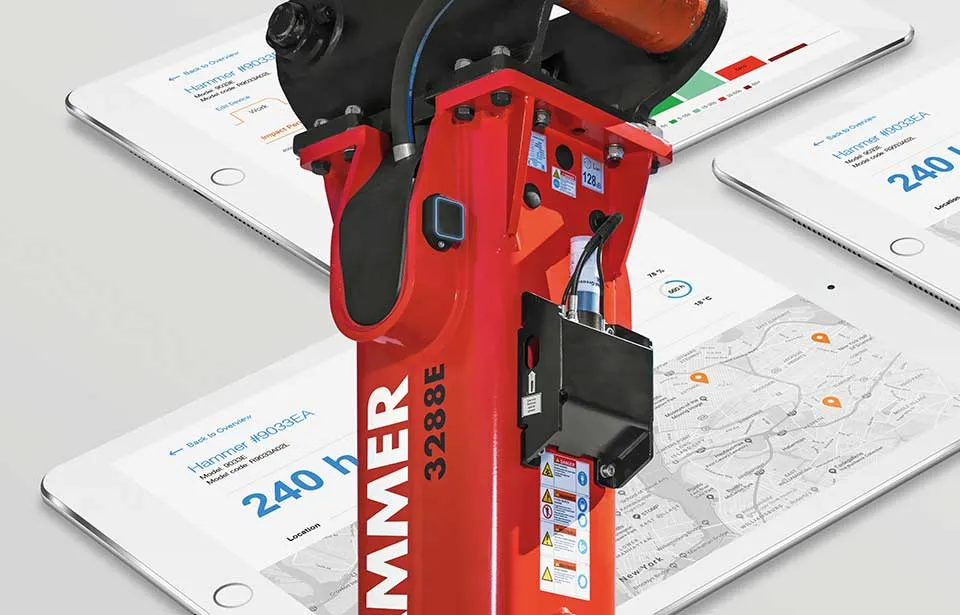
Rammer, a manufacturer of demolition breakers available through ACDE, equips its Excellence Line hydraulic breakers with a sensor that allows their performance, consumption and maintenance to be monitored anywhere in the world. The RD3 system can also be retrofitted to any Rammer breaker built after 2009. This makes Rammer the first attachment manufacturer to equip its tools as standard with remote data access. The RD3 sends its data to the cloud via a 2G/3G network. When a breaker is operating, the RD3 collects data on its position, location, movement patterns, tilt, temperature and use (that is, operating hours), and sends the data back to a central location. It is also fitted with a three-axis shock sensor that measures the stresses and forces exerted on the breaker during each use. The ability to monitor a breaker’s impact and stress levels in real time is an important development for the industry. With more data at their disposal, operators can now use their breakers more effectively, extending the service life of each tool.
Question about this story? Ask your question
Keep following this
Get an email when a new story is published. No account needed.
- SubjectNews







