












‘The Netherlands is leading the way in tyre recycling’
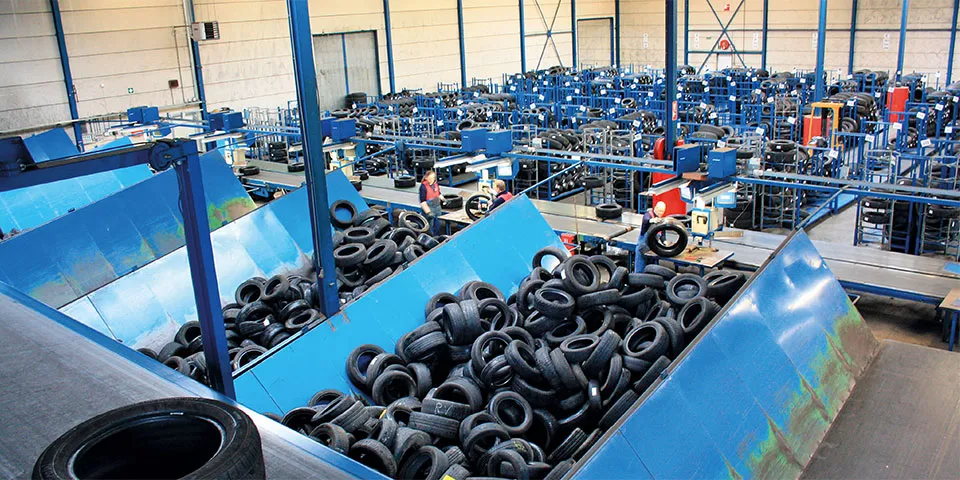
For every new car tyre placed on the market in the Netherlands, manufacturers and importers must take back and process an old tyre. RecyBEM is the organisation that ensures this happens properly. Director Kees van Oostenrijk is pleased to see the Netherlands leading the way in Europe in reusing old car tyres. “Not only is the percentage of new products made from recycled tyres growing, but so is the proportion of raw materials used to produce new tyres.”
RecyBEM is the collective organisation for collecting and processing used tyres. Or, in the words of its director, Kees van Oostenrijk: “The chain manager for the end-of-life tyre chain.” RecyBEM collects more than 9 million used tyres a year in the Netherlands. The organisation not only oversees the collection of used tyres, but also ensures they are reused properly. Various recycling companies process old tyres into three material streams: steel, textile and rubber. Ideally, that rubber would also be used to manufacture new tyres, but the technology is not yet there. Van Oostenrijk: “Around 3 to 5 per cent of the rubber granulate from old tyres is also used by tyre manufacturers to make new tyres. The aim is definitely to increase that percentage, if only because the supply of rubber trees is not infinite either. Until it can be used in new tyres, there are fortunately many other products that incorporate rubber granulate.”
Artificial turf pitches
One of those products is the rubber granulate used on artificial turf pitches. “There has of course been a lot of debate about it in recent years, but within the circular economy, it is probably the material currently used in the largest volumes worldwide. It also has a service life of 15 years and excellent playing characteristics. And when you want to renovate a pitch after 15 years, you can remove the granules, clean them, replace 50 per cent and reuse the rest. You just have to make sure the material does not spread beyond the pitches. What bothers me about the debate is that in the Netherlands alone, we discard 120 thousand tonnes of old tyres every year. Worldwide, the figure is more than 50 million tonnes. Would you want to burn all of that? That would be a real problem.”
Van Oostenrijk says another point that is not always considered is that “passenger car tyres have to meet extremely stringent user specifications. They are not made of rubber alone, but also contain plastic additives. All of this is to ensure that the tyre is safe, does not burst at 120 kilometres per hour, provides a good braking distance, uses less fuel and contributes to driving comfort. A tyre is a very special product that connects the vehicle to the road surface. Over the past 5 years, health and the environment have gained enormously in impact and importance. We take responsibility by collecting, sorting and processing all these tyres in an environmentally friendly way. Even after 40 years, we are still following the famous Lansink’s Ladder.”
Balance
Since a used tyre must be collected for every new tyre, the two should balance each other out. But Van Oostenrijk notes that the figures have started to diverge since 2015: more tyres have been collected than sold new. “You could see that as a good thing, fewer old tyres left lying around here and there, but it does put pressure on our finances.”
The reason more tyres are collected than sold is that many car owners have, or used to have, multiple sets of tyres. “The law requires every tyre manufacturer or importer to take back one old tyre for every new tyre,” Van Oostenrijk explains. “In 2009, winter tyres suddenly took off. And since 2015, we have seen sales of all-season tyres soar. That means two tyres now have to be taken back for many new tyres. We do not know the exact figures, but we are now at a point where we collect more tyres than are sold new. We will therefore have to find a financial solution. The waste management contribution does not always cover the costs. But this system has proved to be the best way to deal with used products. The same applies to white goods, brown goods, electrical appliances and batteries. And compared with other European countries, we are doing very well. In many countries, shredded tyres are mainly used as high-calorific fuel in heavy industry. We have never done that in the Netherlands.”
Van Oostenrijk continues: “Since the BEM organisation was established, we have focused on high-quality material reuse, making the most of the high-grade raw materials used to produce tyres. In fact, passenger car tyres are bio-based: at least 50% is natural rubber, a plant-based natural product. Truck tyres consist almost entirely of natural rubber. Tyres are therefore ideally suited to circular processing, making them truly circular products. We are on a steep learning curve and building up our recycling expertise to achieve this.”
Devulcanisation
Van Oostenrijk sees several promising technologies emerging that will enable an increasing proportion of old tyres to be reused. “We are living in an interesting time. Rubber tyres themselves have been around for more than 100 years, but tyre recycling as an industry is only 20 or 30 years old. The technology currently available involves shredding and separating steel, textile and rubber granulate. The finest fraction can be used as carbon black, a pigment. But it is still all mechanical processing. In recent years, we have seen that raw materials can be recovered from used tyres to a higher standard. One of these technologies is devulcanisation: chemically breaking down a tyre. This allows the oil to be recovered, along with the carbon black. Gas is also released that can be reused. It is not easy, but there are promising developments, including in the Netherlands. This technology is at the relaunch stage. I expect the first two devulcanisation plants in the Netherlands to open in 2021, 2022. I also expect a breakthrough in pyrolysis in the near future, making it profitable to recover oil and gas from car tyres. That will be the point at which we really start moving towards a circular economy.”
Question about this story? Ask your question
Keep following this
Get an email when a new story is published. No account needed.
- SubjectNews







