












The largest tyre recycler continues to innovate
Amsterdam-based Granuband is the Netherlands’ oldest and largest collector and processor of end-of-life car tyres. The coronavirus pandemic has also put a brake on its growth, but the company is continuing to pursue growth and broaden its product range, with the aim of increasing the proportion of material reused from 24 to as much as 80 per cent. “The timing is right for us.”
The coronavirus pandemic has also affected the Netherlands’ largest collector and processor of car tyres. Edwin Kuiper, sales & marketing manager at Granuband/Granuflex, is candid about the impact of the pandemic. “Fortunately, we operate in several areas: we have the collection business, the recycling division and the sales of various products under the Granuflex brand. The latter serves a range of markets in different countries. In recent months, for example, we have seen the fitness market across Europe, which we supply with sports flooring, hit hard by coronavirus restrictions. Fortunately, it has not come to a complete standstill. We also supply products to the DIY market across Europe, where we are actually seeing growth. Taken together, we are still broadly in line with 2019. Unfortunately, that is not in line with the plans we had drawn up at the start of this year. But given the circumstances, I don’t think we can complain.”
The collection business, on the other hand, has been affected by the measures announced in March. Kuiper: “People are working from home more and using their cars less. That means less tyre wear, and we are starting to see the effect. We are collecting fewer tyres because they are not yet being replaced.”
Ambitious targets
Last year, Granuband invested heavily in new production lines to increase the proportion of recycled products. “We set ourselves an ambitious target,” says Kuiper. “We aimed to turn 80 per cent of the rubber recovered through recycling into a new end product by 2022. We have had to push that target back slightly. We are now aiming for 2024.” Granuband hopes to achieve this substantial increase in reuse in several ways. Kuiper: “The lines that enabled us to reach 24 per cent are now running at full capacity. So, at the start of this year, we expanded production with 3 fully automated lines, which has already increased our potential to 50 per cent. Our product programme covers several markets: roofing, DIY, sport and retail. But we see more growth potential there than we have been able to handle. So the first thing we will do with the investment is produce what we could not make before because we had run out of capacity. In other words, expand in existing markets.”
Kuiper also sees opportunities to significantly expand the product range itself. “Last year, we developed a huge number of new products. For the fitness market, for example, we developed sports flooring for home use, and we are making new products for playgrounds, shooting ranges and drainage applications, such as for green roofs. Our new lines also allow us to make larger products. We can therefore supply sports flooring in rubber mats measuring 1.20 by 1.20 metres, giving larger spaces a much more seamless appearance. This is entirely new to the market.”
Unique
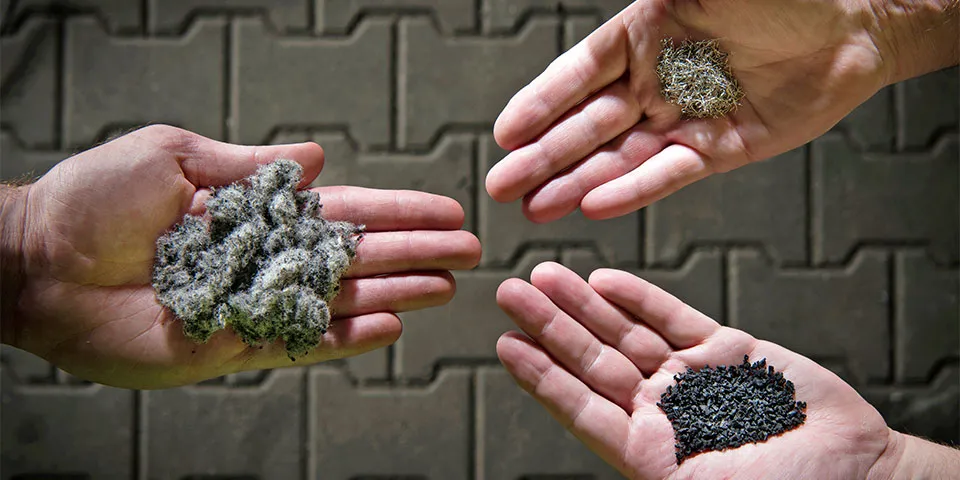
Granuband handles every stage of the recycling process in-house. Its collection division collects end-of-life car tyres throughout the Netherlands. All the tyres collected are then transported to Amsterdam, where they are sorted. Kuiper: “Many tyres in the Netherlands no longer meet the applicable MOT standards, but in places such as Africa they can still be used for years. Tyres that are genuinely damaged or have no tread left go to the recycling plant. This produces three separate material streams: steel, nylon and rubber. And we use that rubber to make new products at the same site.”
Kuiper is not concerned that supplies of raw material, namely end-of-life car tyres, will dry up in the coming years. “I don’t have a crystal ball, of course, but the expectation is that we will still be driving on tyres in 20 or 30 years’ time. Around 9 million end-of-life car tyres are collected in the Netherlands every year. Granuband collects a large proportion of them, and only a percentage of those are actually recycled at our plant. So there is already a substantial buffer. In the worst-case scenario, we will export fewer tyres abroad and recycle more.”
Then there are the other types of tyres: truck, aircraft, forklift, tractor, excavator and wheel loader tyres. “They all have different compositions, which affect the properties of the end product. That means the recycling lines also need to be configured differently. But for now, there are plenty of tyres.”
Circular
Granuband’s approach makes it unique in the Netherlands and perhaps far beyond. As Kuiper explains: “Are we unique as a collector? No, there are several collectors, including others affiliated with RecyBEM. What about recycling? There are several companies in that field too. And rubber product manufacturing? I could name plenty of companies that do that. But the complete process, from A to Z, at one site? That is where we are unique. I would say we are unique in the world. There is no other company that does what we do, from A to Z, in-house and at a single site. That makes us a truly circular business, delivering maximum CO2 savings.”
And that is essential. In the early days, it was considered quite an achievement for a tyre recycler to separate three material streams. In recent years, however, market expectations have risen sharply. Kuiper: “Companies like ours are now expected to do more than just recycle. We are expected to make a real contribution to the circular economy.”
Circularity is the word. Of course, the process would only be truly circular if old tyres could be made into new ones. Is that a realistic prospect or wishful thinking? “It is the ideal scenario. But we are not there yet,” says Kuiper. “I think there is a good chance that we will make progress within the next few years. Tyres have to meet the highest quality standards, which requires a very consistent quality of raw material. Recycled material is not yet as consistent as virgin material. But some new processing technologies are on the way, including devulcanisation, and they are promising.”
Kuiper believes the timing is right in that respect too. “There was a time when we especially did not want to tell people that our products were made from recycled material. These days, having recycled material in a product is a selling point. Manufacturers are increasingly focused on sustainable procurement, and therefore on recycled material. The day will come when tyre manufacturers also say: ‘We can no longer ignore it.’”
Knowledge Center
Granuband was founded in 1991 by managing director and owner Maarten van Randeraat. At the time, it was one of the first companies in the Netherlands to collect car tyres. Tyre recycling did not yet exist either. All the knowledge and experience Granuband has gained over the past 30 years in collecting and recycling car tyres has been brought together in the Granuband Knowledge Center. The Knowledge Center has shared, and continues to share, this expertise with various international partners. This has led, among other things, to recycling plants in the US, Israel, Croatia, Sweden and even Romania.
Question about this story? Ask your question
Keep following this
Get an email when a new story is published. No account needed.
- ThemeCircular business under changing regulations
- SubjectNews







