












Sustainable stackable blocks made from bottom ash
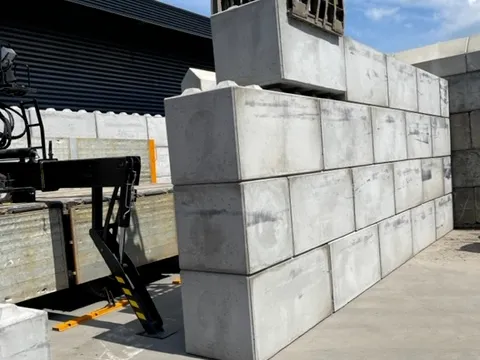
Creating storage bays, retaining walls, site boundaries, storage space or road barriers is child's play with Alphablock's stackable blocks. But did you know that Alphablock is the result of a unique, sustainable production process? Instead of using waste concrete, the stackable blocks are produced to a special ‘recipe’ containing a significant proportion of certified circular raw materials, such as bottom ash.
Alphablock uses patented technology to make concrete from bottom ash. “Bottom ash is the solid residue left after waste is incinerated at a waste-to-energy plant,” says Paul van Woensel of Alphablock. “It is packed with valuable raw materials. Using a unique process, we can upgrade the bottom ash into a clean secondary raw material that can make up a significant proportion of the recipe for our stackable blocks.”
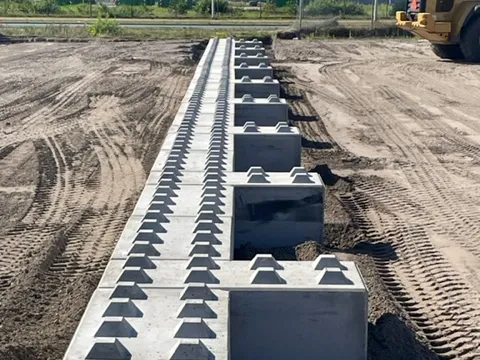
Four sizes, two variants
Alphablock's sustainable stackable blocks are available in four sizes, each in two variants: with lugs or with a flat top. “The standard size is 160 x 80 x 80 centimetres. We also supply three derived sizes in the form of infill blocks measuring 120, 80 and 40 centimetres in length,” explains Van Woensel. “Depending on the ground conditions and application, we work with Concrete Block Engineers, who prepare the calculations and drawings for structures built using Alphablock blocks. As our blocks are produced at several locations, we have a large stock. This means very short lead and delivery times.” According to Van Woensel, Alphablock's stackable blocks are competitively priced, but can also be hired for a specified period by arrangement. “Everything is open to discussion, including a buy-back arrangement.” Alphablock's added value lies in taking the project off its client's hands and managing it carefully from A to Z for
the client.
As well as stackable blocks, Van Woensel sees many more opportunities for clean secondary raw material derived from bottom ash. “We are also very happy to supply the raw material to other concrete companies, so they too can further improve their CO2 footprint. We take our responsibility very seriously by investing in sustainable and circular raw materials, so that future generations can also fully enjoy all the wonderful things the world has to offer.”
Question about this story? Ask your question
Keep following this
Get an email when a new story is published. No account needed.
- SubjectNews







