












‘Stay healthy and successful in the times we are living in’
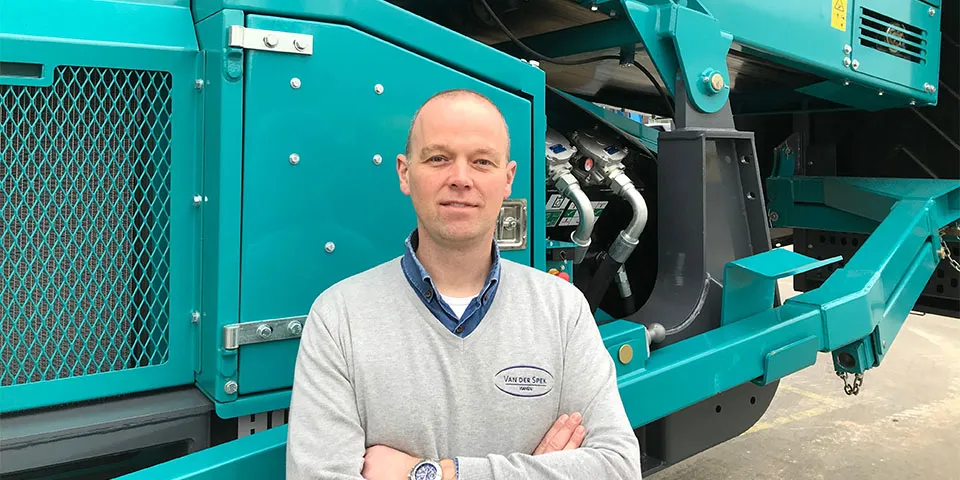
Between the first and second editions of the Dutch-language version of Recyclingpro, the whole world we live in has changed. FORWARD means, as I described earlier: ONWARDS. But right now, the key question is: what next?
We can count ourselves lucky to be working together in the wonderful world of recycling. Recycling is continuing almost everywhere, and will have to continue, as the material streams to be recycled cannot be stopped. Alongside the supply of material for recycling, the demand side naturally plays a very important role, and for some streams it is even the most important factor. It therefore remains important to achieve the highest possible purity in products through optimal separation techniques.
Significant investment can be made in processing, but if the resulting streams and products cannot be sold at the right prices, or, worse still, cannot be sold at all because everything has come to a standstill in some parts of the world, financial and logistical problems can quickly mount up. The highest-quality materials will always be preferred and can be sold at the best prices. Exporting to other parts of the world may no longer be necessary. These products can then be used closer to home in the production of new goods.
Separation technologies are developing rapidly, with traditional techniques such as screening and air separation being taken to the next level (2.0, 3.0 and beyond).
Surely a screen is a machine that separates small and large pieces, just as we used to do on the beach with a small sieve and a bucket? This is a question that still comes up from time to time. Essentially, that is still the case. The material moves up and down, and the small pieces fall through the holes. The rest stays on the screen. With the advent of special Flex mats and specially developed VDS-3D decks, it is now possible to separate not only small and large pieces, but also long and short pieces, and even 2D and 3D materials. These separations make the subsequent processing steps easier to carry out, resulting in higher-quality output.
The same applies to the wind shifter, which can now remove films from the stream as well as light and heavy materials when combined with an Airlift. Separating materials into light, medium and heavy fractions is no longer a problem either. This is a major advantage, for example, in compost processing. The compost can now be separated from stones and films.
Mechanical processing is followed, of course, by sensor technology, where major advances are being made. We are already talking about 5.0! Alongside separation based on colour and shape recognition, induction and X-rays are increasingly being used by our customers.
The latest development is the separation of black plastics from material streams using so-called Black or Blackscan technologies. The highly sensitive sensors and cameras used, combined with the latest software, are now able to identify different types of plastic in black and dark-coloured streams.
I would like to finish by saying: stay healthy and successful in the times we are living in. Things will certainly change again, and I naturally hope that happens as soon as possible.
Question about this story? Ask your question
Keep following this
Get an email when a new story is published. No account needed.
- SubjectNews







