












Smarter dust control with sustainable operation
Conventional dust suppression systems have one major drawback: they consume huge amounts of water. The workplace becomes waterlogged, and materials and goods get wet. Elsie Haertjens and Gil Jhek thought this had to be improved, particularly as water shortages are becoming more common in this region too. Since this year, they have brought their expertise together in Nebula Projects. A new company, but one with a smart, carefully engineered system that uses high pressure to tackle dust formation precisely and adapts to changing conditions. The result? Just a fraction of the water consumption, meaning this dust suppression solution quickly pays for itself.
The world is changing rapidly. In recent years, climate change has led to an increasing number of water shortages. Moreover, available land is not unlimited. Residential and working areas are becoming increasingly intertwined. If recycling companies are to remain part of their local communities, they will inevitably need to pay even more attention to dust control. This is already often included in the checklist for renewing an environmental permit. But dust control systems also need to operate ecologically and sustainably, which is often not the case today. “This is where Nebula Projects comes in,” says owner Elsie Haertjens. “Drawing on our experience in dust suppression, we set out to find a system that could do things differently and better than what is currently available on the market. We found one, and we are now raring to go, ready to support recycling companies with our solution and expertise.”
Nebula Projects aims to make a difference with a dust control system that operates intelligently and sustainably.
The benefits of misting
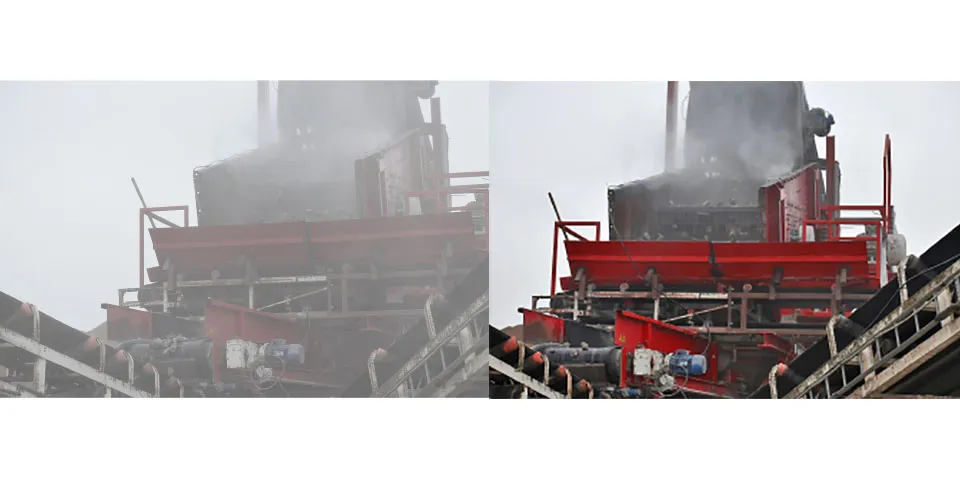
Nebula Projects’ solution is a high-pressure system. “By forcing water at high pressure through our specially developed, robust stainless-steel nozzles, with apertures of 0.2 to 0.7 mm, we create millions of tiny droplets. The microdroplets capture dust particles, weigh them down and make them settle, without wetting the material or the ground,” explains Gil Jhek. This solution is known as misting. Prof. Gerrit Van Daele of UGent sums up its benefits: “The mist droplets capture airborne dust and make it settle. The result: up to 90% less dust. That is good news for employees, who can work in a healthier environment. It also helps avoid disputes with neighbours who might otherwise lodge a complaint about dust nuisance. An added benefit of Nebula’s fixed and mobile installations is that they help slow the spread of fire.” So much for the theory. Nebula’s installations are already proving themselves in practice too. The photographs show the system in operation at Wegenbouw Ivan Vuylsteke in Meulebeke.
Nebula is convinced that its systems can help recycling companies achieve efficient dust suppression tailored to their sites.
Making the most of every litre of water
The company’s name was not chosen by chance. Nebula is the metrological term for mist. “By using misting for dust suppression, recycling companies can make the most of every litre of water. It was therefore important for Nebula Projects to have a smart system. The main challenge in dust control is the impact of changing weather conditions. That is why our system uses sensors to detect changes in the surrounding environment and adjust its operation accordingly. This also makes the system a valuable addition to fire safety,” says Haertjens. “Thanks to this adaptability, the system only operates when needed, and always as required. This means the investment pays for itself quickly.”
The robust stainless-steel nozzles create millions of tiny droplets to make dust settle.
Learning from experience
Anyone aiming to be sustainable must keep one eye on the future. Nebula Projects’ solutions are therefore equipped with the intelligence they need to learn from experience. “Until now, dust suppression has been assessed solely on the visual result: has the dust gone? We are going a step further by installing next-generation dust suppression systems. Our solutions use parameters and sensors to learn to operate more efficiently over time. Our fixed dust suppression
systems are supplemented and integrated with existing systems, as well as mobile dust cannons and dust screens,” adds Jhek. Nebula Projects has a clear mission. Haertjens says: “We are convinced that our systems can help recycling companies achieve efficient dust suppression tailored to their sites. In the coming years, we will be giving it our all to become the benchmark in dust control.” They have already shown their resilience. When Covid brought the economy to a standstill, they adapted their solution to create a mobile device capable of disinfecting even hard-to-reach areas in shops, medical and paramedical facilities, and offices.
Question about this story? Ask your question
Companies in this story
Keep following this
Get an email when a new story is published. No account needed.
- ThemeSafe and clean processing
- SubjectNews
- CompanyNebula Projects







