












Smarter dust control with sustainable operation
Conventional dust suppression systems have one major drawback: they use enormous amounts of water. The workplace ends up flooded, and materials and goods get wet. Elsie Haertjens and Gil Jhek thought this had to be improved, particularly as water scarcity is becoming more common in these parts too. Since this year, they have brought their expertise together at Nebula Projects. A new company, but one with a carefully engineered, smart system that uses high pressure to tackle dust formation precisely and adapts to conditions. The result? A fraction of the water consumption, meaning this dust suppression solution pays for itself quickly.
The world is changing rapidly. Climate change has led to an increasing number of water scarcity issues in recent years. Moreover, land is a finite resource. Living and working are becoming increasingly intertwined. If recycling companies are to remain integrated into their surroundings, they will inevitably need to pay even greater attention to dust control. This is already often part of the checklist for renewing an environmental permit. But dust control systems also need to operate ecologically and sustainably, which is often not the case today. “This is where Nebula Projects comes in,” says owner Elsie Haertjens. “Drawing on our experience in dust suppression, we set out to find a system that could do things differently and better than what is currently available on the market. We found one, and we’re now raring to get started and support recycling companies with our solution and expertise.”
With a dust control system that operates intelligently and sustainably, Nebula Projects aims to make a difference.
The benefits of misting
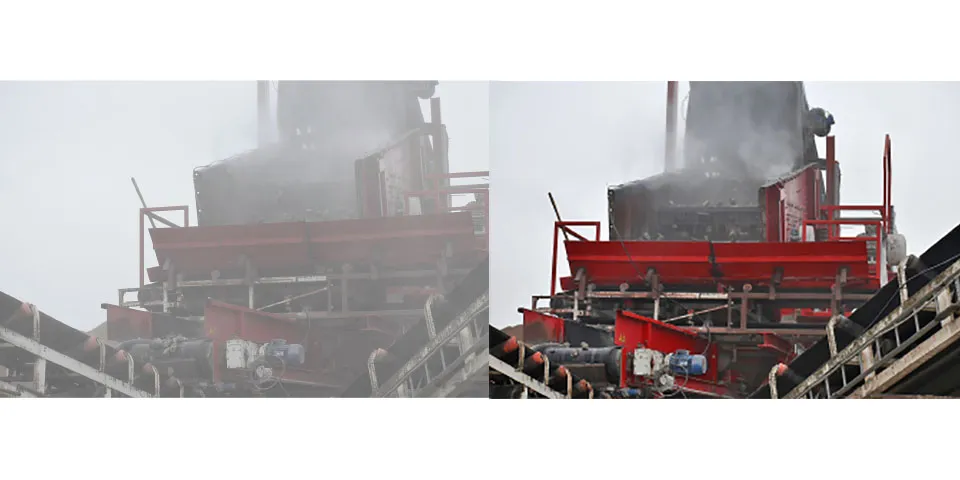
Nebula Projects’ solution consists of a high-pressure system. “By directing water at high pressure through our specially developed, robust stainless steel nozzles (with openings of 0.2 to 0.7 mm), we create millions of tiny droplets. The microdroplets capture the dust particles, weigh them down and cause them to settle, without wetting the material or the ground,” explains Gil Jhek. This solution is known as misting. Prof. Gerrit Van Daele of UGent summarises the benefits: “The mist droplets capture airborne dust and bring it down. The result: dust reduction of up to 90%. That is good news for employees, who can work in a healthier environment. It also helps avoid disputes with neighbours who might file a complaint about dust nuisance. Nebula’s fixed and mobile installations have the added benefit of helping to slow the spread of fire.” So much for the theory. Nebula’s installations are already proving themselves in practice too. The photos show them in operation at Wegenbouw Ivan Vuylsteke in Meulebeke.
Nebula is convinced that its systems can help recycling companies achieve effective dust suppression tailored to their sites.
Making the most of every litre of water
The company’s name was not chosen by chance. Nebula is the metrological term for mist. “By using misting for dust suppression, recycling companies can make the most of every litre of water. It was therefore important for Nebula Projects to have an intelligent system. The main challenge in dust control is the impact of changing weather conditions. That is why we use sensors to detect changes in the environment and adapt the system’s operation accordingly. This also makes the system a valuable addition to fire safety,” says Haertjens. “Thanks to its adaptability, the system only operates when needed, and always in the right way. This means the investment pays for itself quickly.”
The robust stainless steel nozzles create millions of tiny droplets to bring the dust down.
Learning from experience
Anyone aiming to operate sustainably needs to keep one eye on the future. Nebula Projects’ solutions are therefore equipped with the intelligence to learn from experience. “Until now, dust suppression has been assessed solely on the visual result: is the dust gone? We are going a step further and installing next-generation dust suppression systems. Our solutions use parameters and sensors to learn how to operate more efficiently over time. Our fixed dust suppression
systems are supplemented and integrated with existing systems, as well as mobile dust cannons and dust screens,” adds Jhek. Nebula Projects has a clear mission. Haertjens says: “We are convinced that our systems can help recycling companies achieve effective dust suppression tailored to their sites. In the coming years, we will be giving it our all to become the benchmark in dust control.” They have already demonstrated their resilience. When coronavirus brought the economy to a standstill, they adapted their solution to create a mobile device that could also disinfect hard-to-reach areas in shops, medical and paramedical premises, and offices.
Question about this story? Ask your question
Companies in this story
Keep following this
Get an email when a new story is published. No account needed.
- ThemeSafe and clean processing
- SubjectNews
- CompanyNebula Projects







