












Separate collection of kitchen and food waste helps close loops
From 2021, businesses will be required to collect organic biological waste separately in two phases. The first to be affected are supermarkets of at least 400 m² and businesses where hot meals are regularly served or prepared at least once a week. The rest will follow in 2024. So a delay will not mean cancellation. But what impact will this have on the collection and processing of this waste stream? And what are the main challenges involved? We talk to Renewi, which operates a large depackaging line in Kampenhout.
Many hospitality businesses, retailers and food companies are already firmly committed to the separate collection of organic biological waste (OBW). And for good reason. Renewi market development engineer Stephan Claes explains: “We still have too much food loss throughout the supply chain. Separate collection means that not everything goes to waste. We can digest it and convert it into green gas and digestate. The digestate can then be used to grow crops. It’s a great way to close the loop. The challenge is to show all businesses the added value. Residual waste really should be the very last resort, which is why separation at source is crucial. Perhaps residual waste is still being offered too cheaply.”
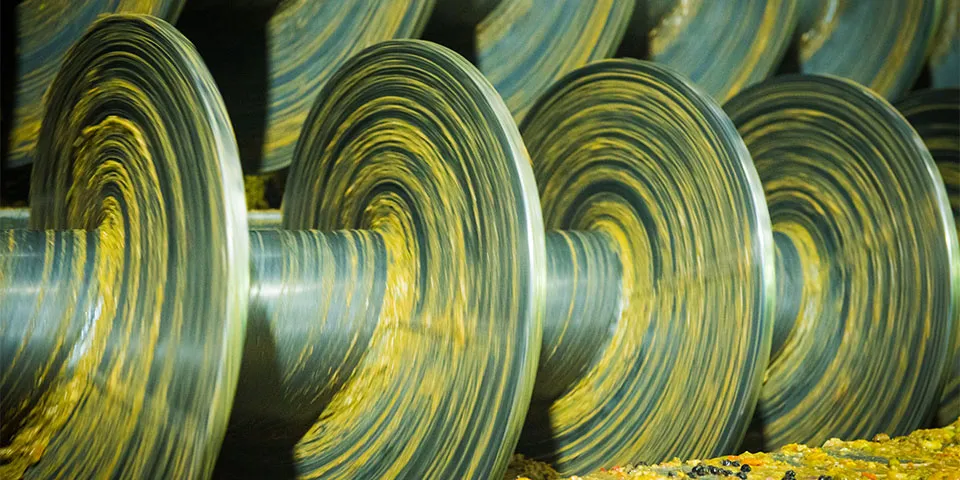
Renewi expects volumes to continue growing in the coming years, reaching 16,000 to 18,000 tonnes.
Meeting acceptance criteria is no easy task
However, collecting more OBW will also bring challenges. “A lot depends on the nature of the waste,” explains Renewi site manager Jens Crabbe. “It requires specific containers. We currently operate a swap system. We collect the full wheeled bin or pallet box from the customer and replace it with an empty, clean container. We are currently testing alternative logistics concepts to reduce logistics costs and further limit CO2 emissions during transport. We hope to have completed our homework by autumn and roll them out. The obligation will certainly lead to higher volumes.” Provided, of course, that customers sort their waste correctly. Crabbe adds: “At our depackaging facility in Kampenhout, we see that it is not so easy for businesses to follow the rules perfectly. A lot of contaminants still find their way in.”
Separation at source is crucial for processing
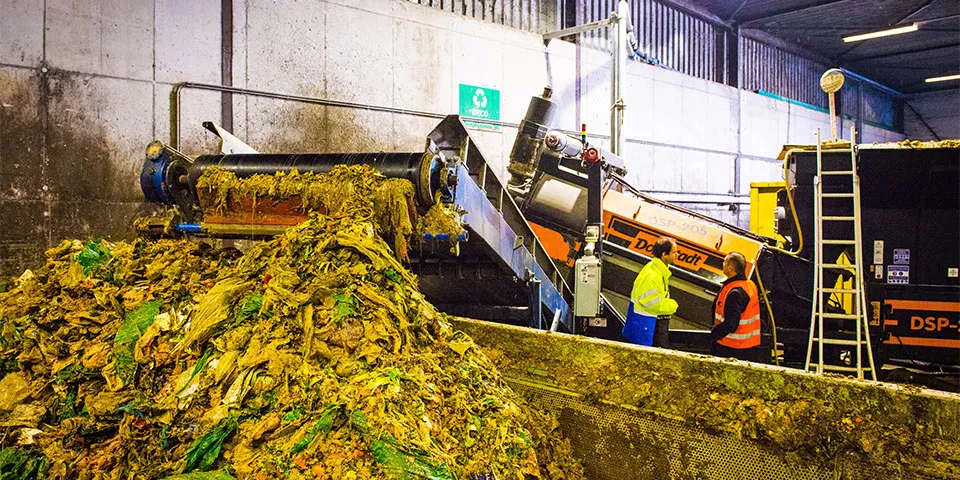
When it comes to processing, the key is to separate the OBW from its packaging perfectly. Renewi has a depackaging line for this purpose in Kampenhout. Claes says: “We have two other sites, one in Ronse and one in Mont-Saint-Hubert, but they serve purely as hubs for collecting OBW. The actual processing takes place in Kampenhout. We currently handle 12,000 tonnes. We expect this to continue growing in the coming years, reaching 16,000 to 18,000 tonnes. This will, of course, depend on how well businesses follow the rules and how quickly and rigorously the authorities carry out inspections.” The depackaging line produces an energy mix that can be sent to anaerobic digestion plants, as well as packaging residue. “It is also crucial during processing that customers follow the rules on what can and cannot go in with the OBW. The contents of the container will affect how much green gas and electricity we can extract from it,” Crabbe adds.
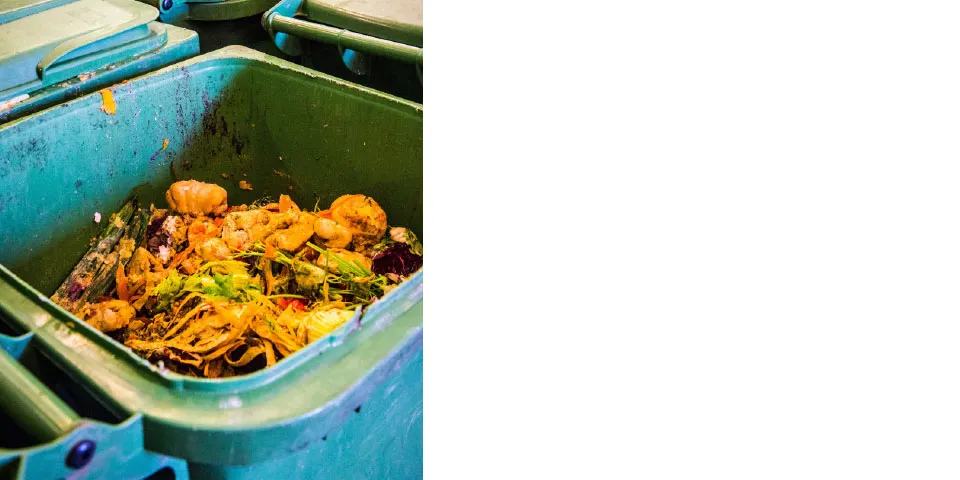
Renewi currently operates a swap system for OBW. It collects the full wheeled bin or pallet box from the customer and replaces it with an empty, clean container. It is now exploring other logistics concepts.
A sustainable end product
A second point of focus is finding the right staff. “You can imagine that the working conditions are not always the most attractive,” says Crabbe. “Especially in summer. That is why it is important to have people who are 100% motivated. The machines run well thanks to them. What makes OBW challenging and interesting is that it is not a uniform waste stream. It takes experience to achieve the ideal mix. I’m very pleased with the team we have.” Most of the energy mix from Kampenhout goes to industrial and local agricultural anaerobic digestion plants. “The local nature of anaerobic digestion plants makes their green energy production future-proof, because they process local raw materials. One kg of our energy mix can provide enough electricity to drive a Tesla Model 3 for 3 km. But we are also exploring other options. Could it be used as feed to farm insects sustainably? We believe this separate collection requirement will enable us to achieve some great things,” Claes concludes.
Question about this story? Ask your question
Keep following this
Get an email when a new story is published. No account needed.
- SubjectNews







