












Screening and improving soil
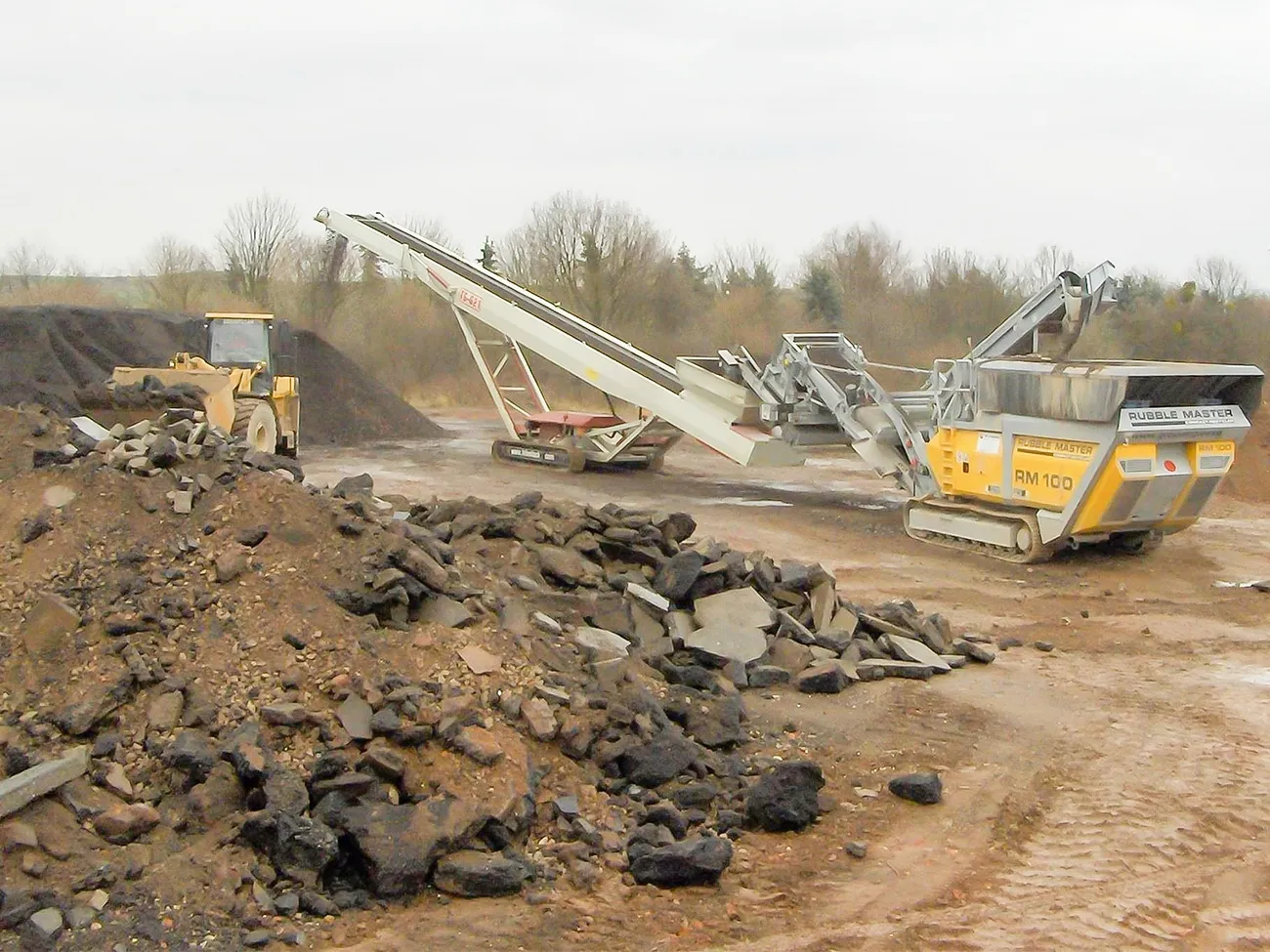
Soil screening is becoming increasingly important, as you cannot simply do whatever you like with every m³ of excavated soil. Construction sites are getting larger and deeper, and consequently the composition of excavated soil varies considerably. Screening out the stones is an important first step. The stones can then be processed more cheaply at recycling centres or used as on-site sub-base, saving on transport in turn.
There are several ways to screen different types of soil. The traditional method is to use a flat-deck screen or a trommel screen. The choice of screen depends on what you want to screen, whether it is crushed rubble, concrete, asphalt or soil containing stones. A mobile flat-deck screen is very popular, particularly the direct-feed/high-stroke type. It is easy to deploy, flexible and budget-friendly. More on that later.
Trommel screens
For soil containing stones, and when smaller aggregates are required, for example for sports pitches, operators often opt for a trommel screen. Its high drop height and cleaning brush help prevent the mesh apertures from clogging, giving the material longer exposure to the open screening surface. The downside is lower capacity and the limited use of trommels throughout the year. Even slightly damp soil can also become ball-shaped, which has a negative impact on screening results.

Star screens
Even after screening, soil may still be unsuitable for reuse because it is either not stable enough or remains contaminated. This is particularly the case when its moisture content, clay content or silt content means it lacks sufficient load-bearing capacity. These properties make the soil very difficult, or even impossible, to process with conventional screening machines. For such material streams, which require considerable energy to screen, a star screen is the next and best solution. A star screen consists of a series of shafts driven synchronously by chains. Each shaft carries a set of stars with multiple fingers. Thanks to these fingers and the angle of the screening deck, the fingers strike the soil and stones repeatedly as they pass over the screening surface, cleaning them through friction. This enables a star screen to produce an exceptionally clean intermediate fraction and oversize material. Proportional speed control allows the machine to be adjusted to suit the product, weather conditions and desired result. A star screen has the valuable ability to loosen the material, allowing it to be screened further into smaller fractions or mixed with lime or cement.
Improving the product
Once the product has passed over the star screen for the first time, it can be conveyed internally to an integrated mixer and improved with lime or cement. The action of the stars on the material helps the lime mix in more thoroughly and distribute evenly. Adding lime improves the soil’s structure and load-bearing capacity, reduces its moisture content and makes it workable again. Incorporating lime makes the soil suitable for reuse as a stable sub-base and/or fill. Cement can also be added to the soil with water to produce so-called ‘flussigboden’, or liquid construction material. This mixture can be used as backfill around pipes, ensuring they are better supported. With the correct mixing ratio, it is also self-supporting and can easily be removed later with a shovel. Its improved structure also makes it less likely to flow underground.
All year, all-round
A mobile mixing plant with screening capability is a highly versatile yet still mobile machine that can work throughout the year, even in poor weather. A star screen is also a real capacity booster, processing 150-200 t/h when mixing and achieving up to 300 t/h without a mixer, depending on the stars selected. In short, a star screen is an ‘all year, all-round’ machine that effectively separates even the most challenging soils into reusable or recyclable material streams and, when fitted with a mixer, adds value by improving that same soil in a single operation.
Question about this story? Ask your question
Keep following this
Get an email when a new story is published. No account needed.
- SubjectNews







