












Safe processing of hazardous waste
Hazardous waste is a term we would rather avoid. Yet a world without this type of waste is an illusion.
The priority, then, is to invest in technology and processes that enable it to be treated responsibly and safely, so that this waste stream can also be recovered to the fullest extent. And that technology exists.
Hazardous waste is waste with properties that can pose a risk to people and the environment, including potential explosivity, flammability or toxicity. The word ‘potential’ is important: it is far from always harmful. For many businesses, these substances are inherent to their business or production processes and are therefore unavoidable. Examples include various types of sludge, tar, oil, solvents, paint, varnish, ink, stain, adhesives and sealants. Liquid waste is often stored in plastic or aluminium drums and then handed over to a waste collector, which processes both the liquids and the contaminated containers. Some substances must be stored safely to protect the environment and our health; others are incinerated. But this means that raw materials are irretrievably lost, despite there being a third option. Licensed treatment centres can further process many types of hazardous waste so that they can still be recovered. In the case of liquid waste, the treatment process produces three usable streams. In simplified terms, the process looks roughly like this:
1. Liquids are mixed with an absorbent, often sawdust, after which they make an excellent alternative to fossil fuels such as coal and gas.
2. Solid materials are reduced in size using a shredder (SSI or IQR).
3. Screens and magnets (Elme) separate ferrous and non-ferrous metals from the waste stream for further processing by the scrap metal recycling industry.
4. The shredded plastic, wood and textiles are returned to the recycling loop or converted into energy.
5. Granulators (CSB, SSI or IQR) can be used where necessary to reduce the shredded waste further for specific recycling purposes.
A carefully controlled process
This process requires more time, labour and resources than storage and incineration, but it is essential to the transition to a climate-neutral world and a circular economy. Landfilling or incinerating waste puts further strain on the environment. We owe it to ourselves to return the waste we cannot avoid to the recycling loop wherever possible, or at least convert it into sustainable energy. Expertise and safe installations are essential for this process to succeed. Quality checks are built into every stage of the treatment process. For example, licensed treatment centres do not accept any substance without a thorough analysis to establish whether the material meets the acceptance criteria and can be properly treated. A range of measures are taken to avoid potential risks. As combining and mixing different substances can be hazardous, shredders from SSI process waste one batch at a time. Both the treatment operator and external bodies carry out conformity checks to ensure the process is running correctly. Finally, treated materials are only sent to their next destination after a thorough laboratory analysis.
A bespoke installation
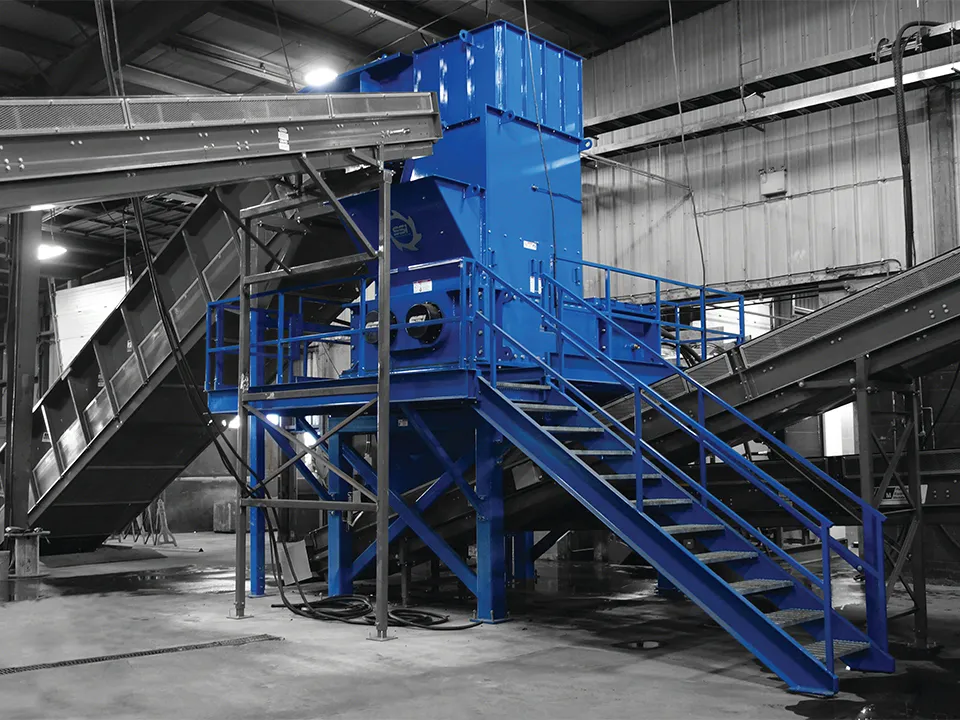
A suitably adapted installation is also crucial. Although drums are drained as thoroughly as possible, they are rarely entirely free of potentially hazardous substances. Residues can remain stuck to the inside of the drum, or sludge and hardened paint can collect at the bottom. Processing them in an unsuitable shredder poses risks to the installation, the treatment centre and, above all, the people working there. One of the leading players specialising in the design of safe installations for hazardous waste treatment is SSI, represented in Belgium by CSB Waste Solutions. The shredders are always built to order, and the following modifications are commonly made:
Sliding gates are installed to create an enclosed space, both at the top, where material is fed in, and at the bottom, where shredded material is discharged. Shredding only takes place when the gates are closed, and the lower gate opens only once the process is complete, allowing the shredded material to be discharged safely.
- Installing fire detection and suppression systems.
- Fitting a nitrogen system to minimise the risk of fire and explosion.
- Precisely calibrated rotational speed to reduce sparking and the risk of fire.
- Using explosion-proof motors.
These technological advances make it possible to process potentially hazardous waste safely and make the process more sustainable, as the raw materials can be put to optimum use afterwards.
Question about this story? Ask your question
Keep following this
Get an email when a new story is published. No account needed.
- SubjectNews







