












Reversible bonding: a positive story for the environment and the economy
Text Saar BenteinImage Flanders Make
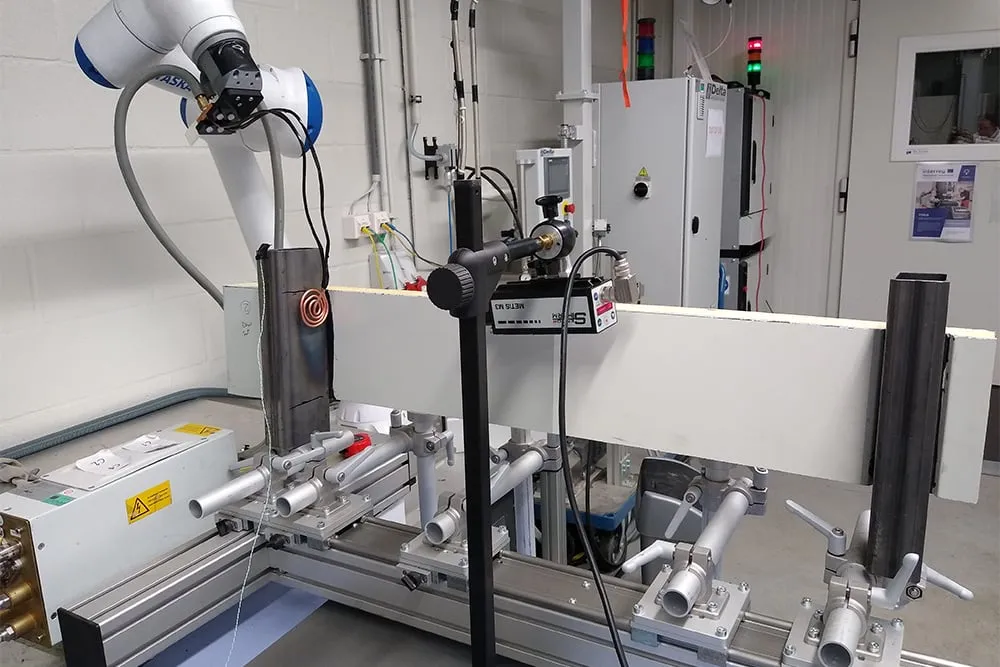
Bonding is essential for many companies to join multi-material assemblies easily. But debonding the adhesive during assembly, to repair products or separate waste streams, is still a different matter. The Circular Bonding project aims to change that: reversible bonding is feasible, sustainable and can be economically viable.
“Interest in the circular economy is growing, and the topic of reversible bonding has been simmering for some time. How can we take bonded parts apart? What options do we have if we need to repair part of a product? And how can we do this cost-effectively? These are questions companies are asking, but so far there is no definitive answer,” says Isabel Van de Weyenberg, Project Leader at Flanders Make. Flanders Make, BIL (the Belgian Welding Institute) and VITO therefore joined forces, with support from an advisory group of thirteen companies. When the project started in April 2021, the first step was an extensive literature review to map the technologies available and those with the potential to be scaled up. In consultation with the advisory group, it was decided to pursue thermally expandable particles. These are added to an existing adhesive. At a certain temperature, they expand and break the adhesive bond. Van de Weyenberg says: “We chose to take this technology further because it is straightforward and can be used across a range of sectors.”
Every case is different
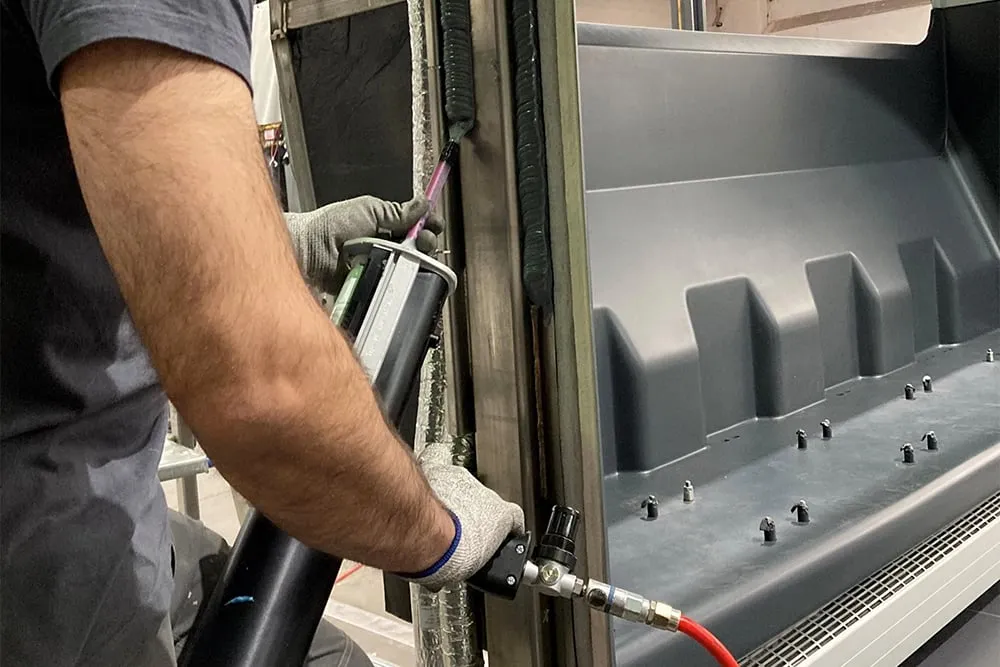
To test and demonstrate the technology’s feasibility in practice to as broad an audience as possible, three demonstrators were selected. One involved a bus manufacturer that bonds large parts together during production. If an assembly error occurs and the parts cannot be separated, they have to be scrapped. Case 1 explored how reversible bonding could avoid this cost. Another case looked at how expensive components could be easily removed from an electronic device. A third, in the construction sector, focused on removing floor coverings from a modular container unit. “In electronics, we are dealing with small parts that need to be removed at end of life. Our demonstrator in the vehicle sector, a bus manufacturer, involves large parts assembled during production. Our experience with bonding at Flanders Make has taught us that there is no generic, one-size-fits-all solution. Every case requires a different approach,” explains Van de Weyenberg.
A positive business case
The Circular Bonding project originated in an earlier European project. “Bringing VITO on board as a partner really got our project off the ground,” says Van de Weyenberg. VITO takes a holistic view of the circular picture. It goes beyond environmental analysis and also carries out an extensive economic analysis. “The circular economy is a good thing, but what will it cost me and what will I get out of it? You need to be able to answer that question if you want to get companies to take real action. That is what VITO does. It has the expertise to determine what incentives are needed to turn the technology into a positive business case,” explains Van de Weyenberg.
Feasibility demonstrated
When asked, the project partners and advisory group members were positive. Reversible bonding is feasible. The project also gave them greater insight into the technologies available on the market. “With reversible bonding, you start from what you know, then adapt it to the specific application. At Flanders Make, we therefore provide companies with one-to-one support. Our collaboration with VITO is a positive for them. Companies are moving away from traditional linear thinking and towards a circular approach that can be positive for both the environment and the economy.”
Question about this story? Ask your question
Keep following this
Get an email when a new story is published. No account needed.
- SubjectNews







