












Reusable packaging becoming increasingly commonplace
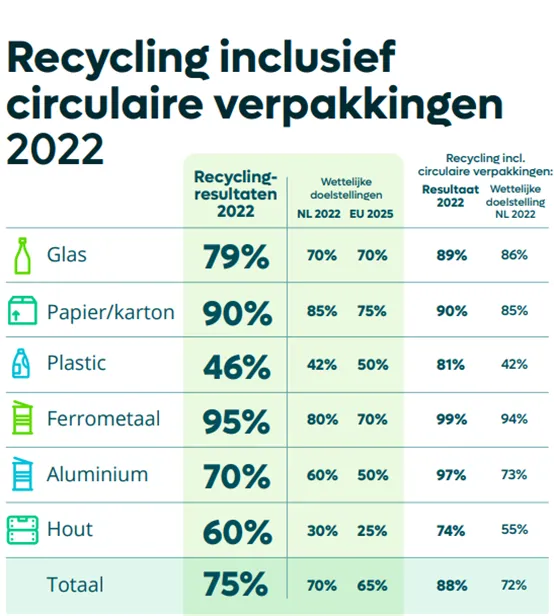
In 2022, a total of 88% of all packaging was recycled and reused, up from 80% in 2021. This is according to the annual public report ‘Towards fossil-free and circular packaging’ from Afvalfonds Verpakkingen.
Reusable packaging
The Netherlands is achieving strong results, showing that it takes packaging seriously. Packaging is not only being recycled, reusable packaging is also being used increasingly often. Many reusable business-to-business packaging items are already in use in closed-loop systems, such as pallets, transport crates and beer kegs. And these systems work well. The total weight of reusable packaging is now roughly equal to the total weight of single-use packaging in the Netherlands.
This also shows that uniformity and standardisation of systems are crucial to success. Afvalfonds Verpakkingen plays a coordinating role and aims to make reusable packaging possible for everyone in the Netherlands. This requires a nationwide, collective infrastructure. Local initiatives are valuable, but too fragmented to provide an efficient nationwide solution. That is why Afvalfonds Verpakkingen is focusing on uniform, user-friendly packaging reuse systems, including logistics and cleaning.
Consumer convenience
“The Netherlands ranks second in Europe for recycling. Each year, we take another step towards our goal of making packaging entirely fossil-free and circular by 2050, as set out in De Plastic Wijzer. By 2030, 100% of all packaging must be recyclable. Good cooperation across the waste chain is important, but more is needed to achieve our goal, such as simplifying waste separation rules. Packaging can only be processed and recycled optimally if it enters the correct waste stream after use. Consumer convenience must therefore be the starting point for everything. We need to make things easy for consumers not only by harmonising collection systems nationwide, but also to make reusable packaging and deposit return a success,” says managing director Hester Klein Lankhorst.
Recycling plastic packaging
The report shows that all statutory recycling and reuse targets are being met, but significant further progress is needed to close the loop on plastic packaging through recycling. The recycling rate stood at 46% in 2022, compared with 49% in 2021. This is largely attributable to the coronavirus restrictions in 2020 and 2021. With hospitality venues, offices, schools and other establishments closed, households put out more packaging waste. In 2022, people consumed more out of home again, leading to a decline in the recycling of plastic packaging.
Klein Lankhorst: “To ensure that even more plastic packaging waste is properly recycled into raw materials for new products and packaging, we are working hard on three necessary improvements. These are more innovation and better sorting and recycling technologies, the development and use of packaging that is easier to recycle, and better, consumer-friendly collection systems. And, of course, packaging should simply be avoided or made reusable wherever possible. These are all actions to achieve the goals of De Plastic Wijzer.”
Deposit return for bottles
The Netherlands has had a successful deposit return system for large plastic water and soft drink bottles for many years. Small plastic bottles were added to the system on 1 July 2021. This also quickly had a positive effect on litter. In 2022, the number of small bottles found as litter fell by 51% compared with 2020 (source: Ministry of Infrastructure and Water Management).
In 2022, 68% of all plastic drinks bottles (small and large, with and without a deposit) were collected. This means the statutory target of 90% has not yet been met. Klein Lankhorst: “So we are not really satisfied. Nevertheless, consumers deserve credit for making a significant change in behaviour in a short time. 91% of people in the Netherlands know about the 15-cent deposit on small plastic bottles. That is good, but it needs to improve. We know that changing behaviour takes time. More communication, repeating the message consistently and expanding the number of return points should further encourage people to return their bottles.”
Increasing collection
In 2023, significant further investment was therefore made in nationwide communication and promotion, increasing the number of return points and improving return points and collection machines. This involves working with as many partners as possible, including not only supermarkets, petrol stations and sports clubs, but also NS, airports, schools, theme parks and events. On 1 April 2023, the deposit return system was extended to cans, helping to retain more valuable raw materials and tackle litter.
About Stichting Afvalfonds Verpakkingen
Stichting Afvalfonds Verpakkingen is responsible on behalf of companies that place packaged products on the market for collecting and recycling that packaging, including operating the deposit return system, and reporting to the government. Companies jointly fund the system by paying Afvalfonds Verpakkingen a contribution for each item of packaging. From 1 January 2023, this also includes packaging waste similar to household waste generated at schools, offices, shops and other locations. Together with businesses, Afvalfonds Verpakkingen ensures that even more waste gets a second life as a raw material for new products or packaging. Its ultimate aim is to ensure that by 2050 all plastic packaging is 100% fossil-free and circular, and no longer harms people or the environment.
Question about this story? Ask your question
Keep following this
Get an email when a new story is published. No account needed.
- ThemeMaking plastics and packaging circular
- SubjectNews







