












Recycling wastewater to heat homes
Sewer heat recovery is gaining ground in the Netherlands
Wastewater can also be recycled. And as the Netherlands has to move away from gas in the coming decades, this is happening more and more often. Sewer heat recovery is the technique used to recover heat from wastewater. While Switzerland and Germany already have plenty of experience with it, in the Netherlands the technology is only just out of its infancy. Swimming pools, schools and homes are cautiously being heated this way. In Amsterdam, housing association De Key now wants to use it to heat 1000 homes.
Sewer heat recovery literally means heat from the sewer. Sewer pipes are warm, after all. The average temperature of wastewater is around 8 to 10 °C in winter and 20 to 25 °C in summer. This is because much of the waste is warm when it is washed away, for example when we wash our hands, drain potatoes or let shower water run away. The temperature is more than high enough to supply a heat pump.
To capture the heat, pipes are wrapped around the sewer pipes or a kind of shell is placed inside the sewer. The fluid in these pipes, or flowing through the shell, heats up as a result. An electric heat pump then raises the temperature to a usable level for heating buildings, helping to create a comfortable indoor climate.
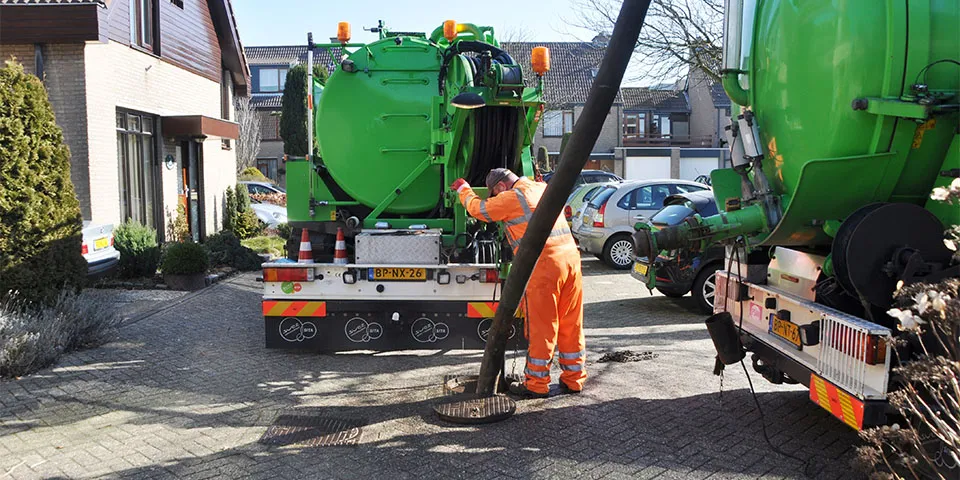
Sewer renovation in Zoetermeer.
Heat network
Around 100,000 kilometres of sewer pipes lie beneath the Netherlands. More and more companies and municipalities regard this valuable infrastructure as a heat network. Efficiently using the available heat can accelerate the transition to sustainable energy. Sewer heat recovery can be used with a low-temperature system, such as underfloor heating or convectors. However, it is less suitable for older heating systems that require high temperatures, which are common in existing buildings. Sewer heat recovery always involves installing a heat exchanger, a technology that can also transfer heat for cooling. This makes the system suitable for both heating and cooling.
In recent years, industry players such as KWR Watercycle, Royal Haskoning and consultancy and engineering firm Tauw Groep have carried out various studies to assess its feasibility in the Netherlands. The findings are now being put into practice. Schools, swimming pools and, for the past year and a half, homes have been connected to heat from the sewer. Goes was the first, with an apartment block containing 60 homes. Now, however, Amsterdam housing association De Key is considering connecting no fewer than 1000 homes in Amsterdam Noord. This would be the first application of sewer heat recovery in Amsterdam.
The plan is to build a ‘source network’ in the neighbourhood. Wastewater at around 15 degrees Celsius will be delivered to the homes through this heat network. Heat pumps powered by green electricity will then raise the temperature in the apartment blocks to the required level.
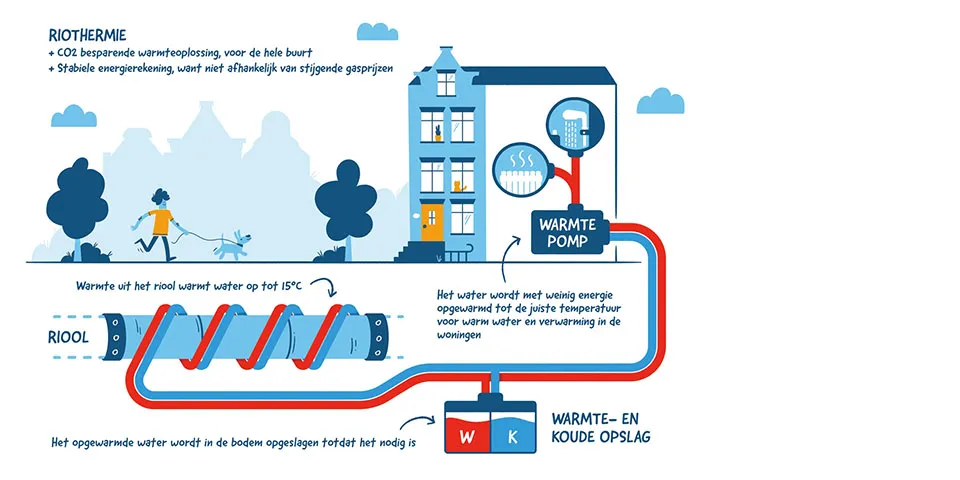
The plans of housing association De Key.
Insulated
As these are existing homes, they are unlikely to be insulated well enough to stay comfortably warm throughout the winter using sewer heat recovery alone. The communal gas boilers in the apartment blocks will therefore remain in place to provide extra heat during the coldest months.
When the apartment blocks are eventually due for renovation and receive modern insulation, the gas boilers will be removed. Until then, a great deal of gas will already be saved: 75 to 90 per cent, according to initial calculations.
Gravity flow
Sewer heat recovery has been used in countries such as Germany and Switzerland for more than fifteen years. There are several reasons why the Netherlands is lagging behind. In other countries, for example, sewers have more ‘gravity flow’, so the water flows faster and less dirt settles, resulting in better heat transfer. In addition, homes in the Netherlands are connected directly to the main sewer, whereas other countries often use a collection point, which opens up more possibilities. The Netherlands also has an extensive natural gas infrastructure, and central heating boilers are still very cheap. The relatively high investment costs of sewer heat recovery made it difficult to compete for many years. The government’s aim to move away from fossil energy is changing the landscape, giving sewer heat recovery a chance to take off.
Question about this story? Ask your question
Keep following this
Get an email when a new story is published. No account needed.
- SubjectNews







