












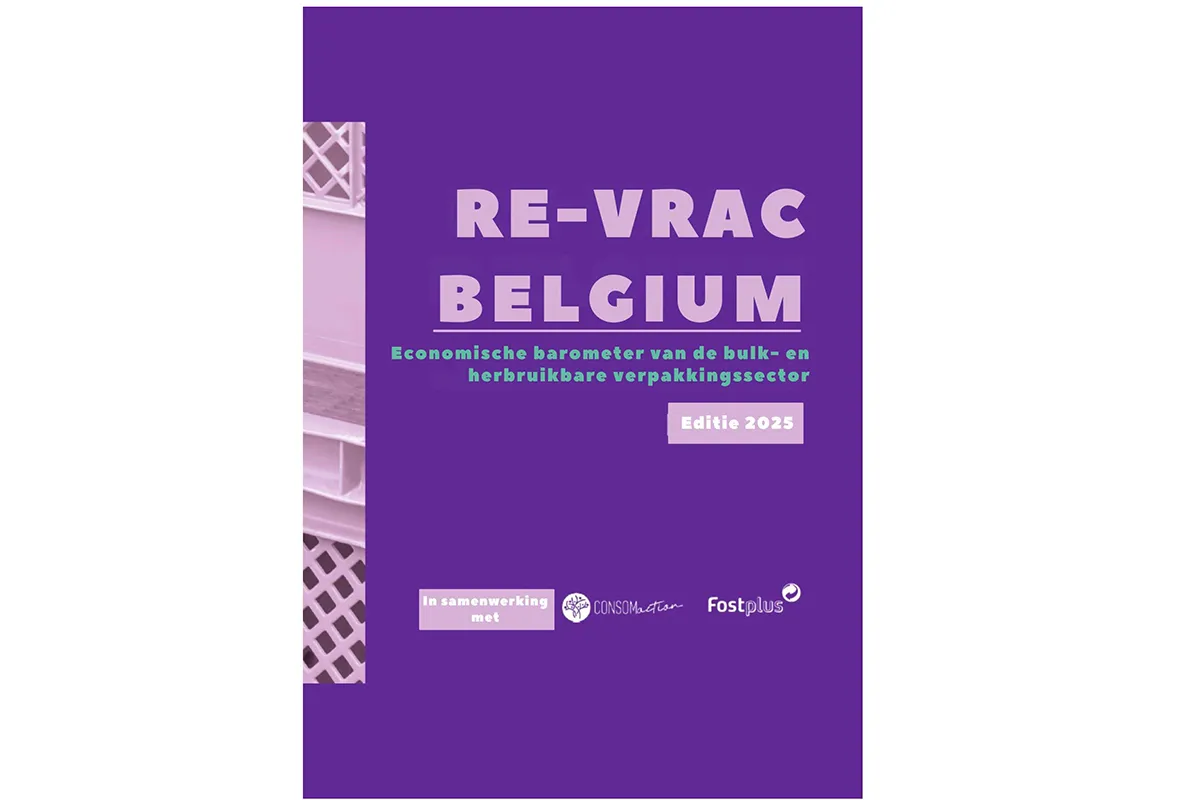
RE-VRAC Belgium: First barometer on bulk sales and packaging reuse
The sector is ready, but consumer demand is lagging behind
With proven logistics systems, strong industry commitment and deep cultural roots, Belgian businesses are well placed to make reusable packaging and bulk sales even more popular. But greater consumer participation is crucial if these systems are to become fully fledged alternatives to single-use packaging.
This is the conclusion of the first economic barometer on bulk sales and reuse in Belgium: RE-VRAC Belgium. The study is the result of a collaboration between Fost Plus and ConsomAction. This initial analysis lays the foundations for tracking the economic, social and operational development of bulk sales and reuse in Belgium year on year.
A growing, innovative market held back by systemic obstacles
90% of the bulk-sector businesses and 80% of the reuse operators that took part in the barometer were established after 2010. This reflects both the sector’s recent growth and the operational maturity of its players. The rapid growth in bulk sales can be explained by the use of straightforward technologies and commercial practices that do not require major industrial investment. Reuse has a long tradition in Belgium, for example for drinks such as fruit juices and beer. Most of the businesses surveyed are small, with an average of 1 to 2 full-time employees, sometimes supplemented by volunteer work.
Revenue from reuse grew by an average of 11% a year between 2022 and 2024, while bulk sales grew by 7% annually. More than half (58%) of the businesses surveyed already generate a positive operating margin. This is mainly true of businesses operating in transport and B2B HoReCa, where systems are mature and competitive thanks to more predictable consumption models. Retail, B2C hospitality and e-commerce, by contrast, are less profitable, owing to their dependence on individual consumer habits and thinner margins.
“This barometer confirms that Belgium has a solid foundation and significant potential to make reuse and bulk sales the new standard in a circular market. Yet we see many players seemingly waiting for the market to evolve to the point where sustainable production and consumption become obvious, competitive and cost-effective. This way of thinking is holding back progress in the sector. To break out of this vicious circle, it is essential to develop mechanisms that can turn this potential into actual market adoption,” says Sylvie Droulans, Director of ConsomAction.
Bulk sales: a more responsible way to shop, but not yet an established habit
Food products dominate the bulk sector, although non-food products such as cosmetics, household goods and hygiene products are also gaining ground. The range of products on offer varies widely. Bulk is usually a complement to pre-packaged products rather than an exclusive model. A third of the participating businesses say that more than half of their bulk products are of Belgian origin, and that most of these travel less than 50 km. This points to a strong preference for local products and support for local businesses.
The main obstacles to switching to bulk sales:
- Bulk sales have yet to become sufficiently established among consumers (42%), owing to competition from pre-packaged products, lack of habit, perceptions of complexity and concerns about hygiene.
- Logistical constraints (18%): some products are unsuitable for bulk transport, while insufficient capacity and storage can also pose obstacles.
- Regulatory complexity (16%), for example around labelling, hygiene and traceability, which is often considered vague or inadequate.
Reuse: a strong trend held back by high costs and logistical obstacles
Reusable household packaging is on the rise: reusable packaging already accounts for 43% of household packaging and 82% of industrial packaging on the Belgian market, by weight1. Nevertheless, barometer respondents see the cost of reusable packaging as the biggest obstacle. Its unit price is often higher than that of single-use packaging, influencing consumer choices.
The businesses surveyed identified the following key obstacles:
- Reusable packaging has yet to become sufficiently established among consumers (32%): consumer habits will change only when the right incentives and infrastructure are in place.
- High investment costs (23%), linked to improving the supply chain (23%), as coordination between the collection, cleaning and redistribution of reusable packaging often remains highly fragmented.
A shared challenge: making bulk sales and reuse accessible and attractive
According to Fost Plus’s 2024 environmental barometer2, 56% of Belgians consider climate change a major challenge and 80% think there is too much single-use packaging. 82% of Belgians always sort their waste at home. Yet only 33% say they already choose reusable packaging.
This gap between our intentions and our actual behaviour shows the urgent need for practical solutions, incentives and stricter rules.
“Change must be driven by all economic actors. Businesses are calling for a clearer framework that gives them long-term certainty. Consumers, meanwhile, need better guidance so that sustainable choices become second nature. Our ambition is clear: alongside recycling, reuse and prevention are the levers we need to move towards a truly sustainable packaging materials chain,” emphasises Valerie Bruyninckx, spokesperson for Fost Plus.
1 Figures from Fost Plus and Valipac, 2024
2 https://www.fostplus.be/nl/milieubarometer
ConsomAction is the Belgian federation of professionals working in bulk sales, reuse, sustainable consumption and the circular economy. We bring together shops, suppliers, producers, service providers and the hospitality sector, working with them towards a local, ethical and environmentally friendly model. Together, we make our voice louder and more credible, and can make our production and consumption habits more sustainable.
Question about this story? Ask your question
Keep following this
Get an email when a new story is published. No account needed.
- ThemeMaking plastics and packaging circular
- SubjectNews







