












Polystyrene industry joins forces
New plant in Terneuzen to recycle HBCD-containing EPS
More than 60 companies and institutions are working together in Polystyrene Loop, a pilot plant where HBCD-containing EPS will be recycled in the coming years. Work is currently under way around the clock in Terneuzen to get the plant operational early next year. In addition to collecting and recycling EPS, this will also make it possible to recycle EPS from the construction sector at all times.
The demolition and renovation of homes built in the 1970s will bring a large volume of insulation material onto the recycling market in the coming years. And although EPS (polystyrene foam) is already widely recycled, a substantial proportion still ends up in incinerators. The reason? The brominated flame retardant hexabromocyclododecane (HBCD). HBCD is a substance that was formerly used as a flame retardant in various products, including EPS. HBCD is now banned: it has not been allowed to be produced since 2015, nor can it be placed on the market in new products. This affects the recycling of HBCD-containing EPS. HBCD can in principle be destroyed by incineration, but incineration has no place in a circular economy. The industry has therefore sought a solution to recycle HBCD-containing EPS.
That solution is the PolyStyrene Loop project, a European partnership bringing together companies and other stakeholders from across the EPS value chain.
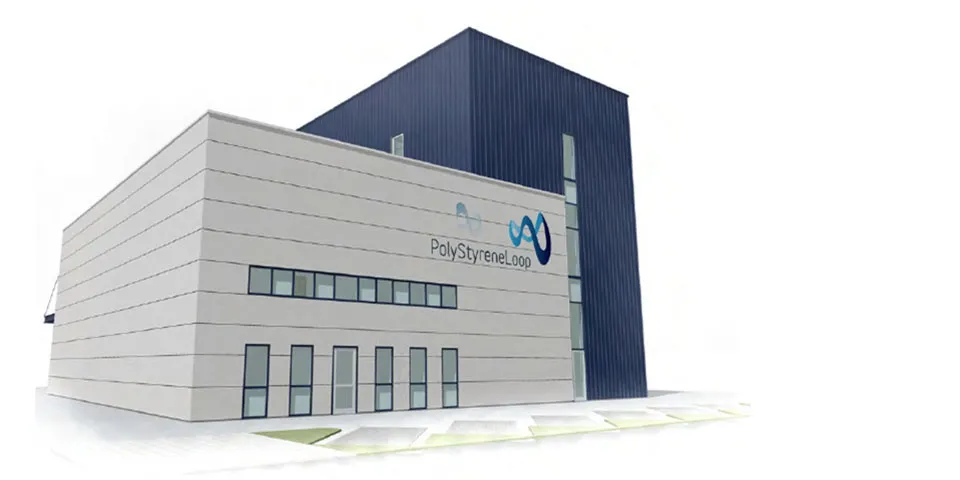
The pilot plant.
Research institute
To separate HBCD from polystyrene waste, PolyStyrene Loop uses a process developed years ago by the German research institute Fraunhofer and the company CreaCycle GmbH. The polystyrene is dissolved in a mixture of organic solvents. Contaminants and additives, including the brominated flame retardant HBCD, are separated out during the process. The result is clean polystyrene, which can be reused without difficulty in a wide range of applications. The brominated residue can be processed by Polystyrene Loop partner ICL-IP (formerly Broomchemie) at its Broom Recovery Unit in Terneuzen.
Partnership
The investment in the Polystyrene Loop pilot plant in Terneuzen, on the ICL-IP site, amounts to 15 million euros. The European Union and the province of Zeeland are contributing a total of 3.7 million euros. The partnership of supply chain stakeholders is contributing the same amount. The other financiers are Rabobank and the Nationaal Groenfonds.
The pilot plant can process 3,300 tonnes of European construction-grade polystyrene foam a year. Depending on the available supply, it could be expanded or a second plant could be built elsewhere in Europe. A collection system has already been set up, with collection points in numerous countries.
Question about this story? Ask your question
Keep following this
Get an email when a new story is published. No account needed.
- SubjectNews







