












New OVAM sorting analysis shows: Businesses are sorting better, but further efforts are still needed!
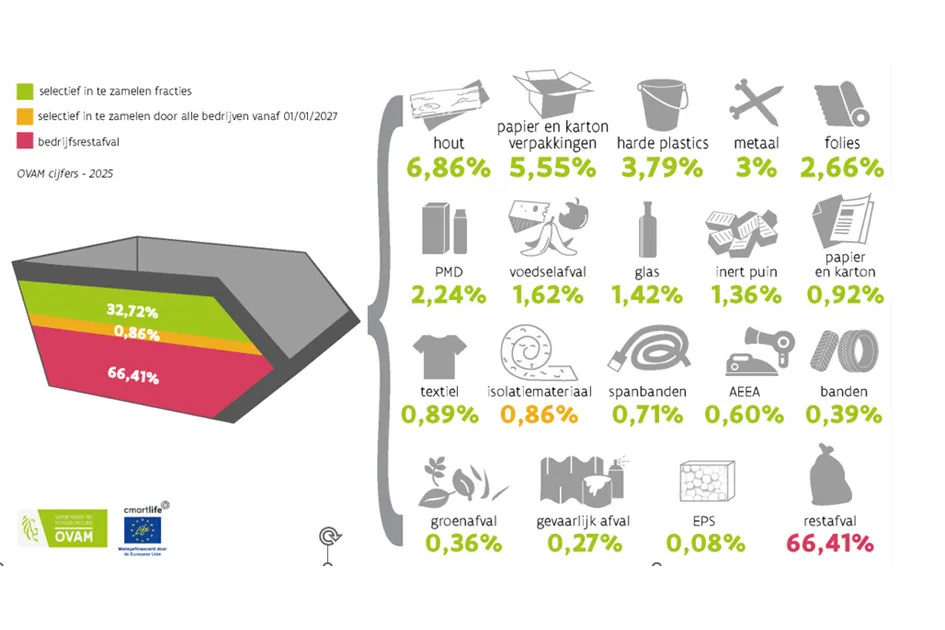
Every four years, OVAM commissions a sorting analysis of commercial residual waste to monitor how businesses in Flanders sort their waste. The analysis covers both skip containers and wheeled bins, across all sectors and business activities. The study is part of the Local Materials Plan and is funded through Cmartlife. It builds on the previous sorting analyses from 2017 and 2021-2022, making it possible to compare the results.
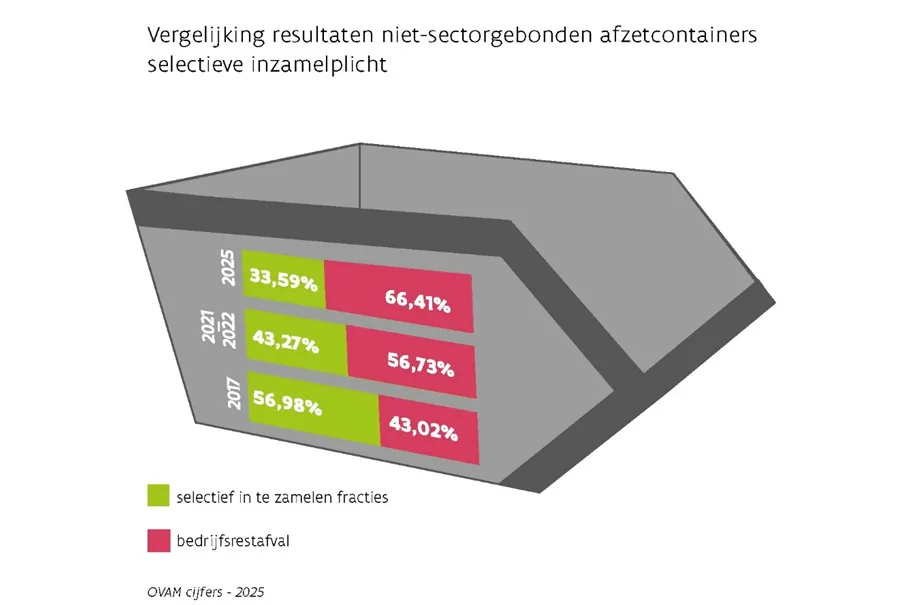
The recent sorting analysis of commercial residual waste published by OVAM shows that, on average, 34% of the waste sorted from skip containers consists of fractions that, under current regulations, should have been collected separately. In the 2021-2022 analysis, the figure was 43%. For wheeled bins, an average of 40% consists of fractions that must be collected separately, compared with 55% in the 2021-2022 analysis. This points to a positive trend, although there is still room for improvement. For example, commercial paper and cardboard packaging is still too often thrown in with residual waste in skip containers. In wheeled bins, meanwhile, we are seeing an increase in PMD waste compared with the previous analysis.
The results of the current sorting analysis of non-sector-specific commercial residual waste from both skip containers and wheeled bins were compared with the 2017 baseline study and the follow-up study from 2021-2022.
Commercial residual waste from skip containers
In 2025, 36% of the commercial residual waste from skip containers consisted of technically recyclable fractions, compared with 57% in 2017 and 48% in 2021-2022. The share of fractions that must be collected separately has fallen by 23 percentage points compared with the baseline, and in 2025 still accounted for 34% of total residual waste. The wood and inert rubble fractions in commercial residual waste from skip containers have declined sharply over the years. Film plastics, which doubled in 2021-2022, have returned to the baseline level in the current study. Paper and cardboard initially increased, but fell again in 2025. The share of PMD remains at the same level as in 2021-2022, but is considerably higher than in the 2017 baseline study, presumably as a result of the expanded sorting instructions.
Commercial residual waste from wheeled bins
The average technical recyclability of commercial residual waste from wheeled bins has fallen by 10 percentage points since the baseline study and now stands at 42% of total residual waste in 2025. The share of fractions that must be collected separately has fallen by 12 percentage points compared with the baseline, and now stands at 40% of total residual waste.
In commercial residual waste from wheeled bins, film plastics and wood have halved compared with the baseline study. Food waste initially increased in 2021-2022, but then fell to 2 percentage points below the baseline level. PMD continues to rise, increasing by 2 percentage points compared with 2021-2022 and by 6 percentage points compared with 2017.
How do specific sectors sort their waste?
To monitor food waste, this sorting analysis also included separate sorting for a number of specific sectors: education, healthcare, hospitality and supermarkets. This analysis was less extensive. At least 57% of commercial residual waste from the hospitality sector consists of technically recyclable materials. More than half of this is food waste, divided almost equally between edible and inedible food waste. PMD is also still prevalent (14%). In education, too, readily edible food waste still ends up in residual waste, including prepared meals, vegetables and fruit. At least 69% of commercial residual waste from supermarkets consists of technically recyclable materials, mainly food waste (for example, bread and orange peel) and PMD. The largest fraction in residual waste from the healthcare sector is nappies and incontinence products, which account for more than 40% of the total.
Flemish Minister for the Environment Jo Brouns: “Businesses in Flanders are making clear progress in sorting their waste, but there is still room for improvement. Good source separation starts on the shop floor. Businesses, waste collectors and government all have a role to play. Through targeted guidance and enforcement, we will ensure that recyclable materials are no longer lost in residual waste.”
Why are businesses sorting better?
We are seeing an improvement compared with the previous sorting analysis in 2021-2022, due in part to:
- the expanded requirement for all businesses to collect kitchen waste/food scraps separately, in force since 2024;
- targeted inspections of waste producers by the ‘source separation enforcement officers’ in the Enforcement Division (Department of Environment), funded through the ‘half-euro work plan’.
The impact of the following policy measures remains to be seen:
the introduction of billing per kg of commercial residual waste from 1 January 2026;
- the extension of the separate collection requirement to include several construction and demolition fractions (3 new streams planned from 2027);
- the option to collect dry, non-hazardous recyclable fractions, which may affect the wood waste fraction in skip containers.
In any case, several notable findings emerged:
- the share of commercial paper and cardboard packaging remains high;
- the share of PMD in wheeled bins has risen slightly.
Under the regulations, it is always possible to sort recyclable material out of commercial residual waste after collection, but policy continues to focus on source separation by the waste producer.
>> Read the study at https://ovam.vlaanderen.be/sorteeranalyses.
Een zakelijke vraag aan OVAM? Get in touch
Companies in this story

Keep following this
Get an email when a new story is published. No account needed.
- SubjectNews
- CompanyOVAM







