












More choice for more efficient use
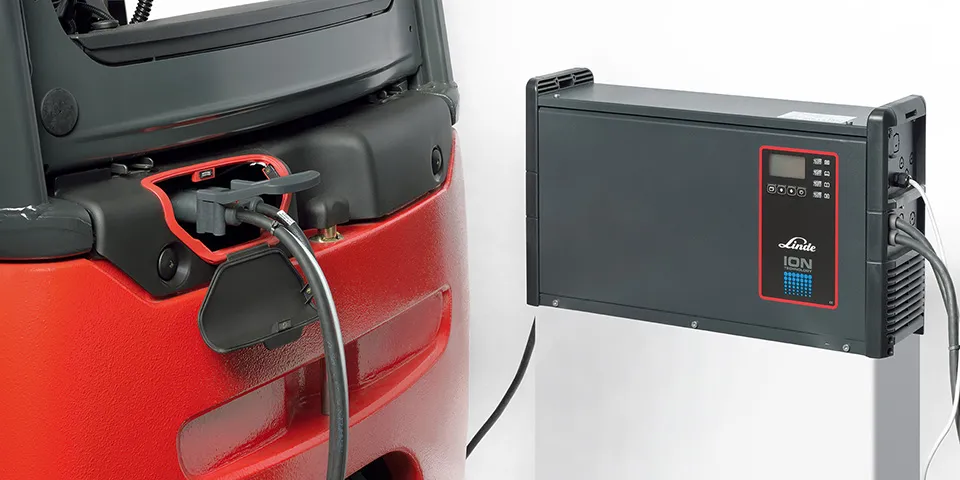
The right battery for every application: this is what intralogistics specialist Linde Material Handling promises its customers. Matching the lithium-ion battery to the application and truck type delivers immediate cost savings.
Compared with conventional lead-acid batteries, lithium-ion batteries in industrial trucks offer numerous benefits: opportunity charging and short charging times ensure high availability, while the efficient overall system reduces energy costs. Other benefits include a service life at least three times longer, no maintenance and lower operating costs.
The only drawback of the innovative energy system is the battery’s relatively high purchase cost. “As costs rise with increasing capacity, batteries must be matched precisely to the customer’s needs,” says Christoph Englert, Product Manager for Energy Strategy and Solutions at Linde Material Handling. It goes without saying that the greater the range of battery capacities available, the easier it is to achieve this.
Linde Material Handling is therefore expanding its lithium-ion battery portfolio.
For forklifts with a load capacity of 2 to 3.5 tonnes (Linde E20 to E35),
the existing 24.1 kWh and 60.3 kWh battery versions have been supplemented by a larger model with a capacity of 84.6 kWh. It is designed for applications with high energy consumption, for example in the paper and beverage industries. In addition, a new medium-capacity battery has been added for industrial forklifts with a load capacity between 3.5 and 5 tonnes. In this range, Linde Material Handling is filling the gap between the smaller battery (36.2 kWh) and the larger battery (118.4 kWh) with a 66.3 kWh battery. Last but not least, a second battery size of 64.7 kWh is now available for 6 to 8 tonne forklifts, alongside the existing 118.4 kWh battery.
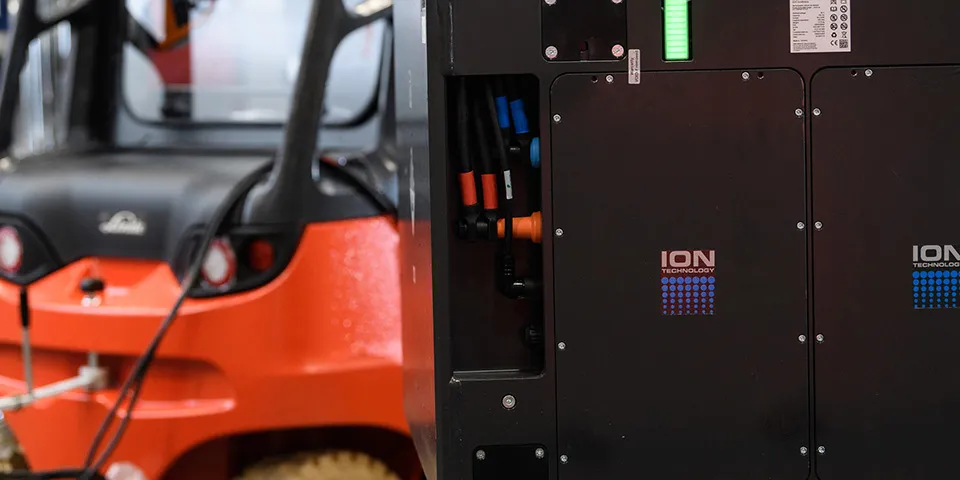
“If a forklift needs a large amount of energy, for example to transport heavy loads, the battery must be sized accordingly. The same applies when trucks are used intensively for many hours without interruption across multiple shifts and drivers have little or no opportunity to charge their forklifts for an extended period,” Englert explains. The situation is different, however, when the forklift can be charged several times during a shift. In that case, a smaller battery may still be sufficient to keep the forklift supplied with the energy it needs.
All the new 90 V batteries can be charged using the 9 kW, 17 kW and 30 kW chargers. The choice of charger also depends on the application requirements: if there is little time available for charging, the charger must have sufficient capacity. If, on the other hand, the charging process can take longer, a lower-capacity charger is sufficient.
These new batteries make it even easier for Linde Material Handling customers to adopt lithium-ion technology. The company already offers lithium-ion models for all its electric forklifts. A major advantage of Linde forklifts is that the complete system, consisting of the truck, battery and charger, is CE marked and all components have been extensively tested. In addition, drawing on its extensive expertise and using specialist tools such as the lithium-ion ROI calculator, Linde’s sales organisation can advise customers on switching from internal combustion or lead-acid forklifts to lithium-ion forklifts.
Question about this story? Ask your question
Keep following this
Get an email when a new story is published. No account needed.
- ThemeCircular processing of electronics and batteries
- SubjectNews







