












Market leader in compactor containers continues to innovate
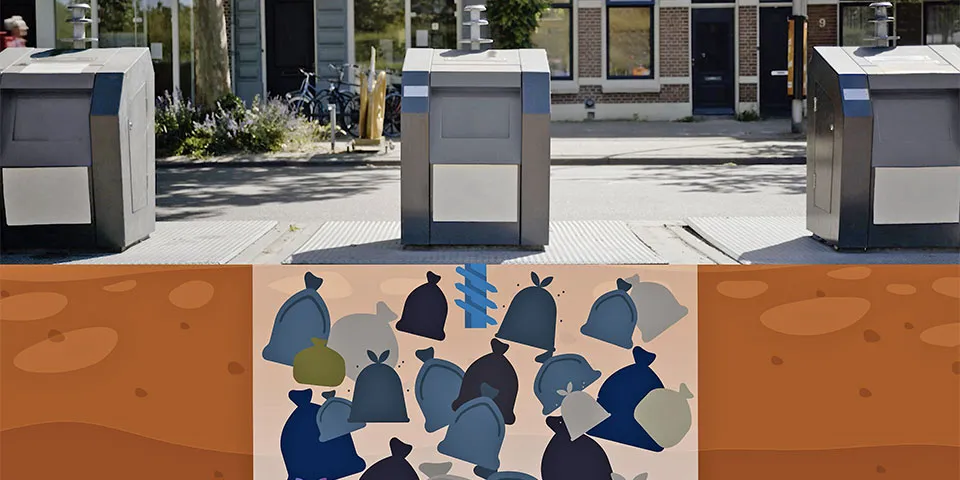
A compactor container lets you collect considerably more waste at a single location. This means fewer containers and fewer vehicle movements. Dutch company Sidcon became the market leader in underground compactor containers in less than 15 years. But its ambitions go further. Managing director Reinier Siderius wants to tap into new markets, not only across national borders but also within the waste sector.
The first underground waste containers appeared in the Netherlands about 25 years ago. According to Siderius, they were a genuinely Dutch invention. They were installed mainly in the large cities. Since then, more and more local authorities have switched to collecting waste underground. And if you want to collect as much waste as possible in one place, a compactor container is, in practice, indispensable.
Reinier Siderius and his company Sidcon Perscontainers were at the forefront of this development. Siderius founded his company in 1993, but work on underground compactor containers began in 2008. “I started out selling steel skip containers. Later, I bought a machine factory and a metal fabrication company. In 2007, a waste collector asked us whether we could make an underground compactor container. We did, and while we were working on it, separate collection of plastic waste was introduced. In response, we developed a compactor container that fits into the same pits as the existing underground containers and can also be emptied by the same collection vehicles. This means the infrastructure stays the same, but using a compactor container lets you collect more waste at the same location.”
Internet connection
The main advantage of a compactor container is its greatly increased capacity, which means the containers need to be emptied less often. This reduces vehicle movements and therefore CO2 emissions. “But,” says Siderius, “from the outset we have also equipped our compactor containers with an internet connection, allowing collectors to access all kinds of data. The most important thing is the fill level, so you know when a container needs emptying. Information on how full a container is and how quickly it fills up allows waste collectors to plan their routes in detail. You can also remotely see how often the motor starts and how hard it is working. This lets you address many problems before they arise, for example through preventive maintenance. It helps you avoid a lot of breakdowns.”
Sidcon’s compactor containers were initially developed for collecting plastic. When this became PMD (plastic, metal and drinks cartons), changing the composition of the waste stream, Sidcon adapted the containers accordingly. Siderius says: “Together with waste processors, we carefully assessed how much we could compact this waste stream, so it could still be sorted easily after collection.”
Collectors soon wanted to use the containers for residual waste too. “Broadly speaking, it’s the same machine,” Siderius explains. The latest development is containers for paper and cardboard. “The composition of this waste stream has been changing rapidly in recent years,” Siderius notes. “Whereas it used to contain a lot of paper and little cardboard, that balance has shifted, partly because of online shopping. Now there is a lot of cardboard and a little paper. This means the weight of the material going into the containers is lower. We have therefore developed containers with a different inlet and compaction mechanism. The first have now been delivered, and the results are very good.”
Another Sidcon innovation is the combination of an underground compactor container with a charging point for electric cars. “Demand for these charging points is growing, and our containers also need electricity. Our motors use very little power and only start when the container reaches a certain fill level. Charging points draw a lot of power when they are in use, so the two make a good combination. You only need to bring electricity to one location, and you get several benefits at once.”
New markets
Underground waste containers may be a Dutch invention, but in recent years Sidcon has also been making inroads abroad. “We are indeed focusing increasingly on Scandinavia, Germany, Belgium and France,” says Siderius. “And although we do have competitors, as a Dutch company we have a slight head start. We bring a wealth of experience from densely populated cities, where people are not always so careful about what goes into which container. So we know very well what our machines need to be able to withstand.”
Residual waste, for example, often contains organic waste, especially in large cities. According to Siderius, compaction has little impact on post-separation. “But the challenge is certainly to keep GFE/GFT, like glass and paper, as a separate stream at the point of disposal. Food scraps mixed in with residual waste turn into a huge mess, making post-separation difficult.”
Siderius hopes Sidcon will be able to tap into new markets in the coming years. “Not only abroad. Alongside household waste, I also hope we can contribute in the commercial waste sector. And we are constantly developing new machines for new applications. For example, we have made a small above-ground compactor container specifically for household PMD waste in so-called bring systems in apartment blocks. Everything that can be reused is collected from people’s homes, while residual waste has to be taken away. This encourages people to separate their waste. And making it available close to home significantly improves the quality of the waste. For this reason, we have also developed a separate above-ground container for GFE in apartment blocks and high-rise buildings. You can’t stand still if you want to remain the market leader.”
Question about this story? Ask your question
Keep following this
Get an email when a new story is published. No account needed.
- ThemeImproving waste collection and transport
- SubjectNews







