












Market leader in compactor containers continues to innovate
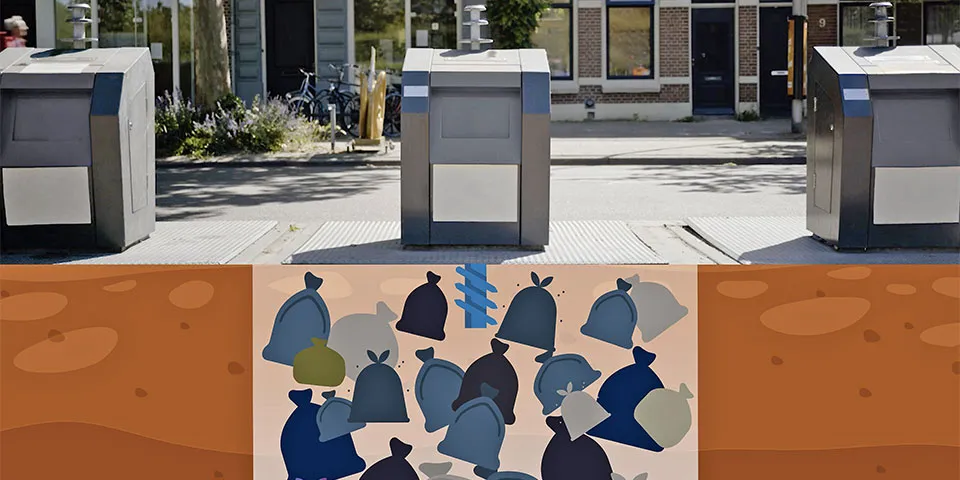
A compactor container allows you to collect significantly more waste at a single location. This means fewer containers and fewer vehicle movements. Dutch company Sidcon became the market leader in underground compactor containers in less than 15 years. But its ambitions go further. Managing Director Reinier Siderius wants to break into new markets, not only beyond the national borders but also within the waste sector.
The first underground waste containers appeared in the Netherlands around 25 years ago. According to Siderius, they were a genuinely Dutch invention. They were installed mainly in the major cities. Since then, more and more local authorities have switched to collecting waste underground. And if you want to collect as much waste as possible at a single location, a compactor container is virtually essential.
Reinier Siderius and his company Sidcon Perscontainers were at the forefront of this development. Siderius founded his company in 1993, but work on underground compactor containers began in 2008. “I started out selling steel skip containers. Later, I bought an engineering works and a construction company. In 2007, a waste collector asked us if we could make an underground compactor container. We did, and while we were working on it, separate collection of plastic waste was introduced. In response, we developed a compactor container that fits into the same pits as the existing underground containers and can also be emptied by the same collection vehicles. The infrastructure therefore remains the same, but using a compactor container means you can collect more waste at the same location.”
Internet connection
The main advantage of a compactor container is its greatly increased capacity, which means the containers need to be emptied less often. This reduces vehicle movements and therefore CO2 emissions. “But,” says Siderius, “we have also equipped our compactor containers with an internet connection from the outset, allowing waste collectors to access all kinds of data. The most important thing, of course, is the fill level, so you know when a container needs emptying. Information on how full a container is and how quickly it fills up allows waste collectors to plan their routes down to the last detail. You can also monitor remotely how often the motor starts and how hard it is working. This lets you solve many problems before they arise, for example through preventive maintenance. It helps you avoid a lot of breakdowns.”
Sidcon’s compactor containers were initially developed for collecting plastic. When this became PMD (plastic, metal and drink cartons), changing the composition of the waste stream, Sidcon adapted the containers accordingly. Siderius says: “Together with waste processors, we carefully assessed how much we could compact this stream, so that it could still be easily sorted after collection.”
Soon afterwards, waste collectors wanted to use the containers for residual waste as well. “Broadly speaking, it is the same machine,” explains Siderius. The latest development is containers for paper and cardboard. “The composition of this waste stream has been changing rapidly in recent years,” says Siderius. “Whereas it used to consist of a lot of paper and little cardboard, the proportions have now reversed, partly due to online shopping. It is now mostly cardboard, with a little paper. This means the weight going into the containers is lower. We have therefore developed containers with a different inlet and compaction mechanism. The first units have now been delivered, and the results are very good.”
Another Sidcon innovation is the combination of an underground compactor container and an electric vehicle charging point. “Demand for charging points is growing, and our containers also need electricity. Our motors use very little power and only start running once the container reaches a certain fill level. Charging points draw a lot of power when in use, so the two make a good combination. You only need to connect electricity at one location, and you get several benefits at once.”
New markets
Underground waste containers may be a Dutch invention, but in recent years Sidcon has also been making significant inroads abroad. “We are indeed focusing more and more on Scandinavia, Germany, Belgium and France,” says Siderius. “Although we do have competitors, as a Dutch company we have a slight advantage. We bring a wealth of experience from densely populated cities where people are not always particularly careful about what goes into each container. So we know very well what our machines need to withstand.”
Residual waste, for example, often contains food and garden waste, especially in major cities. According to Siderius, compaction has little effect on mechanical sorting. “But the challenge is certainly to keep food waste and food and garden waste, like glass and paper, as separate streams at the point of disposal. Food scraps mixed in with residual waste turn into a huge mess, making mechanical sorting difficult.”
Siderius hopes Sidcon can break into new markets in the coming years. “Not only abroad. In addition to household waste, I also hope we can contribute in the commercial waste sector. We are also constantly developing new machines for new applications. For example, we have made a small above-ground compactor container, specifically for household PMD waste in so-called reverse collection systems in apartment blocks. Everything that can be reused is collected from people’s homes, while residual waste has to be taken to a collection point. This encourages people to sort their waste. And by making the collection point convenient, close to home, you can greatly improve the quality of the waste. For the same reason, we have also developed a separate above-ground container for food waste in apartment blocks and flats. You cannot stand still if you want to remain the market leader.”
Question about this story? Ask your question
Keep following this
Get an email when a new story is published. No account needed.
- ThemeImproving waste collection and transport
- SubjectNews







