












Linde MH launches hydrogen project
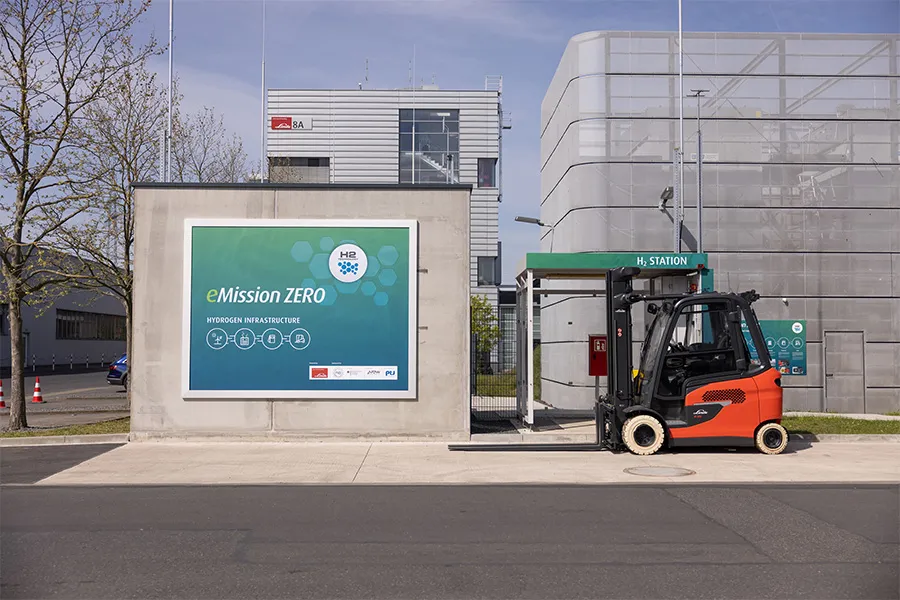
Linde Material Handling’s factory in Aschaffenburg is now producing green hydrogen for its own use
This pilot project is unprecedented in the industry in Germany and even across Europe: Linde Material Handling (MH) is now using its own infrastructure to produce green hydrogen to power 21 fuel cell-equipped forklift trucks in its own fleet. The new facility and trucks were officially commissioned at the Aschaffenburg site on Thursday 11 May. The aim is to gain experience and build up further expertise so that the company can offer customers more extensive advice and support on using hydrogen in their business processes.
“Energy is one of the biggest challenges of this decade and beyond,” said Stefan Prokosch, Senior Vice President Brand Management Linde Material Handling, at the opening ceremony. “As we explore possible solutions, we see hydrogen as one option in the energy mix of the future.” This certainly applies to intralogistics too. In addition to its potential for climate neutrality, the ability to refuel materials handling equipment quickly with hydrogen during intensive multi-shift operations is a major advantage. “A three-minute refuelling time is equivalent to a comparable charging capacity of around 480 kW,” Prokosch explained. In future, the energy source could also be used for energy storage as renewable energy sources are used more intensively, for example to temporarily store electricity generated by solar or wind power. “We want to have the full range of energy supply solutions in our portfolio so that we can offer our customers the best solution. This strategy also allows us to remain flexible and open to different developments. After all, nobody knows exactly where the journey will ultimately take us,” Prokosch explained.
Showing courage and breaking new ground
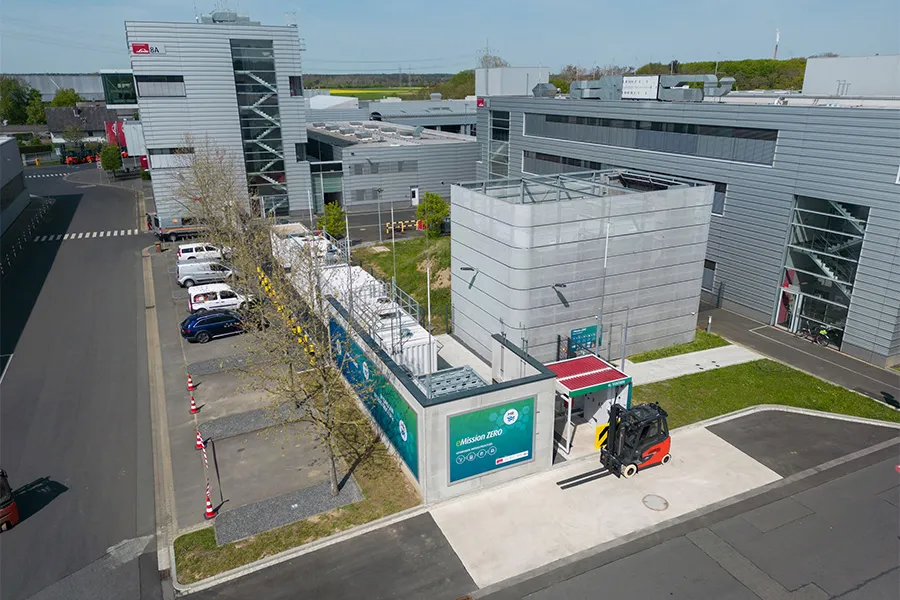
Around €2.8 million was invested in planning and building the hydrogen facility. It was built in eleven months on an existing 280-square-metre site in a convenient location within the production and assembly plant. “By commissioning the facility and the trucks, we are becoming both a producer and a user of hydrogen, while further expanding our technological expertise. Our customers will benefit too. We will share with them the experience we gain in planning, building and operating the facility, as well as using fuel cell forklift trucks,” Prokosch explained. At the same time, the decentralised hydrogen facility at our own premises serves as a showcase for other interested parties. “We are demonstrating how the use of sustainable energy sources can work in practice,” Prokosch said.
Advanced technology
The components of the hydrogen infrastructure are distributed across several modules. At its centre is a PEM (polymer electrolyte membrane) electrolyser, which is designed to produce 50 kg of hydrogen per day. Here, purified and deionised drinking water is separated into oxygen and hydrogen using green electricity. In another vessel, the hydrogen is gradually compressed to 450 bar before flowing through pipes and valves to the high-pressure storage tanks. A software-controlled valve system regulates the supply line to the dispenser. Employees connect the trucks here in just a few simple steps. Refuelling is completed in a short time. The high-pressure storage tank is designed to hold up to 120 kg of hydrogen at 450 bar, covering peak demand caused by increased refuelling during shift changes.
The 21 electric forklift trucks with fuel cell systems comprise twelve Linde E50s with a load capacity of five tonnes and nine Linde E35s with a load capacity of 3.5 tonnes. They replace models with combustion engines that were previously in use. As part of the factory fleet, they are responsible for tasks including loading and unloading trucks and supplying the assembly lines with large, heavy components such as counterweights, pre-assembled frames and cabs. “The trucks produce no emissions during operation,” Prokosch stressed. In the truck’s fuel cell system, hydrogen reacts with oxygen from the ambient air. The electricity generated charges a lithium-ion battery, which powers the truck. The only ‘by-products’ are water and heat.
Hydrogen is produced and used directly where logistics operations take place. Alongside Linde forklift trucks, the company also uses other technical solutions. For example, the explosion-proof access control in Linde:connect fleet management ensures that only authorised and trained personnel can use the hydrogen facility. The explosion-proof ‘Linde Safety Guard’ safety assistant at the refuelling station and on the trucks automatically reduces forklift truck speed when trucks approach the station. Finally, the “Linde Energy Manager” energy management system enables intelligent planning and control of energy demand across the entire site, prevents peaks in electricity load and optimises costs.
Linde MH hydrogen technology
Linde MH is considered one of the pioneers in the use of hydrogen in intralogistics. The first fully operational prototype forklift truck with fuel cell drive was developed as early as 2000. Fuel cell forklift trucks have been integrated into series production since 2010, and 80 per cent of models, including forklift trucks, tow tractors and warehouse trucks, can now be ordered as customised hydrogen (H2)-powered solutions. In numerous studies and projects, Linde MH and its industrial and academic partners have demonstrated the conditions under which fuel cell forklift trucks are market-ready and already economically viable. This is particularly true where hydrogen infrastructure is already available on site or where very pure hydrogen is produced as a waste product in the business process. Fuel cell trucks are also suitable for intensive multi-shift operations with high annual utilisation, for indoor use, or where space is limited for charging or battery-changing facilities, which also need to be stored.
Alongside the construction of the hydrogen infrastructure in Aschaffenburg, Linde MH’s parent company, KION GROUP AG, is accelerating the development and production of its own fuel cell systems. At the LogiMAT trade fair, Linde MH presented the first of its own 24-volt systems for warehouse trucks, developed at its Aschaffenburg site. A funding decision for the development of a 48-volt fuel cell system has already been approved, and the team is working on rapid implementation. “By developing fuel cell systems and lithium-ion batteries, we will also have the opportunity in future to design our own fully integrated hybrid fuel cell systems, precisely tailored to the requirements of materials handling,” Prokosch said.
Question about this story? Ask your question
Keep following this
Get an email when a new story is published. No account needed.
- SubjectNews







